This story was updated on Monday, Dec. 29, 2025, at 2:13 p.m.
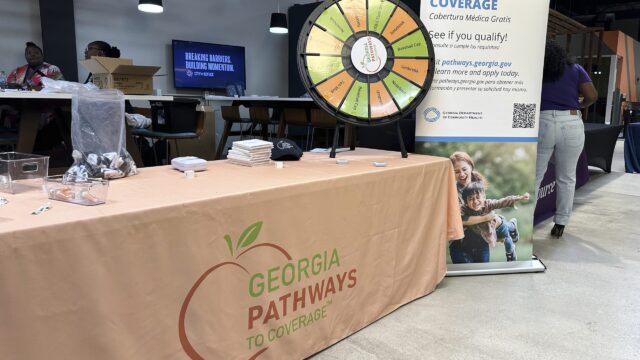
Georgia’s partial Medicaid expansion program, Georgia Pathways to Coverage, is headed for major changes after federal officials told the state it must bring the program into compliance with the new national Medicaid work requirements passed under the Trump administration’s tax and spending plan.
Pathways is currently the only Medicaid work-requirement program operating in the country. It had been set to expire this fall until the Centers for Medicare and Medicaid Services (CMS) allowed it to continue — but only if Georgia rewrites the program to match the new federal rules.
Sam Whitehead is a correspondent with KFF Health News who joined “All Things Considered” to explain how those rules differ from Georgia’s existing model. For example, Whitehead said HR 1 exempts caregivers of children up to age 13 from work-reporting requirements, while Georgia currently exempts caregivers only if a child is under six.
HR 1 also requires enrollees to document 80 hours of work, volunteering, or schooling at enrollment and twice a year after that. Georgia scaled its own verification process back to once at sign-up and once at annual renewal because, as Whitehead explained, “that monthly cadence turned out to be a big administrative headache for the state.”
Enrollment in Pathways remains small at just under 11,000 Georgians as of late October. That low starting point makes it difficult to predict how exactly the federal rule changes will affect coverage in the state, but an estimate by the Georgia Budget and Policy Institute suggests coverage could be extended to slightly more Georgians than the existing Pathways program.
However, the Congressional Budget Office estimates that HR 1’s work requirements will contribute to 5.3 million Americans losing Medicaid coverage over the next decade.
HR 1 allocates $200 million nationally to help states set up new work-requirement systems.
Whitehead said that half of that will be divided evenly across all participating states and the other half distributed based on the size of each state’s Medicaid expansion population. But, he adds, “people who study this say that $200 million is really only a drop in the bucket” when compared to Georgia’s spending on Pathways alone.
Editor’s Note: This story was updated to include a Georgia-specific estimate of coverage differences under federal rule changes.
This is part 5 of the WABE News series: “Medical Wealth Gap: Filling the cracks in Atlanta’s safety net.“