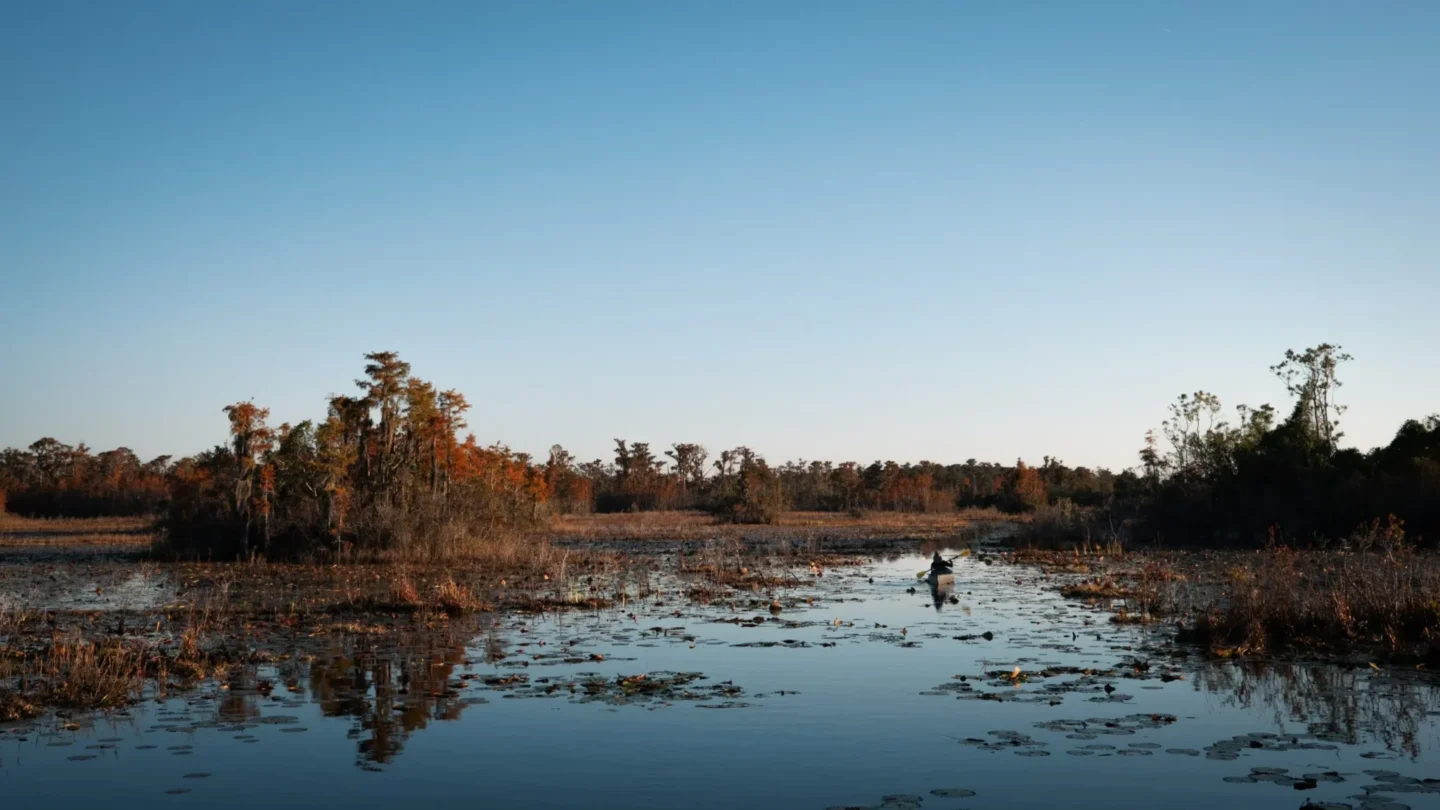
Georgia’s Okefenokee Swamp could soon be elevated to the same level as Yellowstone National Park, the fjords of Norway or Australia’s Great Barrier Reef.
The United Nations Educational, Scientific and Cultural Organization’s World Heritage Committee is meeting this week in Busan, South Korea, with an agenda that includes deciding whether to add the 400,000-acre Okefenokee National Wildlife Refuge to its list of World Heritage sites.
Established in 1972, the list is intended to aid “in the protection of the cultural and natural heritage of outstanding universal value,” according to UNESCO.
Being recognized as a World Heritage site would be a major boost for the Okefenokee and Georgia, said Environment Georgia Director Jennette Gayer.
“I think it is recognition that the Okefenokee is really one of a kind, that we are lucky in Georgia to have such a beautiful, biodiverse, special place, and it will mean that the entire world recognizes how special the Okefenokee is,” she said.
The swamp is considered a good candidate for selection because it is one of the world’s largest naturally driven freshwater ecosystems and it serves as habitat for an enormous number of species, including amphibians, reptiles, mammals, birds, fishes and invertebrates, according to UNESCO documents. Because it is the source of rivers rather than their recipient and because the land has been well-managed, it remains largely unchanged by human activities compared with other wetlands, UNESCO says.
If it’s approved, it will become the 27th World Heritage site in the United States, with other sites including the Grand Canyon, the Everglades and the Great Smoky Mountains.
A local debate
If you spend enough time out on the Okefenokee, you’re likely to run into Rodney Thompson of St. George, who, with his wife, Tina, runs the YouTube channel Blackwater Outdoor Journeys. The channel showcases the couple’s canoeing, camping and fishing expeditions in the Okefenokee and other locations in Georgia and Florida.
Thompson grew up on the swamp, hunting, fishing and enjoying the natural beauty.
“Me and my dad and my brothers, we grew up, and every Saturday, especially early spring – they say when the yellowflies get to bitin’, the warmouths get to bitin’ also – so when you start seeing yellowflies, you’d start seeing us in the swamps, trying to catch them warmouth, and we loved doing that,” he said.
Thompson said he first learned about the proposal to make the swamp a World Heritage site when he started seeing opposition.
“I started seeing signs, you know, ‘Keep UNESCO out’ and all that kind of stuff,” he said. “I didn’t really understand what it was until I started really doing the research on it and what kind of impact it was going to have.”
Some locals oppose the designation because they say it could draw large numbers of tourists, potentially damaging the swamp and changing the local way of life.
Thompson said he ultimately supports the designation, but he is sympathetic to those arguments. He cited a 2024 Conservation Fund report finding that the number of people visiting the Okefenokee per year could double from 800,000 to 1.6 million by 2035 if it becomes a World Heritage site.
“I don’t know how Charlton County could handle that, Clinch County,” he said. “I mean, Fargo has a Dollar General. That’s about all. They ain’t even got a restaurant.”
Thompson characterized towns like St. George and Fargo as “dying,” but said he hopes increased tourism could inject new life. The Conservation Fund projects the region could see 750 jobs, $79 million in economic output and $11.1 million in annual tax revenue.
“Heck, we only got a Dollar General about four years ago,” he added. “So that tells you how small we are. But I think that if it’s done right and you’ve got the right people behind it, I think that it can have a positive impact on these smaller communities.”
Political football
Others who oppose the designation say they fear association with the United Nations would undermine U.S. sovereignty.
An online petition opposing the measure gained over 1,000 signatures.
“A specialized agency of the United Nations, UNESCO, gains major influence of our region through its World Heritage Committee, comprised of 21 foreign nations, which emphasizes furthering the goals of its parent organization, the United Nations,” the petition reads.
If the classification is approved, the refuge would continue to be owned and managed by the U.S. Fish and Wildlife Service. In a FAQ on its website, the service says the designation would not affect the ability to hunt or fish on the property in accordance with state laws or subject the area to any kind of UN policy. UNESCO monitors sites and potential threats but does not have ownership or management rights over the land.
President Donald Trump has pledged to withdraw the U.S. from UNESCO effective at the end of the year.The U.S. previously withdrew from the organization during Trump’s first term and re-joined under former President Joe Biden. The nation’s departure is not expected to have an effect on the Okefenokee’s prospects as membership in UNESCO isn’t required for addition to the World Heritage list.
Not an end to the threat
The designation would not stop all threats to the swamp.
Last year, environmentalists celebrated after an Alabama-based company scrapped plans to mine valuable minerals near the Okefenokee National Wildlife Refuge, but the designation would not stop others from developing near the swamp in a way that could harm the ecosystem.
Advocates have rallied behind a bipartisan attempt to protect Trail Ridge from mining.
“The reality is there are still many acres of land that are adjacent to the Okefenokee that we know contain minerals that people want to mine that are not protected, that could be mined without regard to this designation,” Gayer said. “We hope that this would influence regulators to think twice about another effort to mine adjacent to the Okefenoke, but the reality is we still have unprotected lands that people could mine on.”
This story was provided by WABE media partner Georgia Recorder.