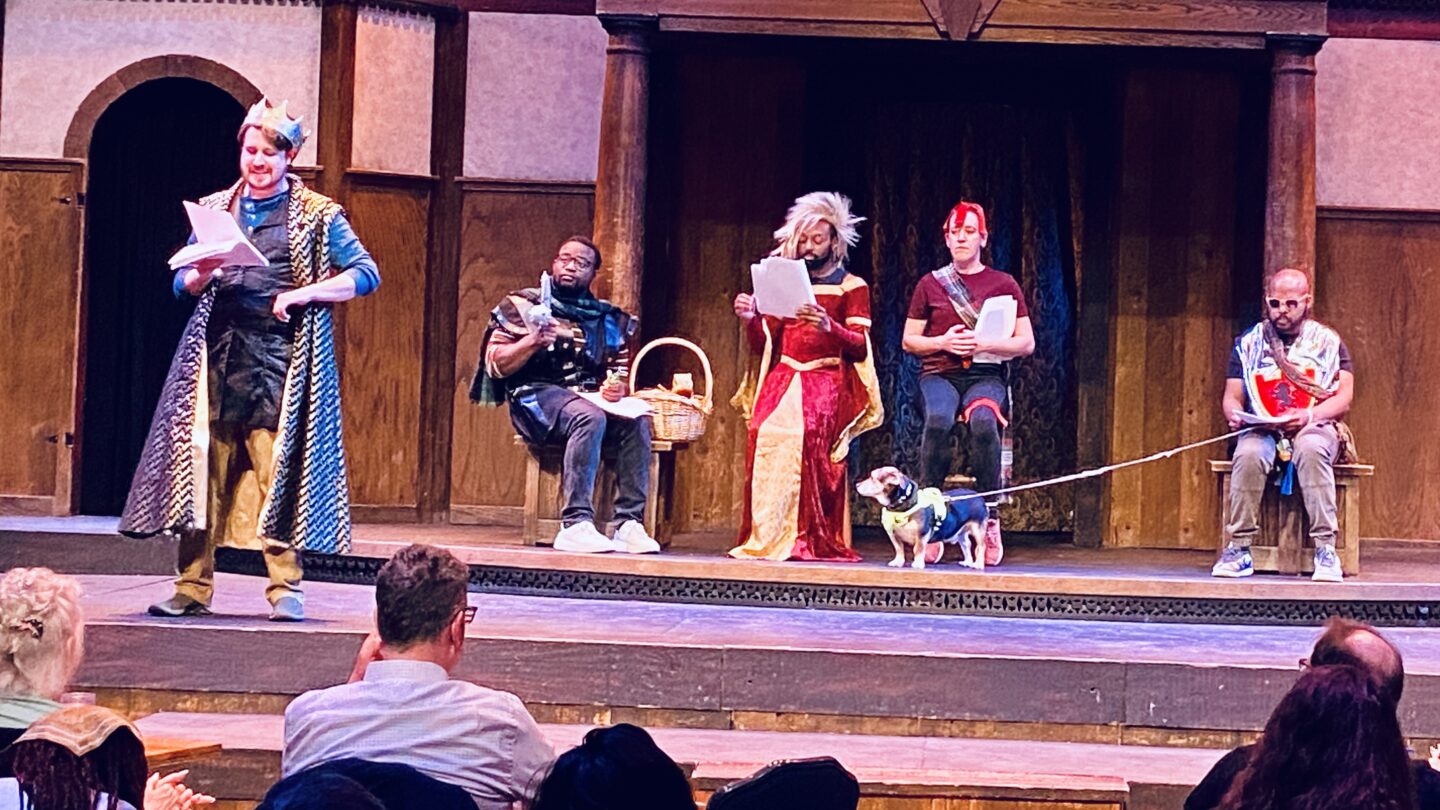
The Shakespeare Tavern Playhouse on Peachtree Street is home to some of Atlanta’s most polished classical theater. But a few nights a year, the stage belongs to something wilder.
Actors don’t know their roles. In some cases, they don’t even know what play they’re performing. They find out the same way the audience does — when someone reaches into a hat.
That’s the premise of Shakespeare Out of a Hat, a recurring event at the Atlanta Shakespeare Company that blends improv with the company’s deep repertory knowledge. The format returns this week for two nights: “The Comedy of Errors” on Thursday, July 2, and “A Midsummer Night’s Dream” on Friday, July 3. Both shows begin at 7:30 p.m.
How the hat works
O’Neil Delapenha, the company’s associate producer and community engagement manager, says the process is exactly what it sounds like.
Two to five minutes before the show starts, actors walk onstage and draw their roles from a hat. From there, they have seconds to confer with scene partners, grab a prompt script, and pull a costume piece before the show begins.
Shakespeare Out of a Hat tests a specific kind of skill: the ability to perform Shakespeare without preparation, using a combination of memorized text and in-the-moment improvisation.
Delapenha says how well that goes depends on two things: the play and the performer. Longtime company members have performed Shakespeare’s most popular plays so often that lines are, as he puts it, absorbed through osmosis.
“A Midsummer Night’s Dream” is one of those. “A lot of the longtime actors and staff members there know that show in and out and have played just about every role in that show,” Delapenha said.
“The Comedy of Errors” is a different story. The company performs it less frequently, which means actors will lean more heavily on improvisation to get through it.
That show presents an additional comic challenge: it involves two sets of identical twins. When the casting is random, those twins are almost certainly not going to look alike.
“Six-foot-four Black guy with like a five-foot short white woman,” Delapenha said. “It’s like, yeah, you guys look exactly alike. No wonder I confused you.”
When things go wrong — that’s the point
Part of what makes Shakespeare Out of a Hat work, Delapenha says, is the permission to fail.
When an actor loses the thread, they have options: call for a line, consult the prompt script, or improvise, what Delapenha calls having to “make Spear.”
“If things are going wrong, you gotta kick in those improv muscles if you have them and bust out a rhyming couplet to try to get the show back on its feet,” he said.
Delapenha’s been on both sides of that moment. As a performer, he’s had to recover in real time. As an audience member, he’s watched colleagues freeze.
“To see these professionals who are normally so polished … when they’re confronted with this terrible situation, an actor’s nightmare, how they respond to it and whether they rise to the occasion or succumb to it. It’s glorious either way,” he explained.
The format also creates room for commentary that a traditional production doesn’t allow on casting, on gender, and on the distance between Shakespeare’s world and the present one. When a woman plays a male role, or two actors playing lovers have to navigate the reality that they’re close friends offstage, the audience is in on it.
“It has way more room for ad libs and pointing out things that are awkward in our time that weren’t awkward in Shakespeare’s time,” Delapenha said.
A way in for first-timers
Shakespeare Out of a Hat typically sells out. Delapenha says the audience includes longtime Shakespeare fans and people who have never seen a production at the Tavern. The format serves both.
Delapenha describes it as Shakespeare with training wheels: the language and structure of the plays are present, but the stakes feel lower, the humor more visible.
“You’ll see that there are several similarities between our normal shows,” Delapenha said. “It’s like, ‘That is really funny,’ whether they were doing it the way Shakespeare would have intended or the way they just did it, the words and the situational comedy of it, it’s written in there.”