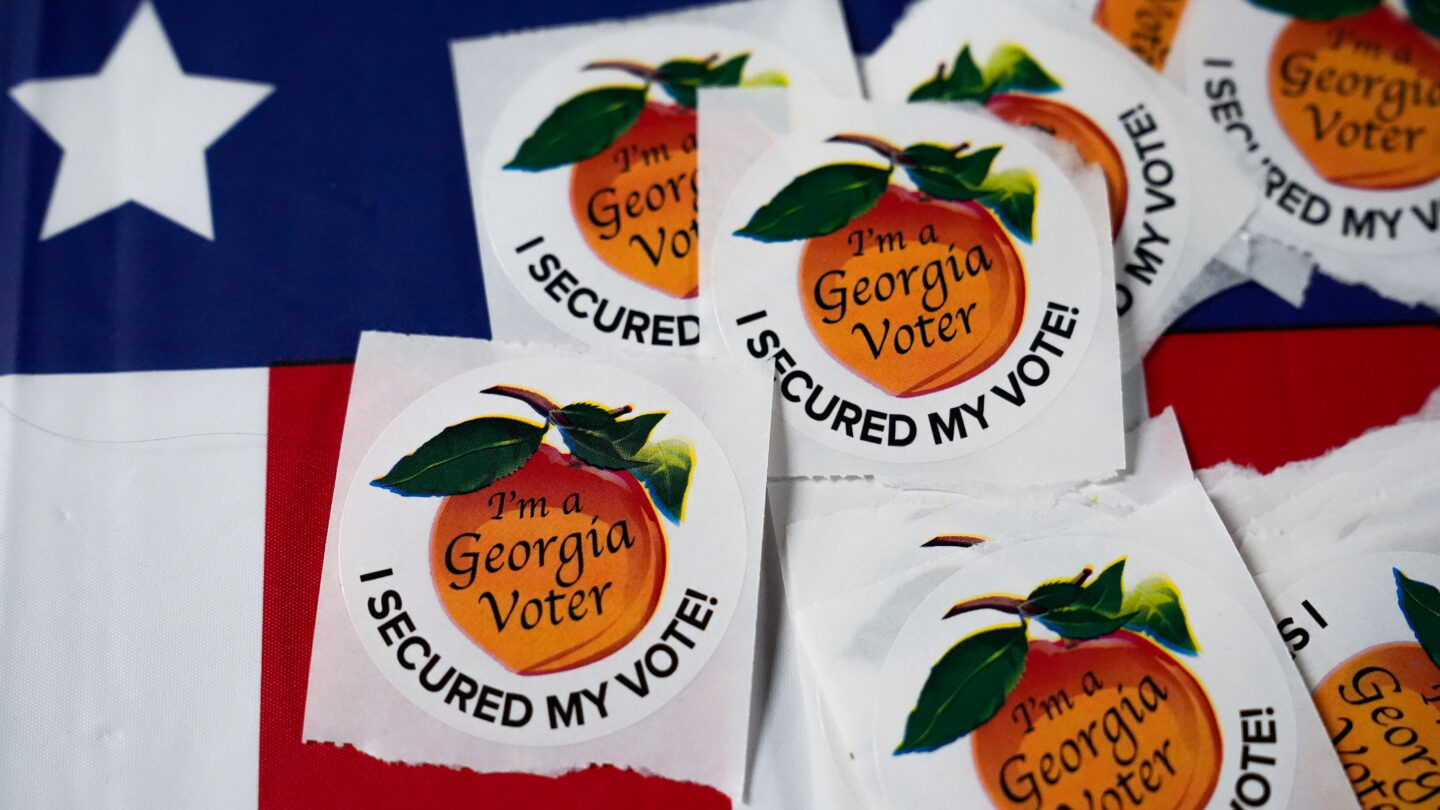
Stickers sit on a table inside a polling place, Nov. 5, 2024, in Atlanta.
(AP Photo/Brynn Anderson, File)
Libertarians will not appear on this year’s ballot in Georgia after a petition drive came up well short of the needed signatures.
Libertarians lost automatic ballot access because they did not get enough votes during the 2024 elections, which necessitated the drive.
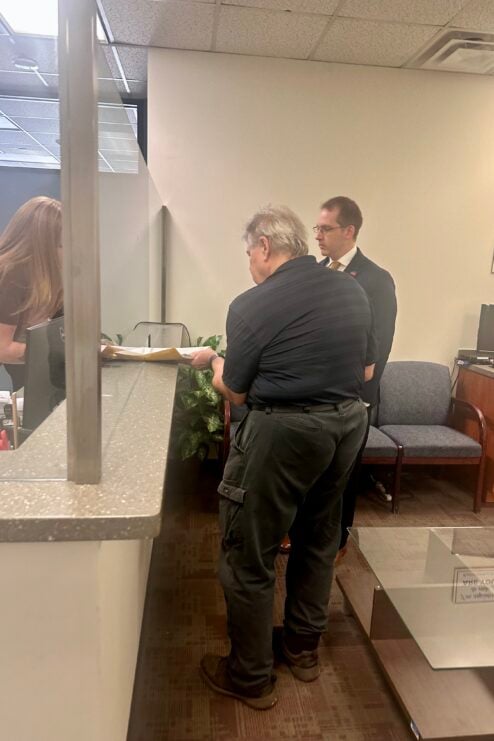
Despite collecting only a few hundred petition signatures of the more than 70,000 needed, acting Libertarian Party of Georgia Chair Brian Allen was one of two party leaders who made their way to the Georgia Secretary of State’s office Friday to turn in what they had.
“We promised the people who signed that we would, and we tried to keep our promises,” he said.
Libertarians can file to run as write-in candidates in November. The deadlines to file are in September.
As for what is next for Georgia Libertarians, Allen shared his thoughts Friday before filing the petition.
“I’m suggesting that we switch to focusing on ballot access reform at the legislative level to lower the requirements. Georgia is one of the worst states in the country for ballot access, so that’d be number one,” he said. “In the meantime, we will be focusing on local races — next year is a big nonpartisan year. Nonpartisan races have no petition requirements, so that’s easy enough. And then, in 2028, we can look at state House races, and also in Georgia, because of recent changes in the law, we will be able to field a presidential candidate.”
Stay in the know with WABE’s 2026 Georgia Midterm Election page, where you can find the latest election news, important dates, voting locations, candidate info, results and more.
Allen says they plan on working with other parties on ballot access efforts.
With no Libertarians on the November ballot, that likely means Georgia voters will only be choosing between Democrats and Republicans. It also means there will likely be no runoffs in December.
In 2020, then-Republican U.S. Sen. David Perdue got the most votes in November, but not more than 50%. Democrat Jon Ossoff would go on to win the runoff.
Libertarian Party of Georgia’s Mark Mosley (left) and Brian Allen at the Georgia Secretary of State’s Office in downtown Atlanta on Friday, July 10, 2026. (Rahul Bali/WABE)
Allen says that the Libertarian Party of Georgia will not endorse candidates this year other than their own.
“Obviously, we can highlight when candidates say something that is good or when they say something that is bad, according to our principles, so we can do that, but again, to be clear, we will not be endorsing any candidate,” he said.
So where could Libertarian voters go?
Former Democratic State Labor Commissioner Michael Thurmond, who has run against a Libertarian for statewide office, shared his thoughts.
“I think it’s unfortunate that we won’t have a Libertarian on the ballot this fall, but just from a practical perspective it increases the importance of the independent voters because many of the Libertarians fell between the Republicans and Democrats, so they may have an even greater influence on the general election and not necessarily the runoff,” he said.
“Those votes now become more important because you’re gonna have a very tight race, what, two to four percentage points — those two to four percentage points will have a significant share of Libertarian voters within that, so they’ll become even more important as we move towards November,” he added.
Former Republican U.S. Rep. Drew Ferguson believes there are more Libertarians on both sides of the aisle than people realize.
“I think that those are the ones that are really gonna be most concerned about the individual freedom and liberty and what that looks like,” he said. “Republicans may have a view of that, Democrats may have a view of that, but I think that they exist on both sides of the aisle, and Libertarian votes may actually be that new independent vote.”
Allen says Republican and Democratic campaigns for Georgia governor and U.S. Senate have not reached out to them.
“I’m always open for a discussion with anybody,” he said. “If they want to discuss our issues to reach our voters, that’s certainly a conversation that we can have.”