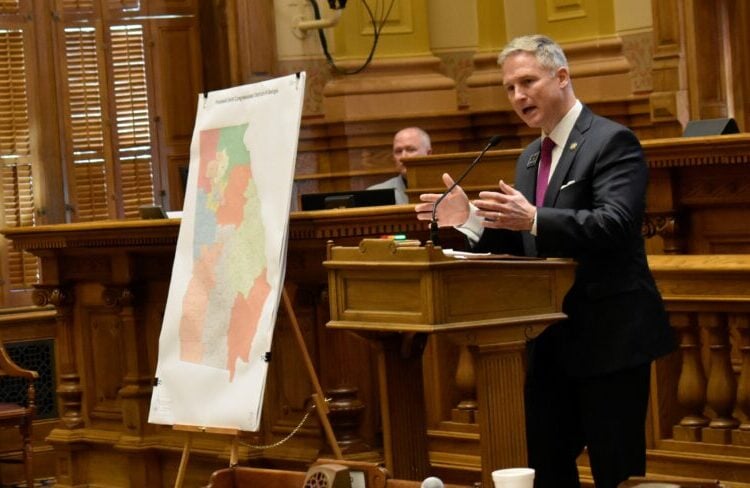
Georgia is just days away from the start of another special session — the third during this decade that will center around redrawing district lines for Congress and the General Assembly.
But unlike the last round of redistricting, in which state lawmakers were tasked with creating additional districts to protect the voting power of Black Georgians, this time the Republican-controlled Legislature may choose to strip electoral power away from minority voters to gain a partisan advantage.
The redistricting push comes in the wake of an April U.S. Supreme Court ruling in Louisiana v. Callais that dilutes a key provision of the 1965 Voting Rights Act by ruling that plaintiffs must prove there was “intentional racial discrimination” in order for gerrymandered districts to be overturned.
Georgia’s current districts were drawn during a court-ordered special session in 2023. The state’s previous maps, which were adopted in 2021, faced a series of lawsuits from Georgia residents and advocacy groups who argued the districts illegally diluted Black Georgians’ voting strength.
In the fall of 2023, U.S. District Court Judge Steve C. Jones ordered legislators to redraw the maps to include an additional majority Black congressional district in west metro Atlanta and seven additional majority Black legislative districts — two Senate and three House districts in metro Atlanta and two House districts around Macon.
The maps were ultimately redrawn and went into effect for the 2024 election cycle, but both sides filed appeals to the 11th U.S. Circuit Court of Appeals, where the cases still sit. The state is challenging the original decision that tossed out the 2021 maps, and the plaintiffs are appealing Jones’ decision to approve the boundary lines drawn in 2023, which are still in use today.
But in the weeks since the Supreme Court decision was released, Georgia has started its own redistricting push, following similar moves from neighboring states like Alabama, Louisiana and South Carolina. Normally, new political maps are drawn each decade based on new U.S. Census data.
Shortly before announcing the special session to redraw Georgia’s legislative and congressional districts, Republican Gov. Brian Kemp said “it’s clear that Callais requires Georgia to adopt new electoral maps before the 2028 election cycle.”
But Rep. Saira Draper, an Atlanta Democrat and election lawyer, said Kemp’s interpretation “couldn’t be further from the truth.”
Under the previous understanding of the Voting Rights Act, she said, a federal judge ruled that Georgia’s 2021 maps were racially discriminatory against Black voters.
“Whether that analysis has changed under the new Supreme Court ruling is an open question,” she added.
Shortly after the Supreme Court ruling, lawyers for the state filed a notice arguing that the recent Supreme Court decision “compels prompt reversal” of the district court’s earlier ruling.
However, the 11th Circuit Court has yet to make a decision either way. Last month, a three-judge panel asked both the plaintiffs and defendants to submit briefs explaining how the decision impacts the legal analysis in their case.
“Callais takes a sledgehammer to Plaintiffs’ litigating theory,” the state argued in its brief, which was filed in late May. The attorney general’s office did not provide further comment.
The plaintiffs’ response isn’t due until June 19, after the start of the special session, but ACLU of Georgia senior staff attorney Akiva Freidlin, who helps represent the plaintiffs, said the organization would keep fighting to ensure that Black Georgians had fair representation.
“The Supreme Court has now shifted the standard for proving a (Voting Rights Act) violation, but this case is not over,” he said in a statement. “We will keep pressing for full representation for all Georgia voters.”
Chris Grant, who chairs the political science department at Mercer University, said that part of the reason the 11th Circuit Court may be hesitant to rule is that there isn’t a clear standard under Callais for proving racial discrimination.
“The Supreme Court has not been as clear as I think the lower courts would like them to be in understanding what is and isn’t the standard of law here,” he said.
The case is unlikely to be settled before the end of the special legislative session, and any new maps proposed by state lawmakers could face additional lawsuits, he added.
“My suspicion is whatever the General Assembly comes out with, there will be additional litigation,” he said.
This story was provided by WABE media partner Georgia Recorder.