A free Buford Highway youth orchestra aims to give kids safe space amid immigration enforcement fears

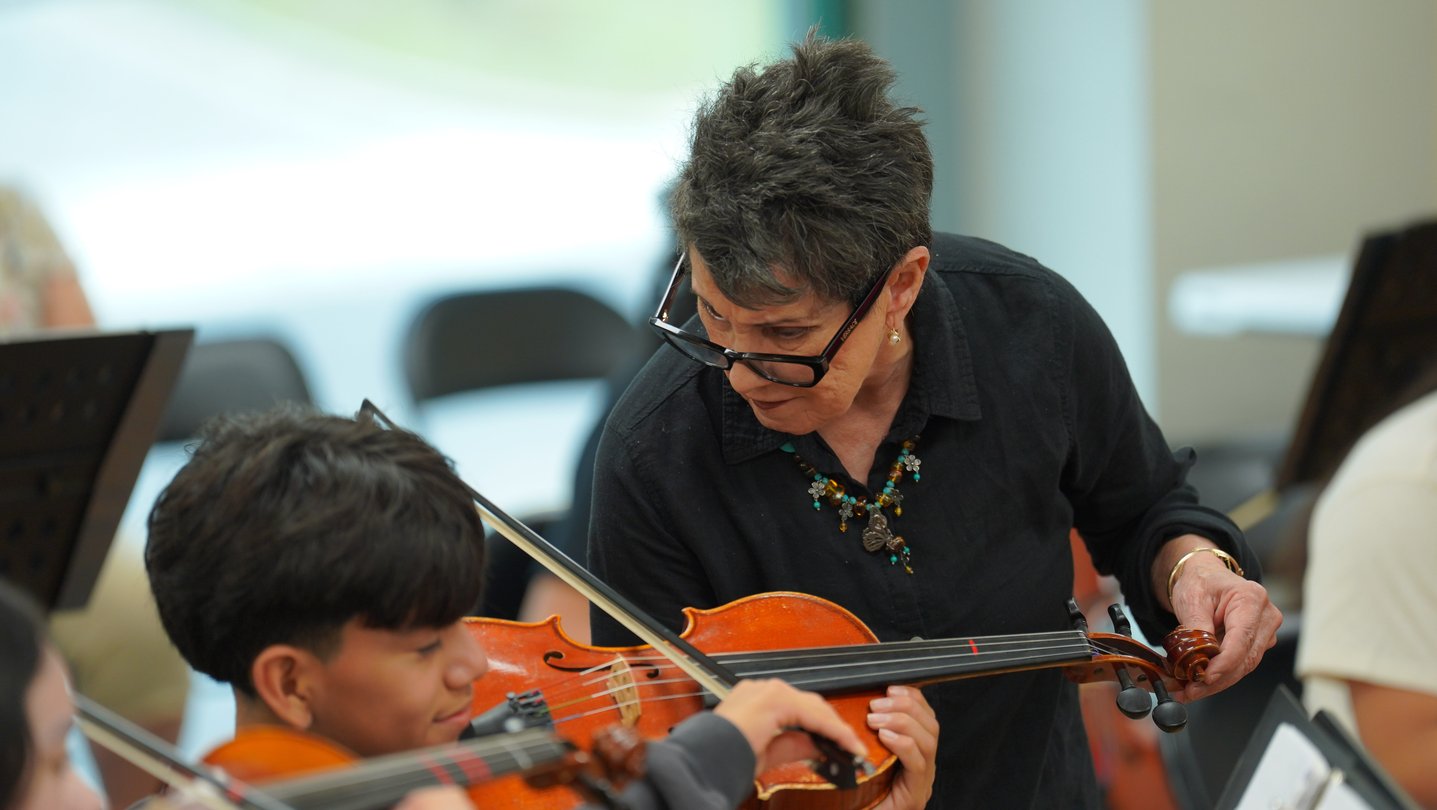
A woman stands, bending over with her hand on the scroll of a violin while a student plays it.
Juana Alzaga gives instruction during a rehearsal of the Buford Highway Orchestra Project, a free after school music program for metro Atlanta students. (Matthew Pearson/WABE)

Juana Alzaga commanded attention in front of an ensemble of musicians sitting on black, metal folding chairs. 

They strained to see her over their music stands while they warmed up their cellos, violins and violas with whole note scales.

Alzaga is quite petite, but the musicians are all kids.


“I always had this dream of having a Latino orchestra,” Alzaga said. “I always had this dream when I was growing up as an immigrant because music was my sustainability.”

She leads the Buford Highway Orchestra Project, a free, afterschool music program for metro Atlanta students.The program started during the pandemic to help students who were feeling the fear and isolation of COVID-19. Alzaga volunteered in her community along the Buford Highway corridor handing out food and books to kids. 

A conductor standing at the head of an orchestra plays a violin
Juana Alzaga leads the orchestra through rehearsing a song. (Karen Lopez/WABE)

“I found so many beautiful children that had no afterschool program, nothing to look forward to, parents looking for something to do,” she said. “I said, ‘Oh my gosh, I’m an orchestra director. Why don’t I start an orchestra?’”

BHOP started in April 2021 over Zoom with 10 students. Now, there’s about 50 musicians across three orchestra levels. 

Both canvas and hard plastic instrument cases littered the side of the room behind the U-shaped orchestra seating during one of the beginning orchestra’s last practices before its year-end performance. The group is made up of about 20 third, fourth and fifth graders. 

Maria Rampaly, the co-conductor, led students through a mostly in-tune rendition of “Old MacDonald” before cutting them off. 

“Where are half of the violins?” she asked. “Are you lying to me in your practice logs?”

A side view of a conductor leading a youth orchestra
Co-conductor Maria Rampaly leads the ensemble as they rehearse a song. (Matthew Pearson/WABE)

The only requirement for kids to enroll in the orchestra is they are on free and reduced lunch at school. They spend the first month learning music theory, then if they pass the music theory test, they can pick up a string instrument. 

At the end of their first year, they’ll have to audition to continue.

“Kids can do hard things,” Rampaly said. “I feel like whenever we don’t give them that extra depth of knowledge, of expectations that they can do these difficult things, then you’re setting them up for failure. When you treat them as musicians, as professionals, it gives them that idea of, ‘Yes, I can do this.’”

Rampaly and Alzaga did not take it easy on the musicians. They rotated out from the conductor’s position. While Rampaly conducted, Alzaga strode between music stands tuning instruments and repositioned bows while kids were rehearsing. 

A woman tapes lines on the neck of a cello while a child stands in front of her
Juana Alzaga tapes on finger guide lines to a student’s cello before rehearsal. (Matthew Pearson/WABE)

While the students are playing music in this classroom, they get to step back from real-world stressors and focus on becoming better musicians, Alzaga said. She said although students are no longer feeling heightened fear and isolation from COVID, she built a safe space from what her students worry about now: stepped up immigration enforcement.

Some of the kids come from families where not everyone has legal immigration status.

“A lot of times people don’t believe in them. They don’t believe that they can do, and they can surpass if given a chance,” she said.

A black binder with Try your best, Do your best, and Keep doing your best written on the flap
A black binder containing a student’s sheet music. (Matthew Pearson/WABE)

After beginning orchestra practice ended, the combined rising and youth orchestras filtered into the room and warmed up on their own. These students ranged from fourth graders to eighth graders. 

Catherine Lopez plays the viola. She’s one of the original 10 students who started the orchestra on Zoom. That’s when she was in the third grade. She heads to her freshman year of high school in the fall. 

She said through music, Alzaga has taught her how to be proud of who she is.

“It shows that in our community there’s a lot of talent. People don’t see us as actual people, and this shows that we’re more than just Hispanic people. It’s part of our culture, too. I think that’s really cool,” Lopez said.

A woman leans forward while several students play stringed instruments
Juana Alzaga gives instruction during a rehearsal of the Buford Highway Orchestra Project, a free after school music program for metro Atlanta students. (Matthew Pearson/WABE)

Alzaga said while the kids and their families have very real fears of immigration enforcement, what’s important is to create an environment that is safe and where kids can be kids. 

“Just play music. Just play. I feel that by playing they forget because they’re so enthralled and into what they’re doing that they forget. They forget about everything, and so do the parents,” Alzaga said.

The orchestra has its free, year-end performance this Saturday at 4 p.m. at Chamblee High School.