A family hugs at a 2018 graduation ceremony for the Rural Communities Diplomas Program offered by the Dr. Annise Mabry Foundation. (Courtesy of Annise Mabry)
Last year’s sweeping cuts to U.S. Department of Justice funding are costing rural Georgians opportunities to improve their lives and communities.
An 11-year-old, whom Annise Mabry, with the Dr. Annise Mabry Foundation, calls their “biggest success story” in Burke County, southeast of Atlanta, will be among the last to graduate from her Rural Communities Diploma Program.
Mabry said the boy had been getting bullied, fighting and expelled from school, all because he couldn’t read. But after three years, he is now planning to do dual enrollment at the local technical college.
“Could you imagine if this program hadn’t been there for him?” Mabry asked. “He would have fallen through the cracks.”
At the time, Mabry said neighboring Richmond County was known as a “hotbed” for gang activity, and a large number of people in the area were without a high school diploma and living in poverty.
“Unlike the city, the rural areas often didn’t realize that they had a gang problem until they had a gang problem,” she said.
Burke County residents sit for a photo at a school gym in 2025 after obtaining their high school diploma through a program supported by federal funding. (Courtesy of Annise Mabry)
For Mabry, though, it was no wonder that gangs had gotten “a strong foothold” there.
“An uneducated community is very, very difficult to maintain law and order in, because no one has anything to lose,” Mabry said.
Soon, over 400 kids will have graduated from the program, most of whom had a parent or caretaker who didn’t have a high school diploma either. Mabry said that thanks to some other private grant funders, the parents or caretakers ultimately got theirs, too.
The goal, she said, was always to increase access to education so the community could qualify for jobs and not turn to crime to meet their basic needs.
Like the 11-year-old, many of the participants were flagged by school counselors as being at-risk, including because they were chronically absent, experiencing homelessness or about to age out of high school before getting their diploma.
Rural funding gap widens
The national nonprofit Local Initiatives Support Corporation, or LISC, also secured $150,000 from the DOJ’s Rural Violent Crime Reduction Initiative for a full-time crime analyst and other tools for Burke’s sheriff’s office.
Matt Perkins, with LISC’s safety and justice team, said small and even medium-sized law enforcement agencies often don’t get the opportunity to try new things like that, which is why the DOJ tapped LISC to serve as a bridge for hard-to-reach capital.
“I would say, in general, rural law enforcement agencies need to be full of generalists, because everybody has to pitch in and do a little bit of everything,” he said. “We were able to do something a little new and a little innovative and help out a lot of communities. It’s unfortunate that it was just ended.”
The sheriff’s office spent the entire grant before April 2025, when DOJ funding was either pulled or canceled altogether. Perkins said it would have been eligible for more, but that’s no longer an option.
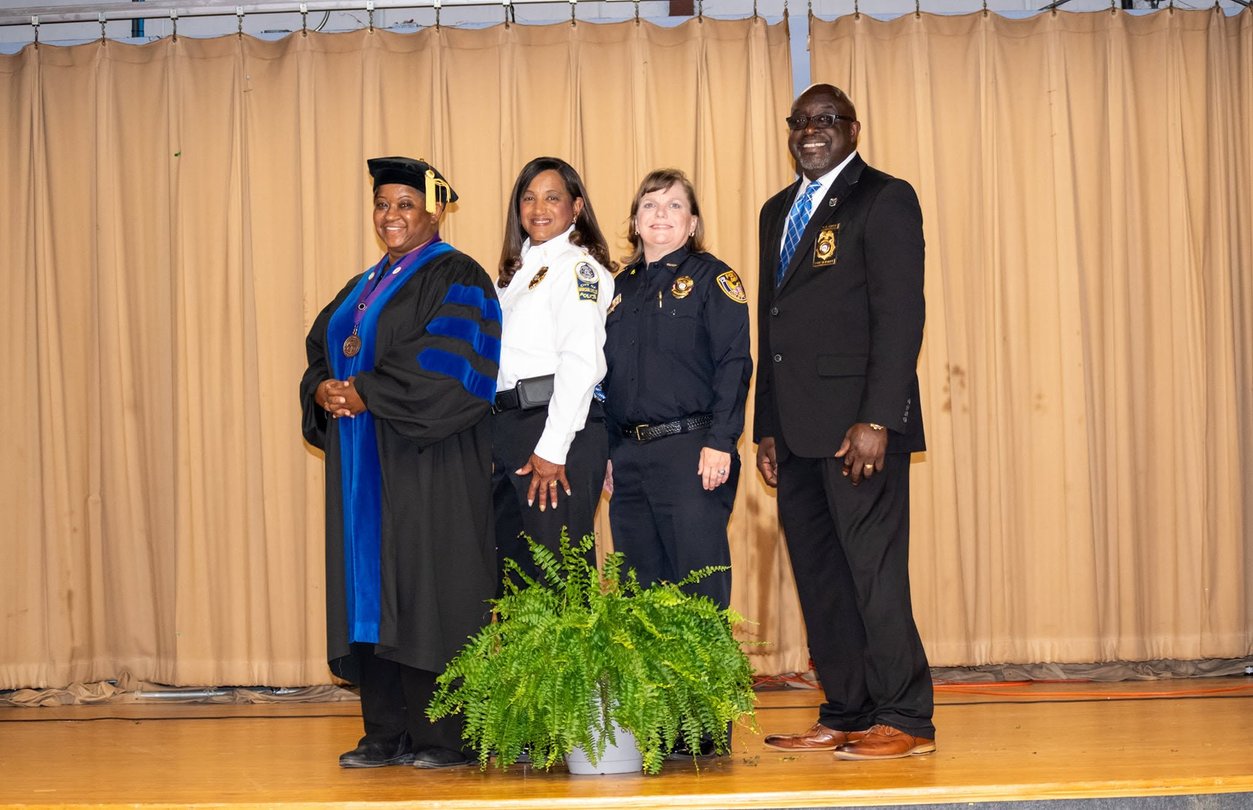
Shown in this 2022 photo is Annise Mabry, far left, who has partnered with law enforcement agencies throughout Georgia to help more than 400 at-risk youth, and sometimes even their parents, get high school diplomas. (Courtesy of Annise Mabry)
And some things did come up that they did not anticipate, said Julianne Dunn with LISC’s rural team.
“What’s the use of results if you [aren’t] able to act on them or react to them, understand what the analysis means, and keep up to date with current trends?” Dunn said. “Understanding what the real problems are in your community means that you can respond appropriately, and when you only have a limited amount of staff and a limited amount of time, that really makes a huge difference.”
There aren’t many other places to look for funding. Before the DOJ’s cuts, Dunn said rural communities, where 20% of the country lives, were getting as low as 6% of federal and private funding.
“Rural already has a hard time keeping people in rural,” she said. “It often comes back to how safe people feel, and it doesn’t even take that much crime to make people feel unsafe.”
Perkins and Dunn agree that many factors may have played a role, but they say that, at least in part, through the federal grant funding, Burke saw the number of violent crime incidents drop from 146 to 68 in two years, or a 53.41% reduction.
Meanwhile, Mabry’s foundation was serving 78 counties in Georgia, not just Burke. The cuts have left her work in limbo.
She said other agencies are being trained to run the diplomas program on their own, but it’s unclear whether they’ll be able to afford the staff that’s needed to ensure it’s just as effective.
“We need the community to champion for us,” Mabry said. “We need people who are willing to… lobby for programs like this to remain in the community, because once they’re gone, it’s a tremendous loss.”
The Burke County Sheriff’s Office did not respond to repeated requests for an interview.