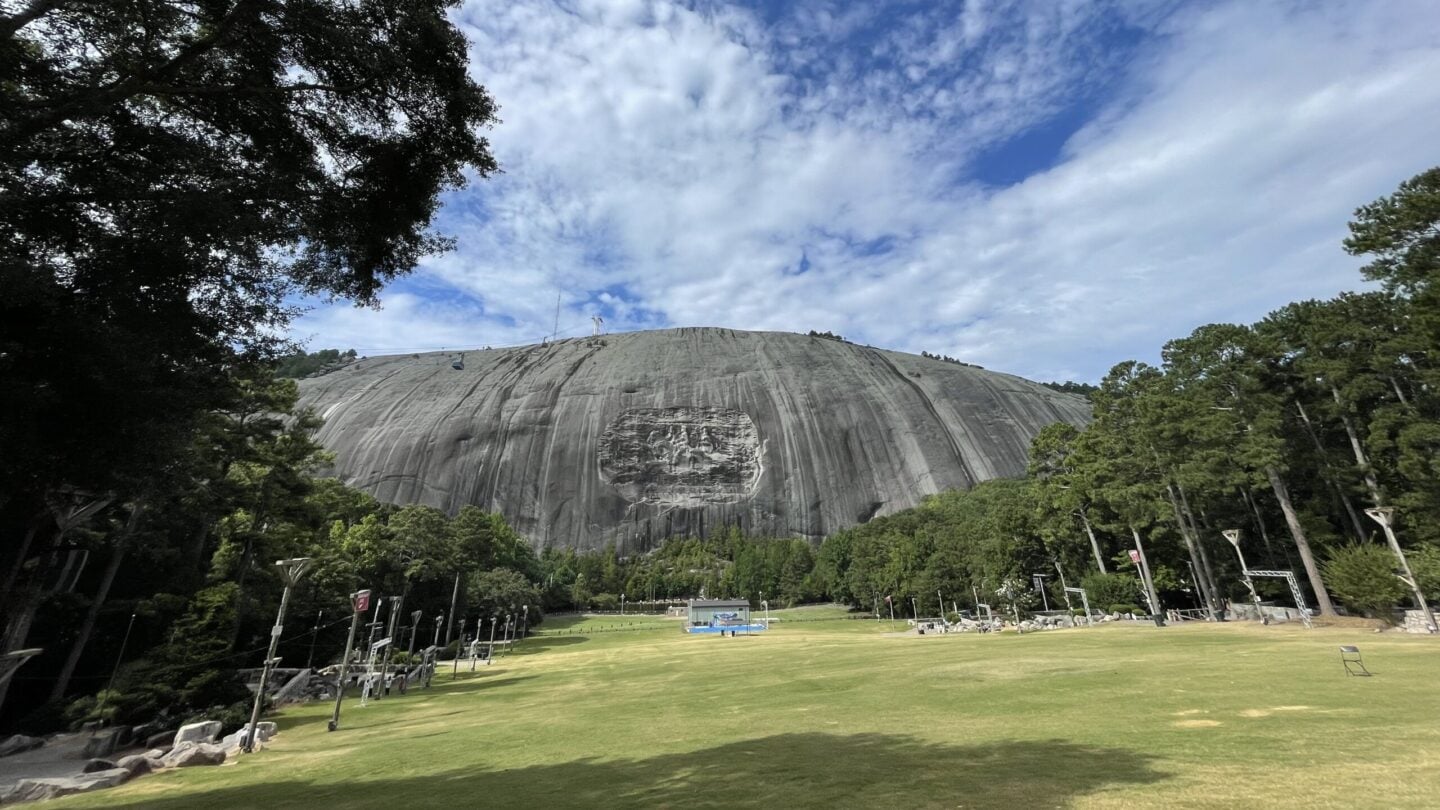
A new exhibit wants to tell a broader story about Stone Mountain. A Confederate group is suing to stop it

The idea for a Confederate memorial on Stone Mountain dates to the early 20th century, It wasn't finished until 1972. (Sam Gringlas/WABE)

A group for descendants of Confederate Civil War veterans is suing to stop an exhibit at Georgia’s Stone Mountain Park focused on the site’s connections to white supremacy, slavery and segregation. 

The group says the exhibit violates a state law preserving the state-owned site as a Confederate memorial.

The country’s largest Confederate monument, the massive, natural quartz monzonite dome juts 800 feet above a forested park roughly 15 miles east of Atlanta. Carved on its face are three men on horseback: Confederate President Jefferson Davis and Generals Robert E. Lee and “Stonewall” Jackson. 


Today the community surrounding the monument is roughly 80% Black. For people who live nearby, the space is a beloved local park, with trails, golf, a train and laser light shows on summer nights. The park even hosted a Juneteenth celebration last month.

“Stone Mountain is one of the places we bring visitors,” Metro Atlanta resident Belinda Allen-Clausell says as she prepares to hike to the top with her daughter, Gena Cornelius. “My husband and I like to come fishing. My daughters and I like to come walking.”

Cornelius says she tries not to pay much attention to the Confederate carvings.

“Because I can still remember coming with my dad when he was still alive, having our food and snacks, the fireworks, laser show,” Cornelius says. 

“Celebrating America because this is our country,” Allen-Clausell adds.

In 2021, the Stone Mountain Memorial Association, a governor-appointed commission that oversees the park, agreed to move prominent Confederate flags and install an exhibit about the park’s origins and history, including Ku Klux Klan cross-burnings that happened at the site over the years. Allen-Clausell thinks that context will go a long way.

“I’m an educator, so you can’t just get rid of history,” she said. “You can’t grow if you don’t know. And there are a lot of things that are going on now that are turning back the hands of time.”

Metro Atlanta resident Belinda Allen-Clausell (center) prepares hike to the top of Stone Mountain with her daughter, Gena Cornelius (left). (Sam Gringlas/WABE)

Why a Confederate group is suing over Stone Mountain exhibit

Construction for the new exhibit is underway, but the Georgia Division of the Sons of Confederate Veterans is suing to stop it.

“The entire tenor of their proposal is an attack on the Confederacy rather than a memorial to the Confederacy,” says chapter spokesperson Martin O’Toole. “If they wanted to put a bust of Robert E. Lee at the King Center, I’m sure that would create consternation.”  

The lawsuit hinges on Georgia law stipulating that Stone Mountain remain a memorial to the Confederate war dead, expressly codified in Georgia law in the early 2000s as part of a deal to remove the Confederate battle emblem featured on Georgia’s state flag since 1956.

The Georgia Attorney General’s Office has moved to dismiss the Confederate group’s challenge. 

O’Toole has also been coming to Stone Mountain since he was a kid. He remembers his grandmother hauling up the mountain, with the grandkids trying to keep up. One of his ancestors served under Stonewall Jackson in the 14th Georgia Infantry Regiment.

“The idea of a memorial is to emphasize the positive, not to accentuate the negative,” O’Toole says. “They showed courage, they showed the willingness to sacrifice. Those are values which we could emulate easily today.”

How the Stone Mountain memorial came to be

The drive for a Confederate memorial on Stone Mountain dates to the early 20th century, when Civil War monuments were going up in public places around the country. The effort for one at Stone Mountain gained traction when the KKK relaunched during a mountaintop ceremony on Thanksgiving night 1915, inspired by the film “Birth of a Nation,” which glorified the Reconstruction-era Klan.

The Atlanta History Center’s Gordon Jones says this era gave rise to the “Myth of the Lost Cause,” which downplayed the South’s fight to preserve slavery and highlighted the idea that, “They may have lost the war militarily, but in fact, they were the moral victors.”

But efforts to carve the memorial stalled until 1954, when in the aftermath of the U.S. Supreme Court ruling desegregating schools in Brown v. Board of Education, future Gov. Marvin Griffin campaigned for the office on a pledge to finish it.

“And that was part of the way that he appealed to his voters who were very much concerned about the impact of desegregation,” Jones says.

It still took nearly 20 more years to finish the carving, which was completed in 1972.

Metro Atlanta resident Kelly Clark has been coming to Stone Mountain Park for years. (Sam Gringlas/WABE)

Future of Stone Mountain Park

For park regular Kelly Clark, the climb to the top of Stone Mountain is energizing.

“You get to the top, you feel like you accomplished something, like you’re on top of the world,” Clark says as she comes down from the mountain on a recent muggy morning. 

But the carving below is “disturbing,” Clark says. She wants it removed, recalling her kids asking whether they would be welcome or safe to visit the park. She says no matter what happens to the carving, the ideas that led to its creation and preserved it for so long would not just disappear.

“You can’t let it consume you,” Clark says. “It’s not going anywhere. They move it, it’s still here.”

The Stone Mountain Memorial Association hopes the new exhibit will help tell a fuller story about why the carving is there. 

Now the courts will decide if the plans can go forward.