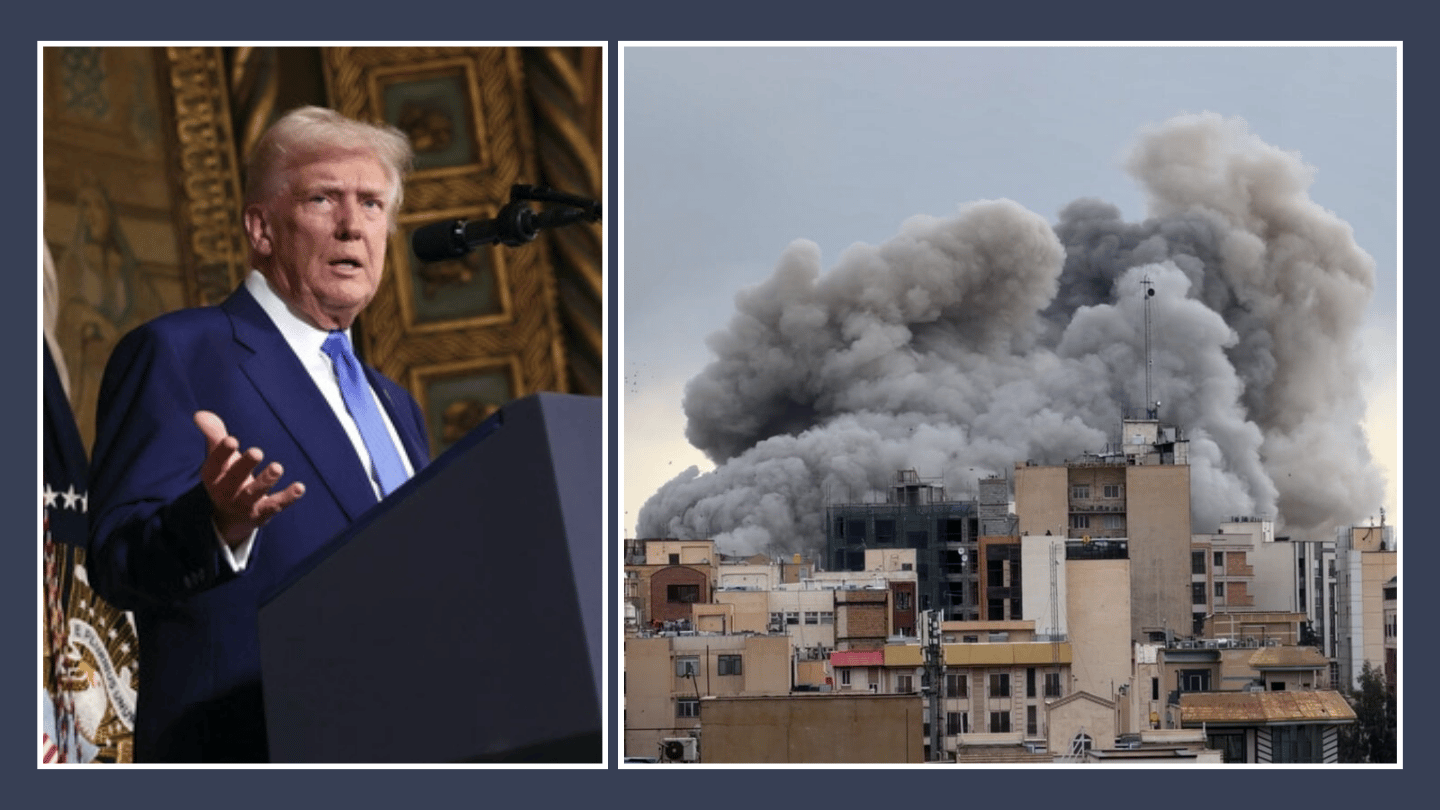
The Trump administration touted swift results when, along with Israel, it launched military action against Iran on Feb. 28. But months later, the conflict continues. During a recent press conference, President Trump insisted a deal with Iran is still possible and defended the decision to strike.
“When I started the very important excursion into the Islamic Republic of Iran, it was a very important excursion because they can’t have a nuclear weapon; otherwise the whole world would get blown up,” said Trump.
“We’re not gonna let that happen. Not only us, not only the Middle East, the whole world would’ve been… It would’ve been catastrophic. We had no choice.”
Trump also maintained the war will “end pretty soon,” adding, “I don’t think they can go much longer.” That early confidence was a risky assessment, says Georgia Tech political scientist and nuclear‑proliferation scholar Rachel Whitlark.
“I think part of that stems from the fact that it’s hard to know what the goals of this campaign are or have been,” said Whitlark.
“My perception is that they’ve changed quite a bit over the course of the campaign. And fundamentally, the president has undertaken things that are very, very difficult to achieve by military force. So it’s hard to know if the ‘swift’ thing was ever possible at the outset, and certainly events have demonstrated that we’ve gotten into something complicated.”
Today, nine nations possess nuclear weapons: China, France, India, Israel, North Korea, Pakistan, Russia, the United Kingdom and the United States.
At the center of U.S. and Israeli action is Iran’s nuclear program and its efforts to expand its stockpile of enriched uranium. That tension is layered atop a long and complicated U.S. and Iran history.
“I can see how it hearkens back to the 1950s and the story of…the U.S. involvement in the coup that brought the Shah to power and so on, depending on your perspective,” says Laurie R. Blank, a clinical professor of law and director of the International Humanitarian Law Clinic at Emory University School of Law.
Blank joined Whitlark on “Closer Look” and told host Rose Scott that historical context shapes how some observers interpret the current conflict.
“If you are thinking about that history, you’re thinking maybe about that here,” said Blank. “One of the particular challenges, though, is that in an effort to provoke regime change with that decapitation strike on the first day of the conflict, what appears to have happened instead is that a more hard‑line, more consolidated regime is now in position in Tehran, which I think is complicating efforts to find an exit, an off‑ramp, whatever word you choose.”
She added that Iran’s governing structure has shifted since the war began.
“In addition to the son of the Ayatollah now being the supreme leader and ayatollah…the IRGC, which is the Iranian Revolutionary Guard Corps, has consolidated its power,” said Blank.
“As opposed to being one component of the power of the regime, it now appears to be the regime. And that’s a different scenario than we had before February 28.”
Both professors told “Closer Look” that depending on perspective, any pathway toward ending the conflict will likely involve multiple nations and factions.
The segment also includes listener feedback.
About today’s guests:
Rachel Whitlark is a political scientist and associate professor of international affairs in Georgia Tech’s Sam Nunn School of International Affairs. Her expertise includes international security, foreign‑policy decision‑making, nuclear proliferation, counter‑proliferation, and military intervention.
Laurie R. Blank is a clinical professor of law and director of the International Humanitarian Law Clinic at Emory University School of Law. She teaches the law of armed conflict and works with students to support international tribunals, NGOs, and militaries on emerging issues in humanitarian law and human rights.