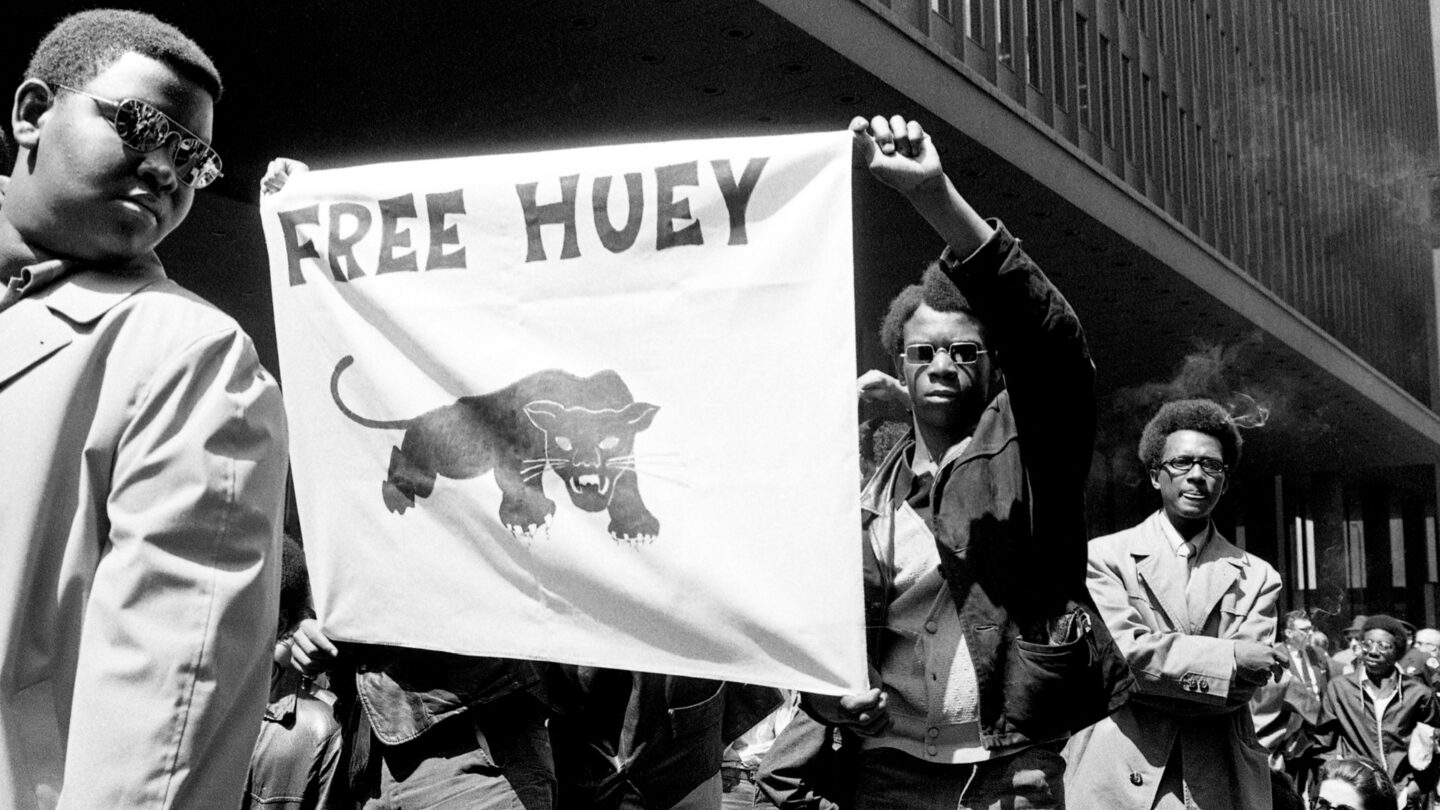
John Simmons's 1968 "Free Huey" photograph predates his current Mason Fine Art exhibition in Atlanta, "It Started in the 60s," by more than fifty years. (Courtesy of Mason Fine Art)
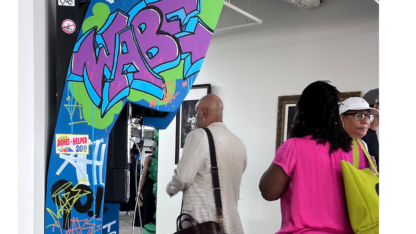
Emmy-winning cinematographer and photographer John Simmons has spent six decades documenting Black life in America — starting at 15, shooting for the Chicago Defender. Now, a selection of that work is on view at Mason Fine Art in Atlanta, in a solo exhibition called “It Started in the 60s,” running through July 25.
WABE’s Sherri Daye Scott sat down with Simmons at the gallery to talk about the work on the walls and the stories behind them.
Learning from Bobby
Simmons grew up in Chicago in the 1960s, and his path into photography started with Robert “Bobby” Sengstacke, his best friend’s older brother, and a photographer for the Chicago Defender. Simmons described trailing Sengstacke as a teenager, hanging around with cameras and jazz records, wanting to be as “hip” as he was.
The turning point came at the National Negro Publishers Convention, where Sengstacke was on assignment and let a teenage Simmons shoot a few frames on one of his cameras.
“When we process the film, he tells me I have an eye and begins to talk to me about photography,” Simmons said. “He shares with me the work of Roy DeCarava, in a book called ‘The Sweet Flypaper of Life’, written by Langston Hughes with photographs by Roy … That’s where it took off. That’s when I knew that I had found something.”
Sengstacke let him work in the Chicago Defender’s darkroom, washing chemicals and mopping floors before he ever touched a camera of his own. By 16, Simmons had his driver’s license and was shooting assignments for the paper himself.
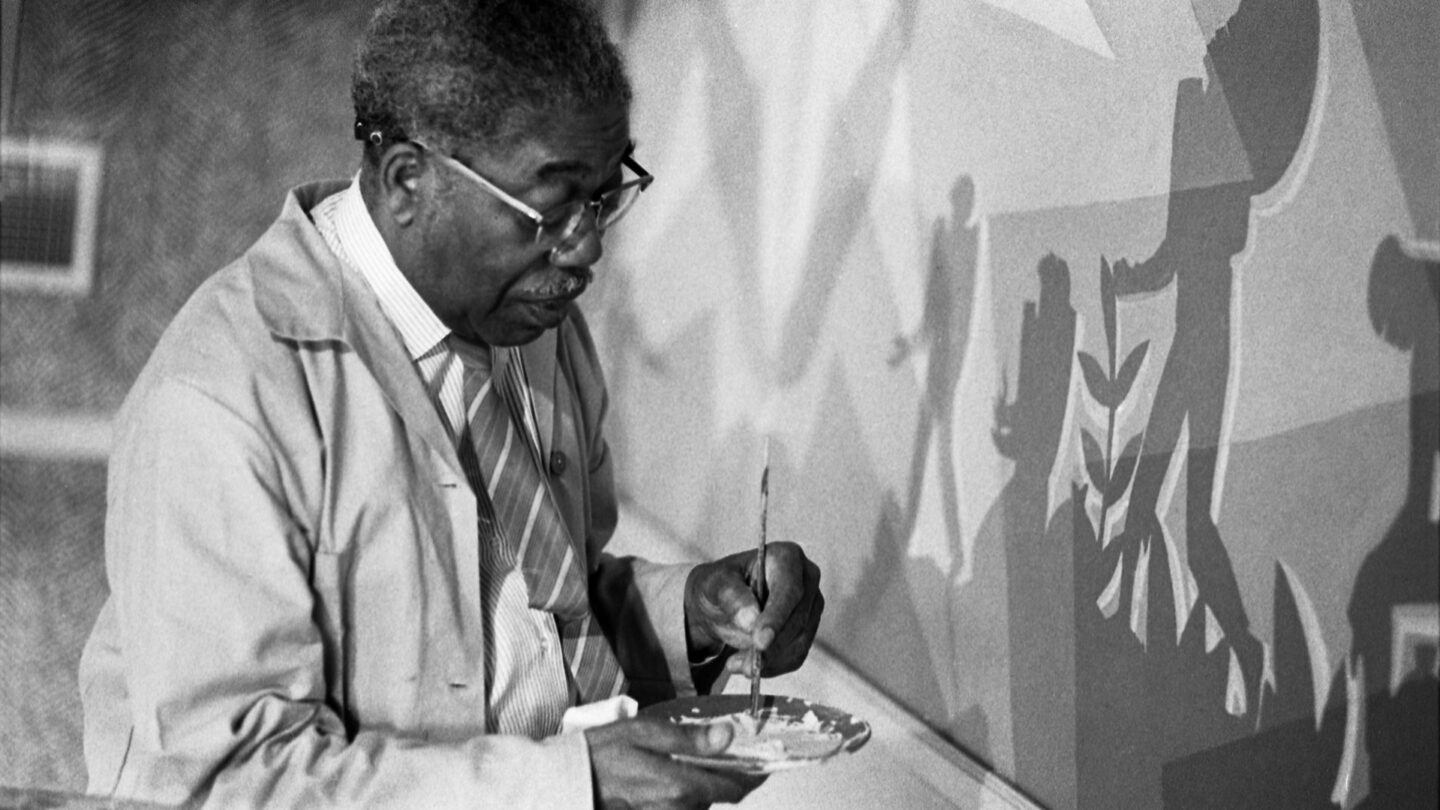
John Simmons photographed painter Aaron Douglas at work in 1970, during his years studying under Douglas — now on view at Mason Fine Art in Atlanta. (Courtesy of Mason Fine Art)
A ghost in the picture
Simmons’s own photography walks a line he’s spent decades trying to describe— somewhere between journalism and what he calls a photograph with “a ghost in it.” He points to an experience at the Getty Museum as one way of explaining what that means.
“I was in the little collector’s room, and there was a photograph taken in the early nineteen hundreds in Europe … a man playing a violin, and there’s a little girl with her head on his knee, and she’s asleep, and the other little girl is staring at him and the violin … That moment that you feel there, hundreds of years old, is as if it were today. So when a photograph has that soul, the power that the picture gives never goes away.”
By his own measure, not every picture in the show carries that same weight — including one of his best-known images. Asked directly whether “Free Huey,” his 1968 photograph of protests over Huey Newton’s imprisonment, is one of his favorites, Simmons didn’t dodge the question:
“It’s very much one of my favorites, but it’s not at the top of the list … it feels more journalistic than that. People like it because it marks a significant period. And I don’t know, maybe some people feel a ghost in it, but it’s not one of my pictures that do that.”
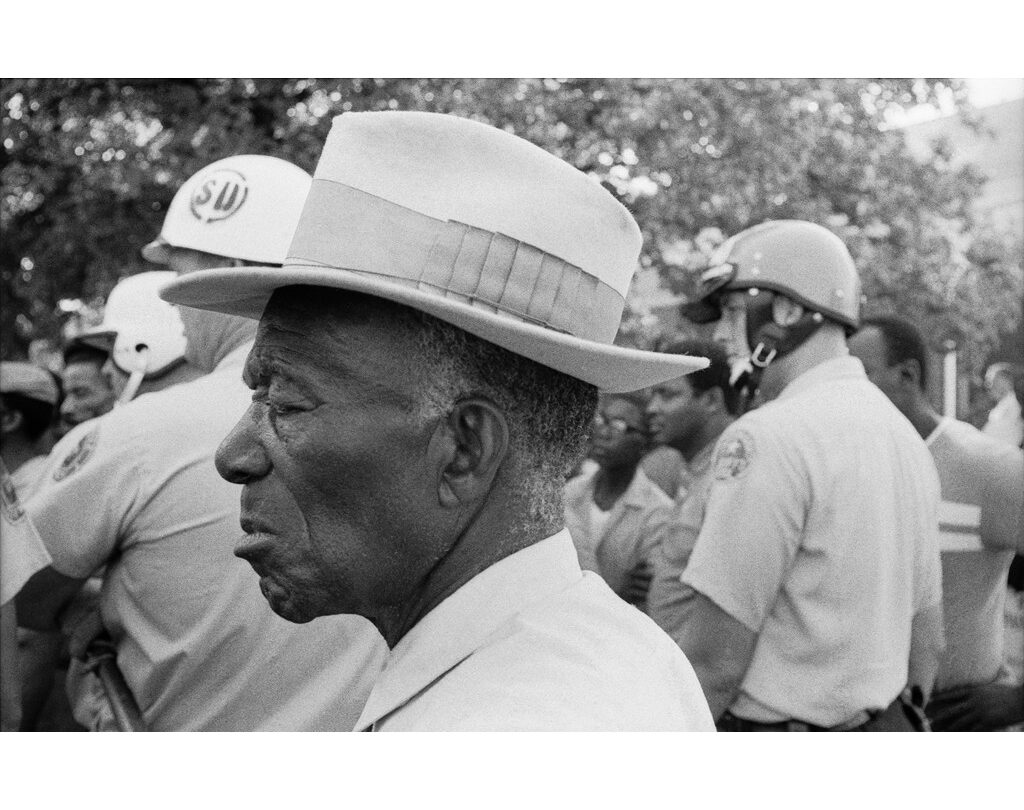
Macon, Georgia, 1969: one of John Simmons’s civil-rights-era photographs now on view in his Mason Fine Art exhibition in Atlanta. (Courtesy of Mason Fine Art)
Beyond the frame
Simmons describes himself as “a cinematographer, a photographer, a collage maker” who “recently started doing installations.”
“Those collages are actually a documentary on a different level … photography has its limitations — it has its light necessity for light, it has the frame within where the image exists,” he said. “My collages transcend reality. There’s their freedom … But a lot of those subjects are pretty intense.”
One of his newer collages, still in progress, involves a single red horizon line he’s been refining for weeks:
“I got home two nights ago with my wife at 11 p.m. She said, ‘Where are you going?’ I said, ‘I gotta go work on this red line for my horizon,” Simmons shared.
He traced another recent collage, built around a photograph of Harriet Tubman, back to his own father, who left the South after witnessing a lynching.
“So we become who we are nurtured by. And my father nurtured me with those stories … So I kind of feel like all of those pictures are protest pictures — not protest in the sense that one would normally think of protest, but there’s a lot of love in my pictures, because it’s what motivates me,” he said.
A harder road behind the camera
Simmons is quick to note that his still photography and his cinematography work differently. On set, he answers to writers, directors, and studios. Behind his own camera, “I see it, I shoot it, nobody cares.”
He recalled his first day on a television production, when he found racist caricatures pasted inside a production truck. He called his mentor, filmmaker Carlton Moss, to ask if he was in the wrong line of work.
“He said, ‘Do you know any Black people making movies?’ I said no. And he hung up on me.”
Simmons stayed. He’s now involved with the American Society of Cinematographers’ Vision Committee, focused on opening the field to more diverse cinematographers. And, he’s channeled some of that history into a new installation, built inside a lamp, that plays footage from “Birth of a Nation” alongside a Ku Klux Klan march and audio from the 2017 Charlottesville rally.
“It Started in the 60s” is on view now through July 25 at Mason Fine Art.