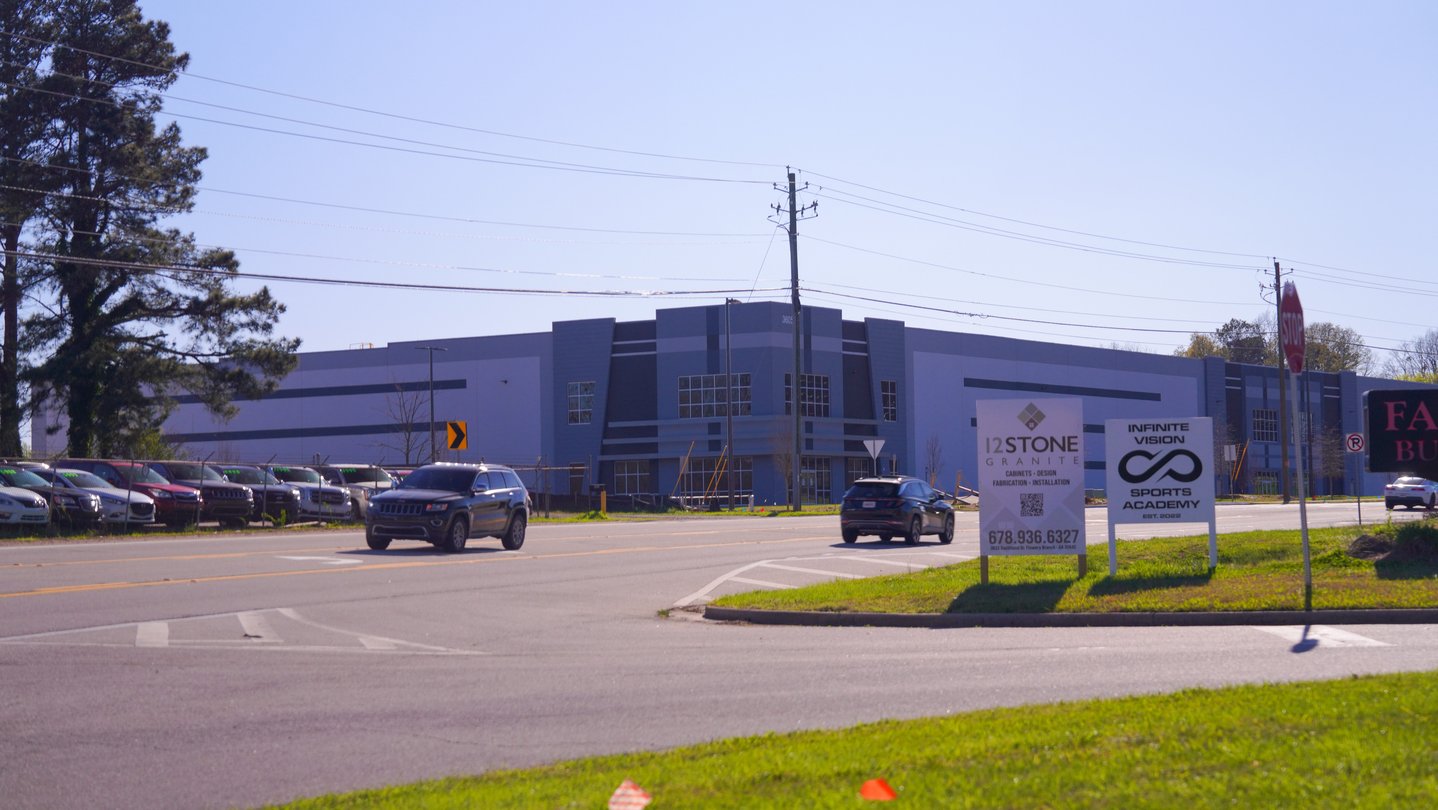
In February, the Department of Homeland Security bought the warehouse at 3619 Atlanta Highway in Oakwood for a little more than $68 million as part of its nationwide plan to convert warehouses into Immigration and Customs Enforcement detention centers.
Matthew Pearson / WABE
Late afternoon traffic slowed on Atlanta Highway, about an hour northeast of Atlanta and just 15 minutes south of Gainesville. Cars stacked around a corner and jammed in front of a brand new, empty warehouse.
“I grew up on this highway, going to La Flor De Jalisco, the Mexican restaurants, the El Salvadorian pupuserias,” said Mateo Penado, as he stood across the street from the warehouse. “The Catholic Church, they still hold the annual Guadalupe celebration.”
In February, the Department of Homeland Security bought the warehouse at 3619 Atlanta Highway in Oakwood for a little more than $68 million as part of its nationwide plan to convert warehouses into Immigration and Customs Enforcement detention centers. They planned to detain up to 1,600 people in the warehouse.
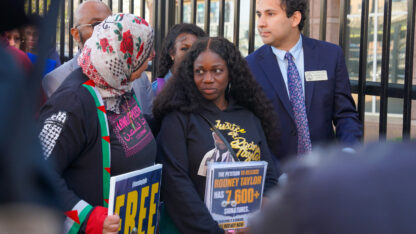
“Human beings don’t deserve to be detained or locked up in any warehouse, underneath any inhumane conditions,” Penado said. He’s been organizing against the facility in Oakwood by translating and sharing information in Spanish, and reaching out to Georgia members of Congress.
Proposed Social Circle ICE warehouse draws controversy
Who’s also reaching out to Congress for help? City Manager Eric Taylor in Social Circle, Georgia, about an hour east of Atlanta.
DHS bought a larger warehouse there, more than 1 million square feet at 1365 East Hightower Trail, for more than $128 million. Taylor said DHS plans to detain anywhere from 7,500 to 10,000 people in the warehouse.
“Please help us protect this community from long-term harm. Help us protect our economy, our environment, our water and sewer supply, our school children, and our residents,” Taylor said at a March press conference alongside Democratic U.S. Sen. Raphael Warnock from Georgia.
Warnock has been advocating on behalf of the city, a Republican stronghold.
U.S. Sen. Raphael Warnock visited the city of Social Circle, Georgia, where city leaders are trying to stop the Department of Homeland Security from converting a vacant, 183-acre warehouse into a mega Immigration and Customs Enforcement detention facility.
“For Social Circle, this has never been about making a statement about the current administration’s immigration policy,” Taylor said.
Unlike Penado, Taylor is actually a government official. But all he could do was ask the feds for more information, and shut off the water to the facility.
DHS not telling local officials when new ICE facilities are planned
Both Oakwood and Social Circle officials found out about the federal government’s plans for their communities in the news. They didn’t get any kind of heads-up from DHS.
In College Park, city officials were surprised to learn ICE had opened a satellite administrative office there.
“It actually just puts the local government in an incredibly tough position,” said Rusi Patel, general counsel for the Georgia Municipal Association, a nonprofit that helps local governments navigate interactions with larger governmental bodies.
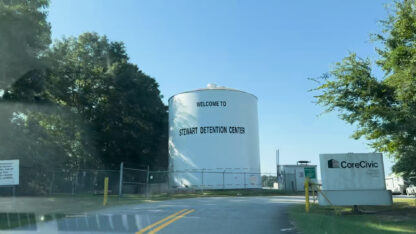
ICE detains thousands of immigrants in Georgia, and the numbers are increasing under the second Trump administration. WABE spent time in Stewart County, home to one of the largest immigration detention centers, to better understand what it means for the community — and the people detained there.
He said there’s not exactly a liaison that navigates between agencies like ICE and someone on the local level, like the mayor for example.
“It becomes a position of the county officials of trying to express what the people in their community wants, or may not want, but knowing that they don’t have the authority to actually tell the federal government, ‘You have to stop,’” he said.
Because of this, Georgia’s seen leftist anti-ICE protestors and Republican local leaders coming together to oppose the warehouses, although for different philosophical reasons.
Cities, counties consider local resolutions — but feds don’t have to listen
Seeing the struggles Oakwood and Social Circle are facing, the City of South Fulton passed a resolution opposing warehouse detention conversions there. The City of Atlanta is looking at one, too.
DeKalb County tried to pass a resolution opposing militarized ICE raids, but Interim County Attorney Terry Phillips cautioned commissioners the federal government always gets the last word, whether you agree with it or not.
“If you look at history in this region of the country, when local governments and state governments decided to tell the federal government that schools would not be integrated, the federal government came and escorted children in those schools at gunpoint,” he said at a February commission meeting.
Commissioner Ted Terry was behind the resolution. He said even though the federal government doesn’t have to listen to local governments, it was worth it to him to try to have an official statement on the issue, especially as it came when Renee Good and Alex Pretti were killed by federal agents.
“We have these moments in our culture and our history where it’s either you said something when you saw something that was wrong or you just cowered and kept your head down,” he said. “To me at that moment, that period of time was the time to say something.”
For now, new DHS secretary Markwayne Mullin has called for all the warehouse plans to undergo review as former secretary Kristi Noem’s spending in the role is scrutinized.