DeKalb County considering regulations on data centers

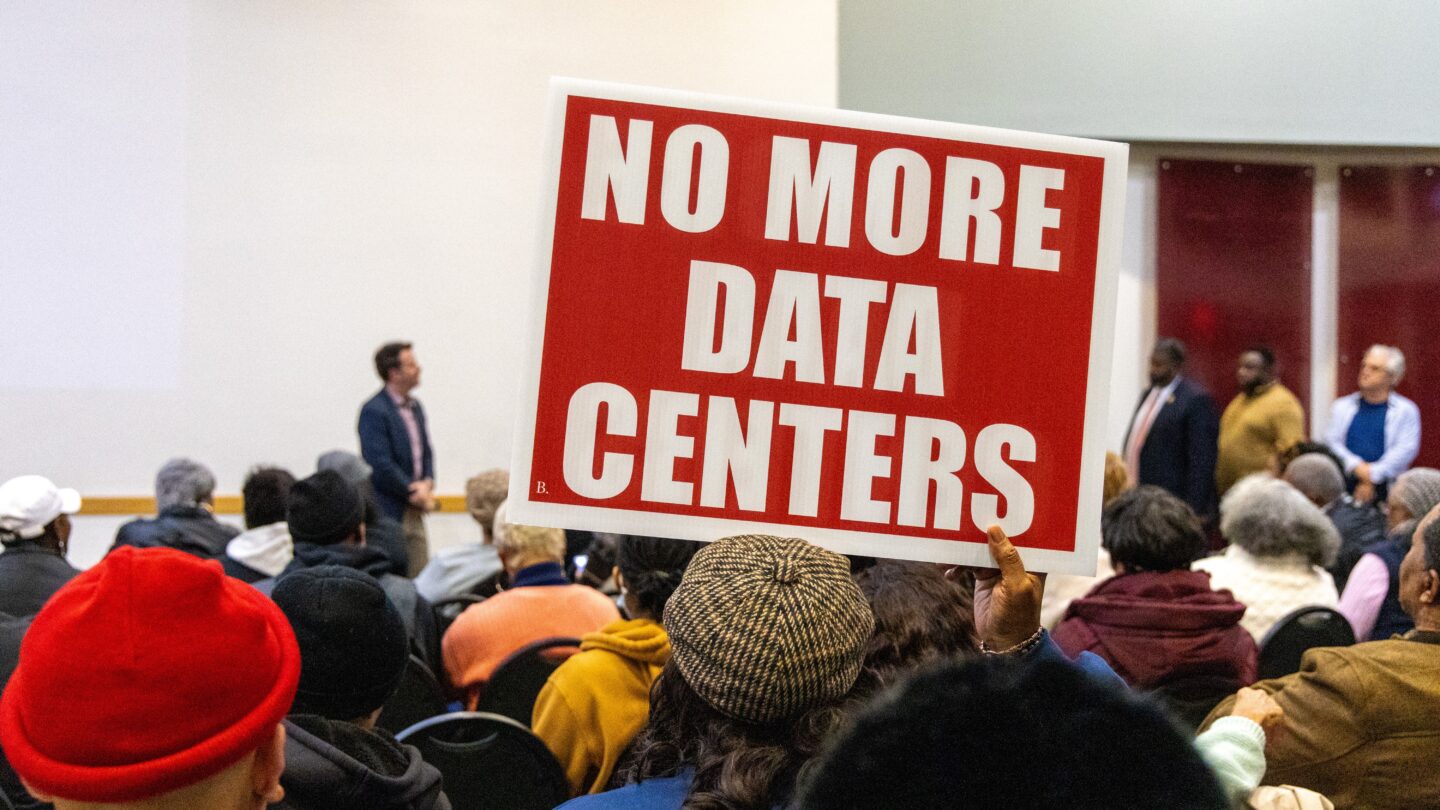
Someone holds up a red sign with white letters spelling out No More Data Centers
DeKalb resident Jackie Macolm holds up a “no more data centers” sign during a town hall at Porter Sanford Performing Arts Center on Dec. 10, 2025. (Zoe Seiler/Appen Media)

GREATER DECATUR, Ga. — DeKalb County residents remain concerned about the potential for data centers to be built in their community. Some county commissioners said that having regulations in place would protect the community.

The county commission is considering regulations for data centers, and a moratorium on applications for the facility is in effect until Dec. 16. The county commission is anticipated to vote on the ordinance on Dec. 16. The meeting will start at 9 a.m. at the Government Service Center, located at 178 Sams St. in Decatur.

“Strict regulations are so important in the process if you want to limit what’s built in DeKalb and to have a voice in what happens,” Commissioner Ted Terry said in a news release.

The county has received an application from PCC-DeKalb for a special land-use permit for a 1 million-square-foot facility at 4358 and 4280 Loveless Place. This would be in small-lot residential and mixed-use low-density zoning districts.


According to a county staff report, the 95-acre site would be a data center campus with an outdoor electric substation. Three two-story buildings would be located on the site.

The county staff recommended denial on Nov. 20, and the commission deferred the application until January.

DeKalb County also sent two zoning certification letters to developers in 2024. The letters indicate that a data center would be allowed, but are not binding. The proposed locations are 2235 Bouldercrest Road and 3600 International Park Drive. Both properties are zoned light industrial.

The zoning certification letters said the proposed data centers would be a permissible use in the light industrial zoning district and on those two properties. These proposals have not moved forward.

“The stated goal of those regulations…if there would ever be a data center in DeKalb County, it has to be the cleanest, greenest, safest and quietest,” Terry said. “If on Tuesday the moratorium expires and we don’t have regulations, then the old code goes back to being what it is and those applications can now go forward. Those applications would not have any public hearing. It would be an administrative process.”

Residents disagree

During the Q&A portion of the town hall, about 20 people lined up to speak. A couple of them criticized Terry and the commission for discussing environmental justice, but then seemingly backing data centers.

“It felt insincere to hear you acknowledge that and then in the same breath talk about how we’re going to continue to put data centers in South DeKalb,” the resident said. “Everything that I have seen, the community has said resoundingly that they do not want data centers. So my question to the commissioners is, why do you guys keep talking about installing data centers and regulating data centers when the people have said they don’t want them at all?”

Resident Erin Parks agreed and said she’d like to see the commission set the bar so high that it cannot be reached.

“I know that you’re saying that we can’t put a moratorium in place, but I think the disconnect is that these meetings feel like soft marketing for the data centers,” Parks said.

Terry added that the commissioners and staff do not believe they can legally implement a permanent moratorium on the facilities.

“What we’re trying to set up is the foundational guardrails and the bare minimum of what you have to do, and then the special land use permit allows us to go even further,” Terry said.

Commissioner LaDena Bolton added that the ordinance would protect the county.

“If we say no data centers whatsoever and there is no legal standing for that, when they sue, then we lose all of our rights to regulate what we want,” Bolton said. “They can sue and get what they want. This way, when we regulate on the front end, we tell them what we will allow in our communities.”

To see an updated draft of the data center regulations, visit engagedekalb.dekalbcountyga.gov/data-center-text-amendment.

Data center ordinance

The goal of the ordinance is to establish land-use regulations for data centers. It includes requirements about permitted locations, plans to be submitted with an application, architecture, noise and maintenance.

The draft includes a use table listing four permitted classifications for industrial areas.

— Data Center, Minor: Fewer than 20,000 square feet, and likely does not require a dedicated substation. This includes data centers as an accessory use if they are under 2,000 square feet.
These would be allowed as an accessory use in office-institutional areas and as a permitted use in office-distribution, light-industrial, and heavy-industrial zoning districts.

— Data Center, Medium: Facilities between 20,000 and 100,000 square feet and may or may not have a dedicated substation. These would be allowed in high-intensity commercial districts or industrial areas.

Medium data centers would require a special land-use permit in office-institutional and distribution, and would be a permitted use in light and heavy-industrial zoning districts.

— Data Center, Major: Facilities between 100,000 and 500,000 square feet and likely has a dedicated substation. These would be allowed in high-intensity commercial districts or industrial areas.

Major data centers would require a special land-use permit in office-institutional and distribution, and light and heavy-industrial zoning districts.

— Data Center, Campus: A singular development containing more than one building, with a minimum square footage of 500,000 square feet, and likely has more than one substation.

Data center campuses would not be allowed in office, institutional, or distribution areas and would require a special land-use permit in light- or heavy-industrial zoning districts.

During the town hall, Terry said that the county would most likely see applications for campus-sized facilities, rather than smaller ones.

With any data center application, developers will have to provide a noise impact assessment, water consumption and sustainability plan, energy consumption and sustainability plan, stormwater management plan, lighting plan, transmission line impact assessment, tree preservation and reforestation plan and a sewer update plan.

The ordinance also contains architectural and buffer requirements.

Any data center site in a light or heavy industrial zoning district must maintain a buffer of at least 500 feet from surrounding residential properties. But if a property borders an interstate, state highway, or major arterial, the buffer could be at least 300 feet from a residential property.

Resident Faye Coffield said the 500-foot buffer from residential properties should be larger and expressed concern about growth and economic development in South DeKalb.

“For decades, we have heard about tax money coming and there’s going to be an improvement,” Coffield said. “I have been a homeowner in South DeKalb for 46 years, and all I have seen is a decline in Black communities in South DeKalb.”

Once data centers are built, there won’t be other types of positive growth, she said.

The ordinance would require data centers to have a closed-loop system that reuses and recycles the initial water load the system takes on.

“We’re specifically banning any evaporation powers and that’s important because if the water is not being recycled into the air conditioning system and it’s actually evaporating, that means that more water is going to have to be pumped into those systems to fuel the chillers, or the giant AC units,” Terry said.

He added that there’s still work to be done and additional items that should be added to the ordinance, like requiring the facilities to use or purchase 100 percent clean energy, add protections for parks and trails and requiring community benefits agreements.

This story was provided by WABE media partner Decaturish.