Dr. Louis Sullivan: A Servant Life in Medicine and Public Health

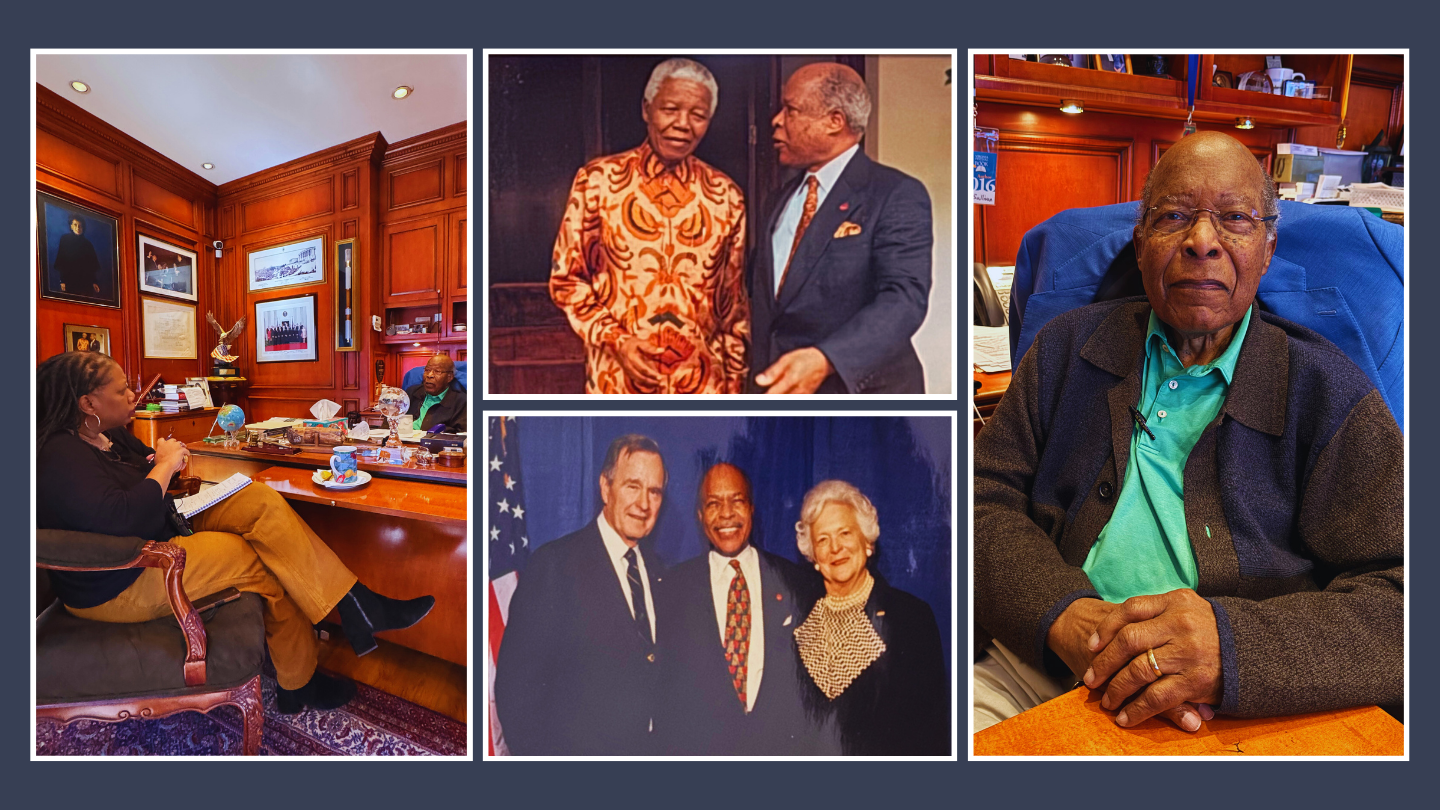
Dr. Louis Sullivan is the founding president and founding dean of the Morehouse School of Medicine. He served as the 17th United States Secretary of Health and Human Services from March 1989 to January 1993. (LaShawn Hudson/WABE, photos courtesy of Louis Sullivan)

The moment you step into the home office of Louis W. Sullivan, you immediately understand his life’s work in medicine and public health.

Photographs line the walls — images with global leaders like Nelson Mandela and several notables, including former U.S. presidents. The room is filled with books, African statues and an old clock that chimes every hour. It feels less like an office and more like a living archive.

During a recent visit to his home just outside of Atlanta, Dr. Sullivan sat down for a conversation with “Closer Look” host Rose Scott.


Their discussion began with Scott reading a reflection from the current Morehouse School of Medicine President and CEO Valerie Montgomery Rice.

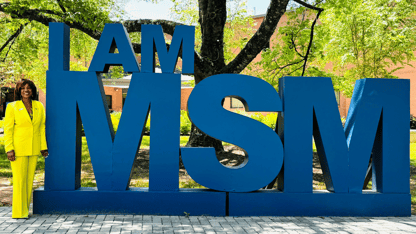
“Morehouse School of Medicine exists today because of a courageous choice by Dr. Louis W. Sullivan. Dr. Sullivan was a tenured professor and a leading hematologist at Boston University. He had a successful career and a settled life. But he heard a call to come back home to Atlanta and lead the effort to establish the nation’s first historically Black medical school in 100 years,” she said.

“Fifty years later, we have become one of the country’s leading academic medical institutions because of the values Dr. Sullivan instilled from the beginning — to focus our students not only on becoming excellent clinicians and researchers, but on being leaders who serve their communities,” she added.

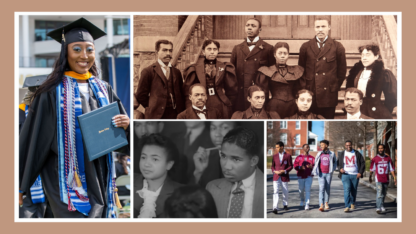
That institution was born from the vision of Dr. Sullivan and others who believed the country urgently needed another historically Black medical school.

As Sullivan reflects on why he even chose medicine as a career, he recalls the influence of Dr. Joseph Howard Griffin. Sullivan met Dr. Griffin as a child while traveling with his father, who founded the first Black funeral home in Blakely, Georgia. His father was also an activist who worked to help Black citizens secure the right to vote and protest discrimination in education and other areas of life.

“Among the services we provided the community were ambulance services,” Sullivan recalled. “Sometimes we would take patients 40 miles south of Blakely to Bainbridge to see Dr. Griffin — the only Black doctor within a hundred-mile radius in southwest Georgia. To me, Dr. Griffin was a towering figure. He had the ability to cure illness and treat emergencies. I decided then, ‘That’s what I want to do. I want to be a doctor like Dr. Griffin.’ He was my first role model. That’s how I got started.”

From that moment on, the path was set. Sullivan enrolled at Morehouse College before applying to medical schools that accepted Black students. He eventually attended Boston University School of Medicine, where he was the only Black student in his class.

His trailblazing continued. He became the first Black intern at New York-Presbyterian Hospital (then New York Hospital-Cornell Medical Center). He later returned to Atlanta to serve as the founding president and dean of Morehouse School of Medicine. From 1989 to 1993, he served as the 17th Secretary of the U.S. Department of Health and Human Services under President George H.W. Bush.

Reflecting on today’s public health climate under the Trump administration, Dr. Sullivan was clear about his concerns.

“I’m very upset. I’m very concerned,” he said. “The advances we made were significant. In 1900, the average lifespan for Americans was about 47 years. Today, it’s nearly 80. That’s the result of improvements in public health and medicine.”

“We are in danger of losing much of that progress. The anti-science sentiment being promoted by some political leaders is deeply misguided. I don’t understand the anti-science and anti-education focus. We became a strong and great country because of our investment in education, research, and science. With the dismantling of parts of Health and Human Services, NIH, CDC, and the Food and Drug Administration, we risk losing much of what we’ve built,” he added.

Though he remains optimistic about the progress made in public health policy, Sullivan is also deeply reflective — and quick to share the credit. He speaks with gratitude about the many people who have walked alongside him, especially his wife, Ginger, whom he married in 1955.

When asked how he views his extraordinary career, Sullivan responded with characteristic humility.

“I’ve served pretty much as a coach,” he said. “You don’t develop a medical school by yourself. Building that kind of team is enriching and rewarding. For me, it’s been a tremendous opportunity — one I’ve benefited from greatly.”