Georgia utility commission races test party loyalty after recent power bill hikes

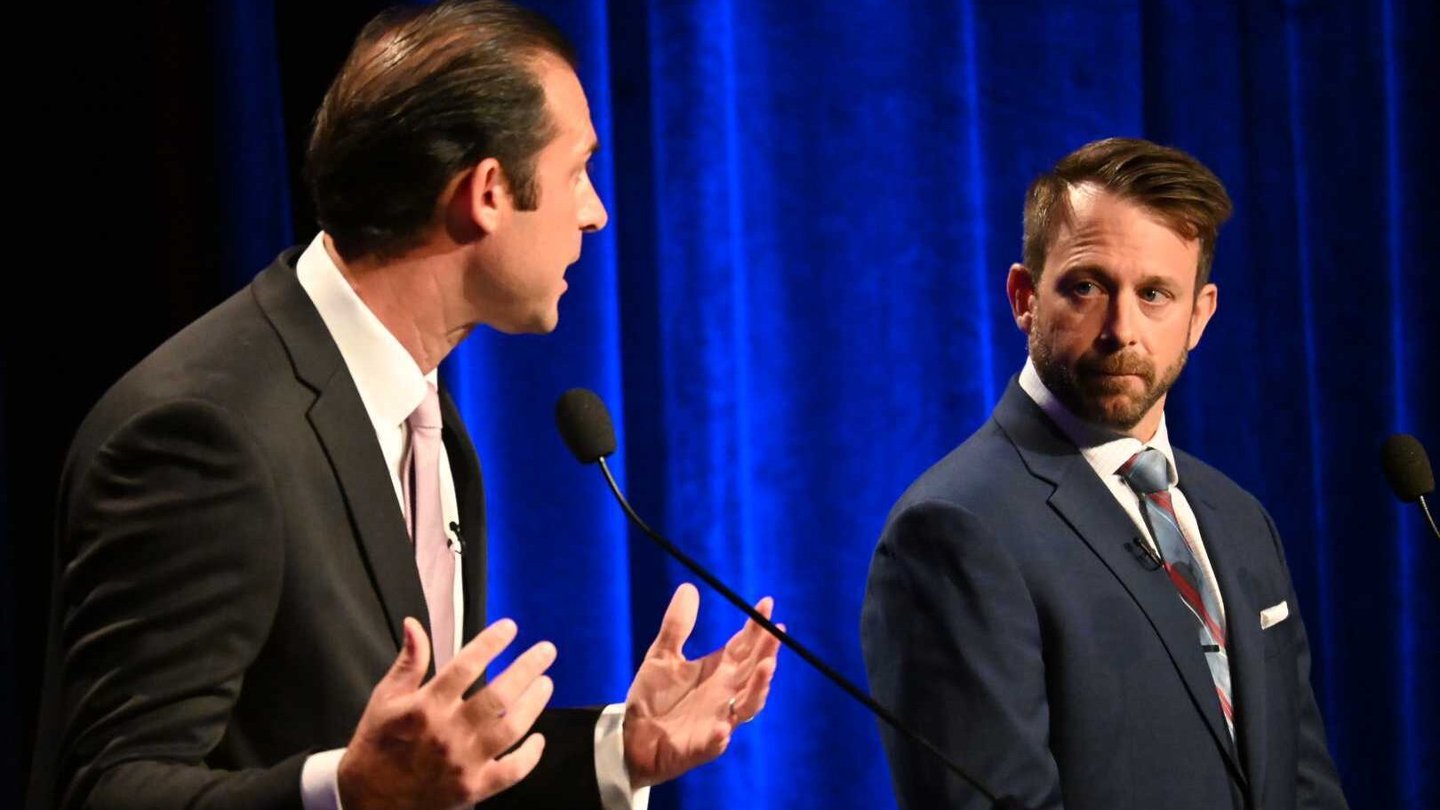
From left, Republican Georgia Public Service Commission candidates Bobby Mehan and Josh Tolbert participate in an Atlanta Press Club debate on March 31, 2026. (Ross Williams/Georgia Recorder)

The race for two Georgia Public Service Commission seats this November is becoming a test on whether pocketbook issues and concerns about unchecked data center growth can overcome traditional party lines.

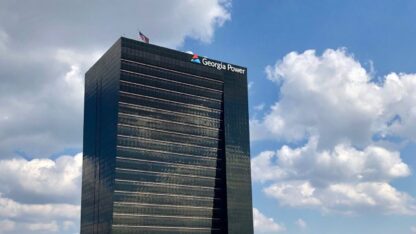
Voters are paying more attention to these once little-known, down-ballot races after the commission signed off on a series of Georgia Power rate increases in recent years.

Nancy Lubeck, a Twiggs County resident who called herself a lifelong Republican, said she voted last year for Peter Hubbard and Alicia Johnson, the two Democrats who flipped seats on the then all-Republican PSC, because she said she wants to see things done differently at the commission. She said she voted in the GOP primary last month but will likely vote for the Democratic candidates again in November. 


Lubeck, who is fighting a proposed data center down the street from her home from being built, said she is concerned that despite a recent promise to marginally lower energy bills, the commission’s approval of a massive energy infrastructure buildout to largely serve data centers could end up raising bills in the future. For that reason, she said she will continue to vote for Democrats this November, hoping for a change of direction for the powerful utility commission.

“We are still going to vote Democrat for the Public Service Commission, [and] most likely Republican for everything else,” Lubeck said in an interview. “We’re still mad about them giving all those increases to Georgia Power, and we just feel that all those people need to be changed out and need to be led by another party, so maybe they’ll do something different to help us.”

Republicans now have a 3-2 majority on the commission, but Democrats are hoping to flip control of the panel this fall.

2026 Georgia Midterm Elections

Stay in the know with WABE’s 2026 Georgia Midterm Election page, where you can find the latest election news, important dates, voting locations, candidate info, results and more.

Kennesaw State University political science professor Jason Shepherd, who previously chaired the Cobb County Republican Party, said with affordability concerns being on top of voters’ minds and with signs that Democratic voters are more enthusiastic ahead of the election, it’ll be an uphill battle for Republicans running for a seat on the PSC. In a world where “in politics, perception is reality even if it isn’t reality,” he said that Republican candidates “have to find a reason to stand out and be different and be different in a positive way to the voters.”

“It may be just voters have decided it’s time to clean house, and voters want something new,” Shepherd said. “It’s going to be harder to run as a Republican against a Democrat incumbent, and it’s going to be that much worse for someone who has a record of siding with the industry more than consumers or at least is seen as siding with the industry more than consumers.”

Georgia State University political scientist Tammy Greer said that “political affiliation didn’t matter as much as the platform” in last year’s special PSC elections, pointing to deep-red counties that turned blue over pocketbook and data center concerns.

“Perhaps that is the first time in a very long time that that’s been the case in Georgia. [It] was about the platform and not the party,” Greer said.

Republicans running for the seat this year are facing ideological differences over how to approach utility regulation, and looking at the May primary results, it appears Republican voters are also divided.

Despite running on a platform promising to protect ratepayers, former Republican incumbent Fitz Johnson, running in hopes of reclaiming the District 3 seat, barely scraped through his primary with 50.2% of the vote against a little-known candidate. In the past, Johnson has defended his record on the commission. Johnson, whose bid for the Republican nomination was backed by donations from groups in the utility industry, did not respond to requests for interviews. 

In District 5, where the commission seat was left open when Tricia Pridemore ran unsuccessfully for Congress, Republican candidates offered different philosophies on how to regulate utilities in the state.

Republican engineer Josh Tolbert, who has spoken against the PSC’s approval of the massive energy infrastructure expansion in public hearings and is running on being an objective voice on the commission, received nearly 50% of the primary vote. Tolbert has argued that his technical background would be an asset to the commission, saying in a recent Atlanta Press Club debate that “this job is technical [and] it’s time we send an engineer to do it.”

Bobby Mehan, who has received campaign contributions from lawyers affiliated with Georgia Power, faces Tolbert in the June runoff, having received 31% of the vote despite promising to vote against rate increases during his tenure. In the same debate, he said that his “vision remains simple and unchanged: no new rate increases.”

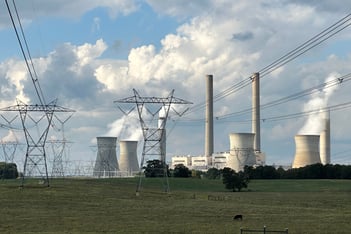
The influx of data centers has been at the heart of debate around utility regulation. While the Public Service Commission does not control whether data centers come to Georgia, they have approved a massive expansion of energy infrastructure, roughly 10 Plant Vogtles worth of energy, to support data centers. Because data centers are being proposed in rural parts of the state, Greer said that the increased pushback comes from these data centers “urbanizing rural areas [and] forcing rural voters out of their land,” which makes it harder for Republicans to craft a message against Democrats, who are promising to change the status quo.

“What the data centers are doing, they are encroaching upon the rural areas, and that is urbanizing rural areas, forcing rural voters out of their land,” Greer said. “So you’re pushing them away from their space, and again, going back to appreciating the way that traditional conservatives think about property and ownership of property, and conserving one’s life, this appears to be the opposite.”

This story was provided by WABE media partner the Georgia Recorder.