The Marietta Police Department recently launched a pilot project offering officers time at a horse therapy program in northwest Georgia. The farm program is designed to help participants process job-related trauma and release accumulated stress that research suggests puts officers at higher risk for divorce, substance use, lower life expectancy and suicide. (Jess Mador/WABE)
Half a dozen Marietta police officers in street clothes gather in a semicircle outside a barn at McKenna Farms therapy program in the rolling hills of Paulding County, in northwest Georgia.
“Y’all are welcome,” says Gabriella Hartz, standing before the group.
Hartz is a certified therapeutic riding instructor at the farm. She and another instructor introduce the horses the officers will meet during their visit.
“Patron, he’s our big boy. He is super sweet, no brakes — if he does not respect you, he will run over you,” Hartz says.
“My goal here is for you to be able to come here, be able to walk through those gates and be able go, ah, just kind of breathe and chill and not have to worry about what’s happening outside.”
Gabriella Hartz, certified therapeutic riding instructor at McKenna Farms
The other horses joining them for the session are Bullseye, Elvis, Doc, Gizmo and Blake.
“Y’all go ahead on in, go take a look at the horses, and we’ll reconvene in a couple minutes,” Hartz says, directing the officers inside.
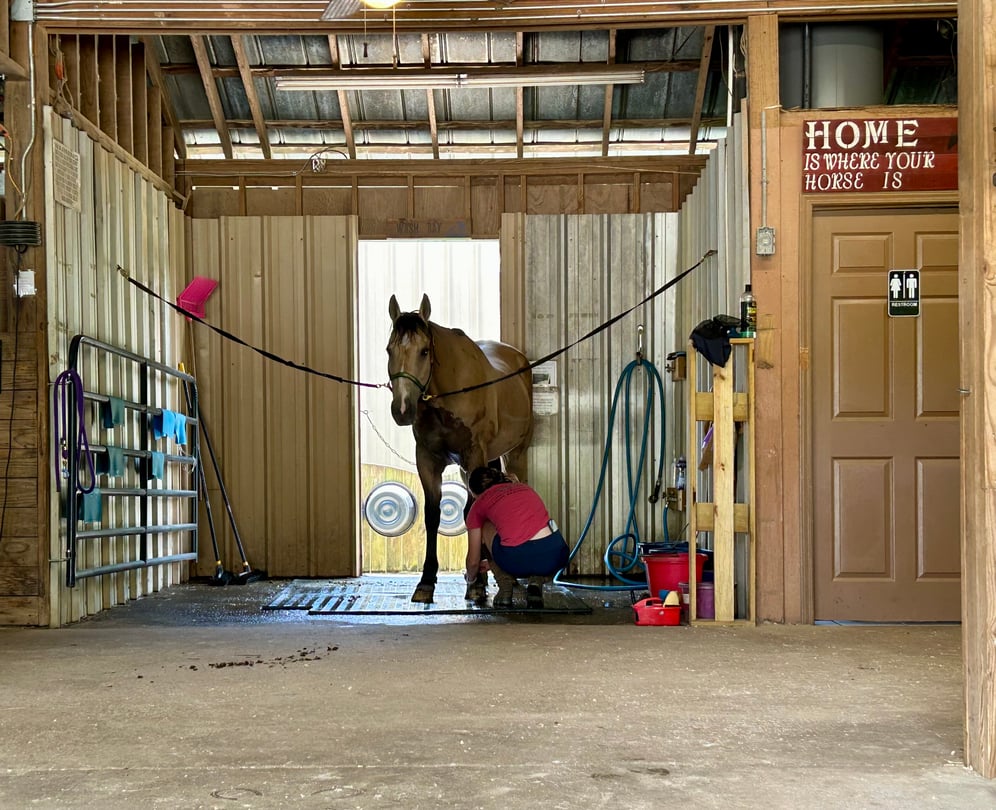
Volunteer stable hands have brought the horses out and tied them up in a line down the center of the barn. The Civil War era building is long and narrow, with hay lined stalls along both sides.
Hartz, who is also trained as a mental health counselor, says the officers will start by learning to brush the horses and clean their hooves before walking them to a nearby arena.
“My goal here is for you to be able to come here, be able to walk through those gates and be able go, ah, just kind of breathe and chill and not have to worry about what’s happening outside,” she says.
The nonprofit 30-acre farm also provides a range of horse therapy programs for children with special needs.
Marietta officers from various units using horse therapy program
This is the second group of Marietta Police Department officers to come to the program. They include officers from Marietta’s mental health co-responder unit, and investigators, including detectives who handle cases of violent crime, serious highway crashes and homicides.
All regularly encounter people in crisis.
“And so they really are exposed to a lot of traumatic scenes,” says Jonnie Moeller-Reed, a veteran of the force.
And officers often face stigma about seeking help and barriers to getting mental health services.
Horses in their stalls at McKenna Farms therapy program in northwest Georgia. (Jess Mador/WABE)
So, with the help of grant funding, the Marietta Police Department recently started trying something new. It’s giving officers time with horses at McKenna Farms — the kind of support that studies show can also help improve policing. Officials say the hope is to make it available for as many officers as possible through this fall, and hopefully beyond.
Moeller-Reed has served as a police officer for 25 years. For 10 of those years she was a detective working homicide cases. And for about a year now, she’s transitioned to become Marietta’s first full-time wellness officer.
“It gives officers, whether they realize it or not, the self-awareness to be cognizant of their emotions, the energy that they’re giving off.”
Marietta Police Department Wellness Officer Jonnie Moeller-Reed on horse therapy
The department recently lost two officers to suicide. She says morale has flagged amid rising stress, especially during and after the unrest of 2020 and the strain of the COVID-19 pandemic.
It was Moeller-Reed’s idea to offer horse therapy.
“Our detectives have been extremely stressed in the past few months. And so, I wanted to give them the opportunity to come if they were available,” she says. “It gives officers, whether they realize it or not, the self-awareness to be cognizant of their emotions, the energy that they’re giving off. The horse is going to reflect that energy back to them. Even if they think they’re calm and cool and all of that, if they’re not, the horse is going to tell them that.”
Moeller-Reed also has a master’s degree in forensic psychology and says working with horses is ideal for teaching officers mindfulness techniques they can use on emergency calls and at crime scenes.
“Because what energy they’re carrying into those calls or onto those scenes can escalate things quickly or it can calm things down very quickly,” she says. “Just that posturing or that body language can escalate a situation that doesn’t necessarily need to be escalated.”
It can also help them process trauma and release stress research suggests puts them at risk for divorce, substance use, lower life expectancy and suicide.
“You can feel the energy you’re giving off to the horse and how he’s receiving that energy, and that kind of dictates what he’s going to do and how he is going to act, and that’s interesting because that’s kind of how it is dealing with the public as well.”
Marietta Police Officer Chris Henry
Most police officers have traditionally received little education about the mental health risks of working in law enforcement, says Moeller-Reed. And it’s uncommon for many departments around the country to provide comprehensive wellness programs.
As Marietta’s wellness officer, she’s working to change that by providing education that begins as soon as officers join the department and continues until retirement. And encouraging officers to ask for help if they need it.
“Because no one teaches us that. And that’s where we’re trying to get better, is educating the new officers on, hey, this is how you process the things that you see. This is how your manage your stress. Don’t make the mistakes I made,” she says. “So it’s changing the mindset of going into this knowing that you’re going to see some really horrible things. And it’s okay to talk about them, and if you get stuck there let us know because we can help you.”
A Marietta officer at McKenna Farms therapy program. (WABE/Jess Mador)
How horse therapy program works
Inside the barn, Hartz and her fellow instructor help match the officers with horses.
Program volunteers guide the officers through grooming — they demonstrate how to brush their horses’ coats and how to clean their hooves.
Then, it’s time for the instructors, volunteers and officers to lead the horses to a riding ring down the hill.
The arena is protected from the rain by a vaulted roof and enclosed by a metal gate. The floor is cushioned with soft material that sends up clouds of dust with every movement in the ring.
Once inside the arena, the instructors stand in the center shouting directions to the officers and volunteers.
“Everyone is with new horses. We’re going to do two laps around so you can get to know your horses,” Hartz tells them.
The group practices for about an hour, officers walking in tandem with their horses along the fence line. Then, trotting, reversing, starting and stopping.
A Marietta Police Department officer practices in the riding arena at the horse-therapy program in northwest Georgia. (Jess Mador/WABE)
“Alright, on the count of three we’re going to ask our horses to whoa in three, two, one, whoa!”
It’s a bonding exercise, Hartz says.
“It’s important that you guys create that relationship with the horse so they’re not listening to us. They’re listening to you,” she says.
Clear, concise instructions are critical when working with horses, Hartz says. And, the more aligned they become with their horses, the better their communication will be.
“Ask your horse to walk on and they’ll walk on. If you ask your horse to ‘whoa’ and you keep walking, they will keep walking,” she says. “Your body is just as important of a guide for your horse as your voice and your wand.”
Regulating energy may help Marietta police interactions with public
Soon, the session winds down.
Officers, instructors and volunteers lead the horses in single file out of the arena and back uphill to the barn, where the horses head back into their stalls for a drink of water and a rest.
McKenna Farms horse therapy program is located in Paulding County. (WABE/Jess Mador)
Moeller-Reed gathers the other officers for a debrief. They discuss how the day went, and share their experiences.
“Do you understand how it helps to regulate the energy that you put off? And how even dealing with people on the street,” she asks, “like the energy that we put off, the horse just reflects that back on us, right?”
Some officers nod their heads.
“I can see it, I can definitely see that, yeah,” Officer Chris Henry, who previously served in the Marine Corps for eight years, said afterwards. “You can feel the energy you’re giving off to the horse and how he’s receiving that energy, and that kind of dictates what he’s going to do and how he is going to act, and that’s interesting because that’s kind of how it is dealing with the public as well.”
Henry is part of a traffic enforcement unit. He also investigates serious injury and fatality crashes.
“I’m the one they call in the middle of the night when it gets to that level that somebody’s seriously hurt or passed away already on scene,” he says.
He says he has felt how the trauma and stress police officers can experience build up over time.
“I think it’s more internal, how it affects me, because I can feel myself getting hyped up. I can see myself, my blood pressure going up, getting very irritated very easily, and then I have to go,” he says. “My strategy, what I normally do is I go sit in my car, take a deep breath, and just calm myself back down, then I just go back to work.”
He says he can envision using some of what he learned during the horse therapy session in his police work and interactions with the driving public.
“I’ll take a step back and think like, well, what kind of energy can change how their energy is deflecting onto me? Maybe it’ll work, maybe it won’t, I don’t know, but I could definitely try it.”