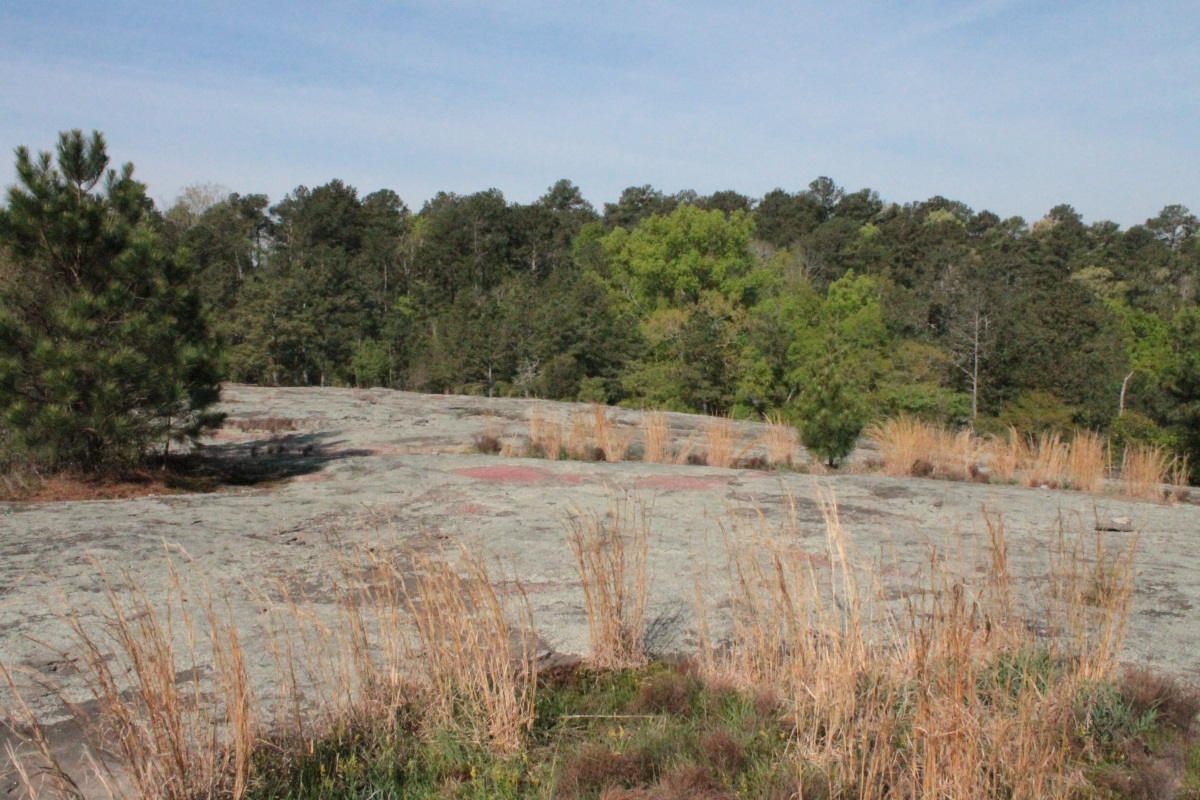
On a pollen-saturated spring morning, Panola Mountain naturalist and interpretive ranger Lieren Forbes hops and twirls in her khaki uniform on a rock outcrop of the mountain. The exercise, which Forbes calls “Stay on the Gray,” is similar to the children’s game “The Floor Is Lava,” but it’s not just for fun.
Forbes is leaping from patch of gray stone to patch of gray stone to avoid stepping on the sea-green lichen blooming on the rock. As a guide, Forbes spends a lot of effort trying not to disturb the mountain’s delicate ecosystem, and a lot of effort teaching others not to, either.
Panola Mountain is a monadnock, or a small mountain, similar to nearby Arabia and Stone mountains. Unlike its sister mondanocks, however, Panola Mountain is a pristine National Natural Landmark. The Georgia Department of Natural Resources has labeled it the “crown jewel” of the Arabia Mountain Natural Heritage Area because, while the department encourages visitors to the park around Panola, the actual mountain ecosystem has been kept as untouched by humans as possible.
Read this story now for free
To continue reading, sign up for our newsletter and get unlimited access to WABE.org
You can select your preferences for news and local content. We will never share your email address. Learn how your newsletter sign-up will support WABE and Public Media