The astronomer in me will tell you that summer officially ends on Sept. 22. That’s the date of the Autumnal Equinox, the point in Earth’s orbit where the hours of day and night are equal. That definition is fine for a scientific understanding of the cosmos, but when it comes to experience, we all know that summer really ends on Labor Day. And in that division between the ways we meter time (for science or business) and the way we actually live time, there is a Labor Day lesson we might keep close to our hearts all year long.
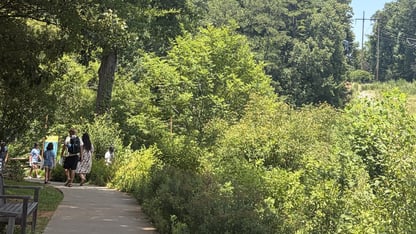
My first experience of this truth came when I was just a kid of 10. It was a warm, lazy, late summer afternoon at the Newark YMCA day camp my sister and I attended. I was sitting by the swimming pond, looking up at the trees and blue sky when it happened. A single falling leaf spun downward into my vision. It fell in a slow spiral until it dropped, silently onto the water’s surface.
It was at that moment I knew. I knew without anyone telling me or showing me a calendar that summer was over. I had never had that kind of experience of time before. I had never been old enough to feel the transition from one season to the next so explicitly, so concretely. For a kid who was already obsessed with astronomy and cosmic time, that single leaf served as an introduction to time’s other reality — the one that tells stories through our own most intimate experience.
There is always a tension between how a culture measures time and how people experience it for themselves. Every society finds its own way to organize the days into useful divisions for getting basic needs accomplished. Every culture divides the year up into calendars pockmarked with festivals and holidays. As civilizations get more complex, those divisions get more refined. In modern culture, where science and technology dominate, we find our time sliced up into ever-finer increments and with ever-higher expectations for how much we can produce in a given bundle of minutes or hours. The calendar itself now gets cut up into financial quarters and budget cycles reminding us in the most visceral way that time is money, time can be measured, time is exact.
But our bodies know differently. Born of the natural world, evolved across hundreds of thousands of generations in field and forest, rock and water’s edge, we have within us another understanding of time.
9(MDAxODM0MDY4MDEyMTY4NDA3MzI3YjkzMw004))