'Young King' reveals early life experiences that shaped MLK

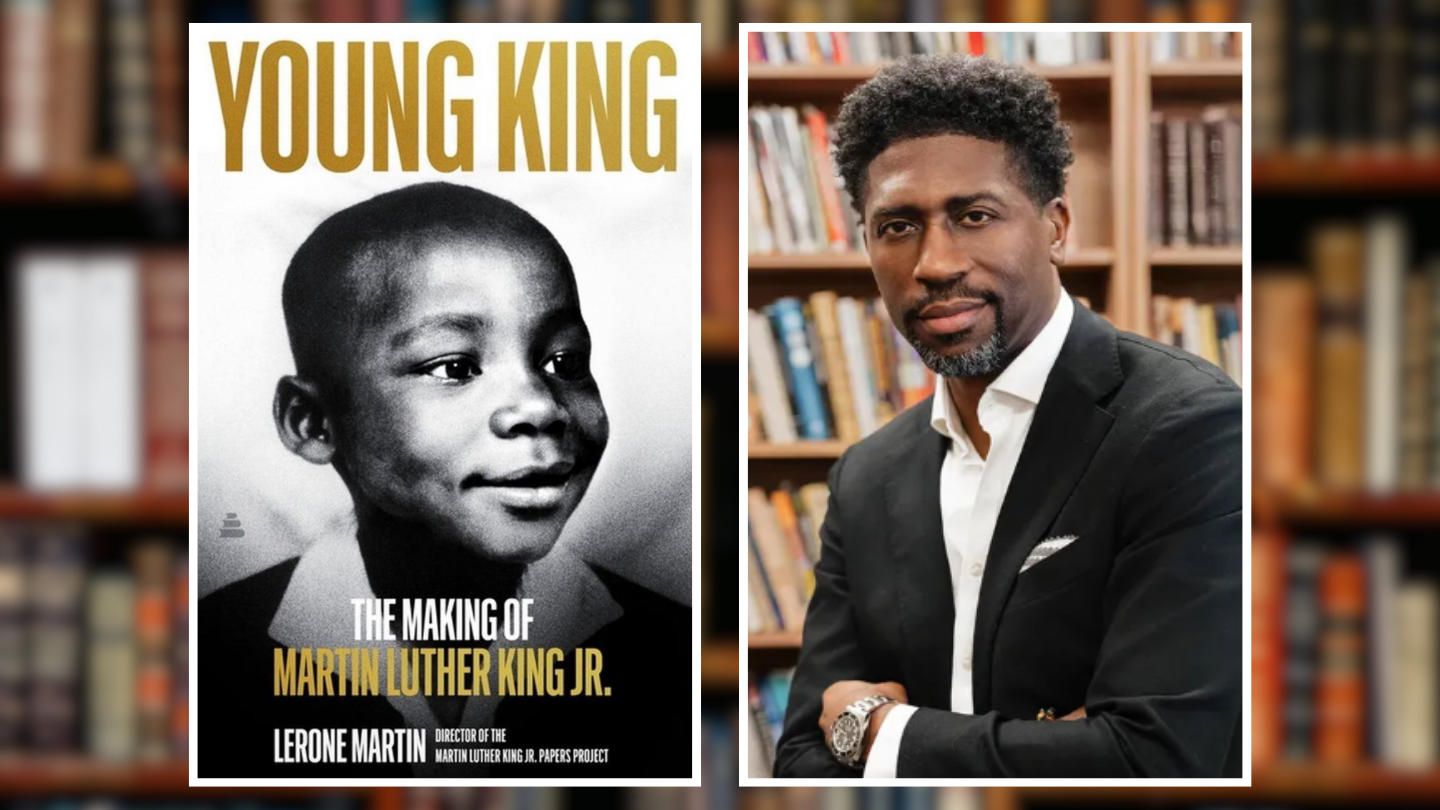
Professor Lerone Martin's new book, "Young King," explores the early life of Dr. Martin Luther King, Jr. and how his adolescence informed his outlook and activism. (Harper Collins/Lerone Martin/Iñaki del Olmo)

Martin Luther King Jr. was known for his moral courage, but as a child, he also had a scrappy side. “Little Mike,” or M.L., as he was called, had a phrase he used whenever a fight seemed unavoidable. “Let’s go to the grass,” he’d say—a challenge that signaled he was ready to defend himself. That detail, says Professor Lerone Martin, reveals a lesser‑known dimension of King’s early character.

These childhood confrontations came well before King delivered his first public address, “The Negro and the Constitution,” on April 17, 1944, at just 14 years old. He gave the speech during an oratorical contest at First African Baptist Church in Dublin, Georgia.

Growing up in the Jim Crow South shaped King’s developing worldview. But as Martin heavily details in his new book, “Young King: The Making of Martin Luther King, Jr.,” there were many other influences—family, teachers, community elders—who helped form the young man who would become a global symbol of human and civil rights.


Martin, the Centennial Professor in Religious Studies and Director of the Martin Luther King, Jr. Research and Education Institute at Stanford University, told “Closer Look” host Rose Scott that two moments sparked the project.

“I started my position four years ago at Stanford as the MLK professor and director of the King Papers Project,” he said. “As I arrived, I began reading letters King wrote home as a little boy—letters I had never seen. They really hit me. And then I became a new dad. Watching Marvel movies with my kids, I realized every hero has a backstory. In all my research, I realized we didn’t really know King’s backstory.”

The book draws on unpublished interviews with King, as well as conversations with his sister, Christine King Farris, and others who knew him during his formative years. When asked what insights readers and listeners might discover, Martin pointed first to King’s complicated relationship with his father, Daddy King.

“I think people will be surprised by the way he and his father struggled,” Martin said. “His father, at times, felt King was too soft and didn’t recognize the gifts he had. King had the same courage as his father, but he expressed it very differently.”

Martin also highlights the often‑overlooked women who shaped King’s early life.

“There is a host of women in King’s family—and beyond it—who played an important role in shaping him,” he said. “These are women who will never get monuments or biographies.” He added King spoke about how they influenced him: his grandmother, his great‑aunt, schoolteachers, and librarians. These women, in addition to living along Auburn Avenue, helped shape the Martin King we know today.”

Professor Lerone Martin plans to return to Atlanta in the fall and will discuss further what he learned about King in his younger years.