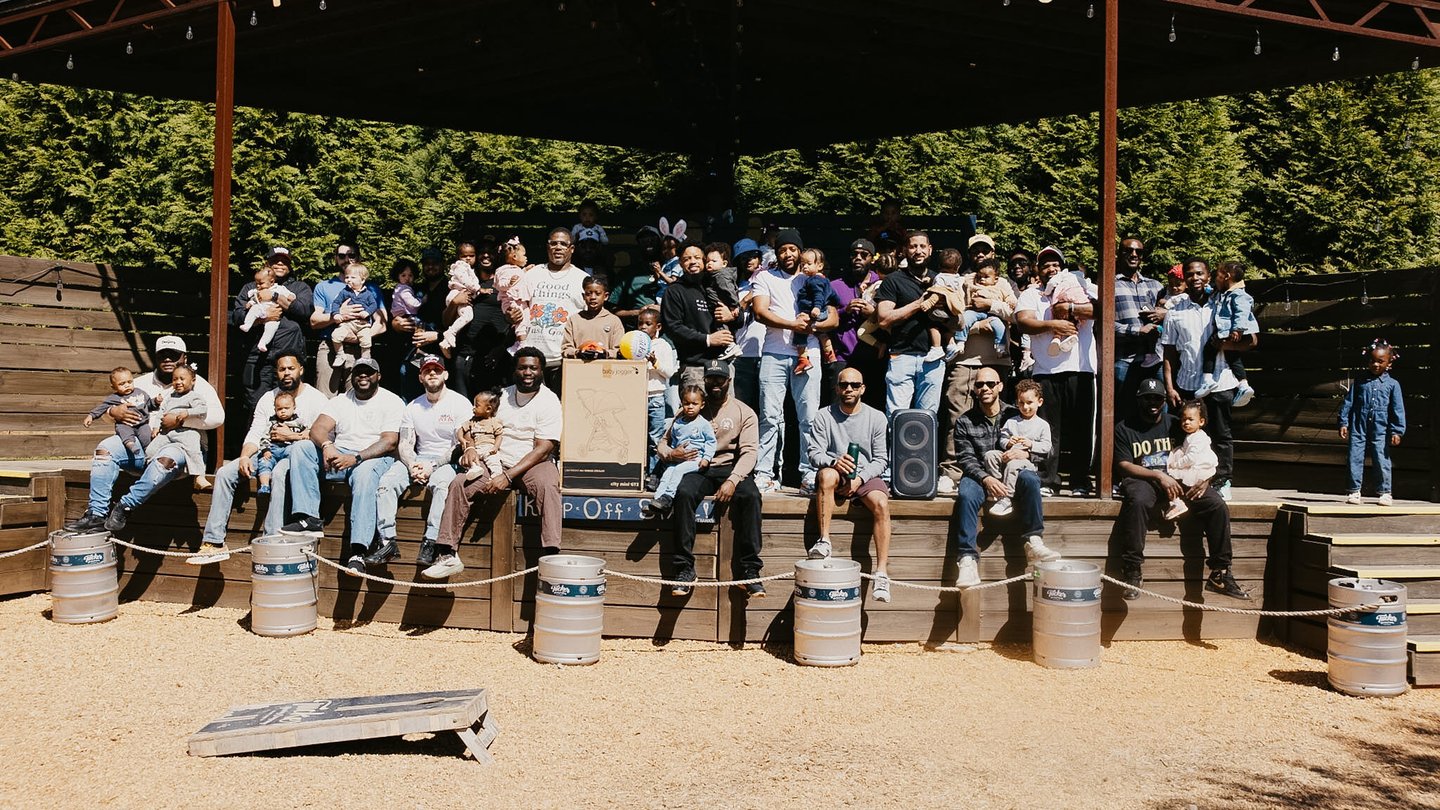
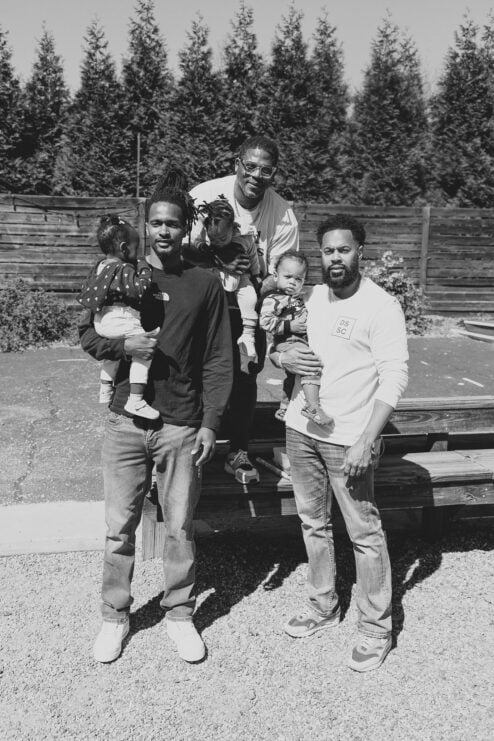
Since its founding in July 2025, the Atlanta chapter of the Daddy Social Stroller Club has coordinated monthly walks and events where fathers are able to bring their children to play, while simultaneously receiving resources, support and a sense of community for themselves. (Courtesy of the Daddy Social Stroller Club)
During a recent Saturday morning interview, Karl Antoine couldn’t help but glance away from his laptop a handful of times before briefly pausing in the middle of a question.
The soft cries that started off hushed in the background slowly grew louder.
“Just give me one minute, please.”
Less than five minutes later, he returns with a 10-month-old infant wrapped within his arms. A smile wraps around the face of what was just moments ago, belting screams.
“She’s a bit of a crybaby,” he notes, laughing.
“When somebody actually comes out loud and says, ‘Hey, being a man is actually really hard, because I have all of these expectations that are building on me … it gets us all to a place where we’re more healthier, more safer, and where we all feel seen in ways that we should be.”
Myer Krah, founder and president of Daddy Social Stroller Club – Atlanta chapter
It is a typical day in the life of Antoine and his wife, New York transplants who have recently welcomed twins into their family in late summer of last year.
The father of four had already experienced the trials and tribulations of parenthood, but adding two new young faces proved to be more challenging than expected.
Anotine began to ask himself how he could find a community of men living through the same experiences he was. And with the Atlanta chapter of the Daddy Stroller Social Club, he seems to have found an answer.
Since its founding in July 2025, the chapter has coordinated monthly walks and events where fathers are able to bring their children to play, while simultaneously receiving resources, support and a sense of community for themselves.
“They’re sharing these tips [of being an infant father] and just you feel that brotherhood,” Antonie says, recalling his first park meet-up with the club in May.
“It’s the guys getting together, the kids playing and doing their thing, and we can chit chat … while we watch the kids, of course.”
“Will I be Enough?”
The Daddy Stroller Social Club first originated in Houston in 2021 after founder Kalvin Bridgewater began to take walks with other new fathers around his neighborhood as a way to cope with the postpartum depression he had experienced after the birth of his first daughter.
According to Atlanta chapter president and founder Myer Krah, the fears of inadequacy and uncertainty are ones he, Bridgewater, and many other first-time fathers have all experienced.
“When you first get that ‘Hey, we’re pregnant,’ you have to think inside of yourself and think, hey, what does that truly mean?” the 33-year-old father of five notes.
“For a mother, a lot of times they’ve already been exposed to even having a conversation on what motherhood might look like for them… dads don’t do that, men don’t do it quite often. Socially, everything else we do doesn’t really revolve around family. So the first time you hear, “Hey, we’re having a baby,’ things start to trigger, and you start to ask yourself questions – ‘Am I enough?’ ‘Will I be enough?’”
“Having that space … to have some of the leaders and some of those more senior members say ‘Hey, is there anything that you want to get off your chest?…’ it allows you to come in, be open, talk freely,”
Karl Antoine, member of Daddy Social Stroller Club – Atlanta chapter
After seeing Bridgewater’s content on social media, Kreh asked the father advocate to be a guest on his “Here for the Dads” podcast series, which highlights resources and educational tips for fathers. A friendship was quickly formed, and Kreh soon found himself as the founder of one of 12 chapters that launched across the nation in the summer of 2025.
The first meet-up saw 500 online registrations and 100 fathers present, with new members continuing to join each event.
“It touches me every single month, when we have 20 to 30% of those guys be new members, coming to listen to share what it’s been for them,” Kreh said.
Fathers attend a Daddy Social Stroller Club Easter Egg Hunt meet up in April 2026. (Courtesy of the Daddy Social Stroller Club)
“Sometimes during the stride, two fathers who have never met before may be given a topic to discuss with one another – where they are able to share resources or a different perspective regarding what they may be experiencing in this new chapter of their lives.”
The fathers range in age from their teenage years to their late 40s. Kreh notes that roughly 50 to 60 are present during the walks each month, and 160 are active in the official group chat, where members will discuss anything from men’s mental health to “How do I put the crispy edges on pancakes for my three-year-old?”
“Having that space … to have some of the leaders and some of those more senior members say ‘Hey, is there anything that you want to get off your chest?…’ it allows you to come in, be open [and] talk freely,” said Anotine, who first met Kreh at a Pints and Ponytails event the latter organized, where fathers with daughters gather together to have drinks and learn how to do their daughters’ hair.
“[As a black father], to be able to have someone who looks like you and is trying to figure it out … it shows you that you’re not alone.”
And the club isn’t just a work-and-play experience for the fathers alone.
“For my two oldest, what they’re seeing is men be open and vulnerable and shake hands and have fun, and I’m teaching them things in different areas of their life that they can use for a really long time,” Kreh says of the monthly “stride” sessions. “They get to see me walk up to a stranger, and shake their hand, and get to know who they, and remember their children’s name … and then as they get older, recognize, ‘hey my dad always had community, and there was a lot of other fathers out there building community, maybe this is something that I want for myself.”
“We’re all trying to figure this out”
When discussing the importance of addressing the mental and emotional health issues men face, Kreh has found that, in recent years, social media has enabled a helpful shift in how we define what it means to be a man and father in today’s world.
While he notes that there is an era of content present that portrays masculinity that “doesn’t feel so positive or sound so positive,” there is also now a voice for others to break long-standing taboos that often went without a face.
“Before, things weren’t getting shared as often, so whatever the social norm is kinda perpetuates constantly because you believe that’s what other people think too,” he said.
“When somebody actually comes out loud and says, ‘Hey, being a man is actually really hard, because I have all of these expectations that are building on me, but I have nowhere to outlet when it is getting hard for me. I have no one to talk to. I don’t feel comfortable doing this or saying that, because I don’t want to be looked down upon. I don’t even want to share with my own family members, with my own children, with my own wife, because I don’t feel I have the safe space to’… it gets us all to a place where we’re more healthier, more safer, and where we all feel seen in ways that we should be.”
Whether it’s their content over the phone or their in-person events, Kreh hopes that Daddy Social Stroller Club remains that safe space for those who may be searching.
For members such as Antoine, the impact has been a Father’s Day gift in itself.
“It tells you you’re not alone in trying to figure this out,” he said. “Because we’re all trying to figure this out.”