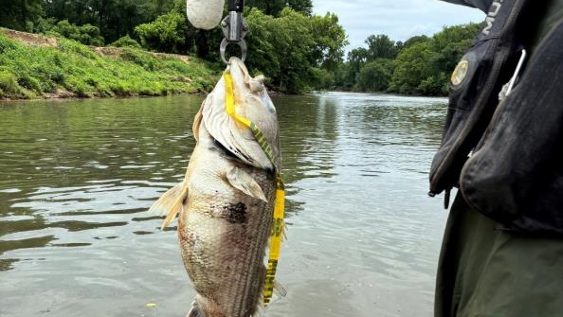
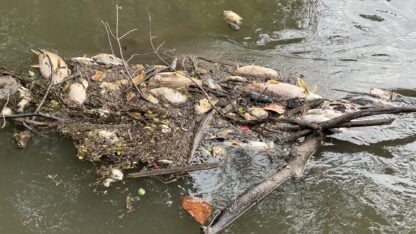
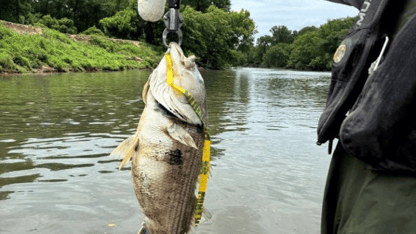
Dead striped bass observed by WRD staff in the Chattahoochee River downstream of Peachtree Creek. (Photo courtesy of Georgia DNR WRD report)
Weeks after the fish kill on the Chattahoochee River, the City of Atlanta, state and nonprofits are still researching the causes.
The City of Atlanta’s Department of Watershed Management Commissioner Greg Eyerly said on top of its own investigation, the city has hired an independent investigator to complete its own analysis.
“We’ve been able to eliminate a couple of potential sources, and so it’s that process of elimination,” Eyerly said. “We’re still in the discovery phase of that, getting all of our information together, all our data, interviewing staff about what happened, what were the sequence of events, looking at our laboratory results.”
He said the City of Atlanta is providing data to its consultants — Brown and Caldwell — but otherwise are working independently.
“We’re not trying to prove that we had nothing to do with it — we’re trying to prove what it was, so we can fix it,” Eyerly said.
He said he’s looking to use what they learn from these investigations to focus on two major areas: physically changing operations — like fixing equipment or upgrading sewage plants; and operations — like addressing staffing and changing protocols to respond to major weather events.
What happened during the storm before the fish kill?
Eyerly said the May 20 storm popped up quickly, and the National Weather Service didn’t notify the city of the storm in advance.
Under normal circumstances, Eyerly said the City of Atlanta Department of Watershed Management looks out for rain events with 40% chance or greater than one inch of rain in the forecast, and starts mobilizing employees and readying the treatment plants the day before the rain.
“The problem with this particular storm is it was not forecasted at all, and so we weren’t in that ready set mode,” Eyerly said.
Another issue, he said, is that these plants were built over 20 years ago — not only are they not prepared for the volume of rain Atlanta has recently seen in these pop-up storms, but they require a lot of manual preparation by on-site employees, and take several hours — not minutes — to prepare for these rain events.
“Our treatment plants require person-machine interface to get up and running, and so some of the facilities that can provide relief to the tunnel system, we weren’t able to get those up and running in time, and all that flow went to the West End tunnel, which is the […] final treatment plant adjacent to the Chattahoochee River,” Eyerly said.
He says Atlanta had a combined sewage overflow — a mix of stormwater and partially treated sewage — that went into the Chattahoochee River.
The city is allowed a certain number of combined spills like this over a three-year period per their permit.
“All the testing and data that we pulled showed everything was within our operating and permitted parameters, but we had a fish kill, so if we’re related to that — if that overflow is related to that fish kill — we need to figure out why,” Eyerly said.
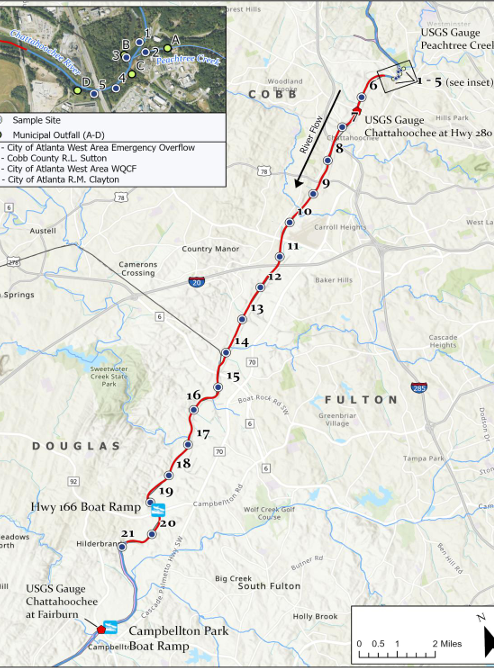
A map of Georgia Department of Natural Resources Wildlife Resources Division sample sites established during a May 22, 2026 fish kill investigation on the Chattahoochee River. The fish kill zone is highlighted in red. (Graphic courtesy of the Georgia DNR WRD)
The fish kill investigation
Chattahoochee Riverkeeper Jason Ulseth reported the fish kill to the City of Atlanta and the Georgia Environmental Protection Division on May 22 during a routine river patrol.
The fish kill started where the City of Atlanta’s West Area tunnel meets Peachtree Creek, which is just below Standing Peachtree Park. The stretch of affected river was about 15 miles long.
The fish kill and sewage overflow did not impact further upstream portions of the river, including the Chattahoochee River National Recreation Area, which are more popular for recreation.
Ulseth said during his survey of the river, his organization found striped bass, spotted bass, catfish, carp, bream and shad dead in the river.
At the time, Ulseth said in an interview with WABE that this was the largest fish kill he’d seen in his two decades working on the Chattahoochee.
Earlier this month, the Georgia Department of Natural Resource’s Wildlife Resources Division published its investigation report. The report details DNR employees’ investigation, including a narrative summary of who they spoke with, information and data gathered, and a timeline of events.
The DNR’s Wildlife Resources Division concluded that the fish kill was due to the lack of oxygen following the City of Atlanta’s wastewater overflow on May 20.
Low dissolved oxygen levels often occur after a sewage spill because bacteria in the river eat the organic material in the sewage, and in the process suck all the oxygen out of the water — leaving the fish without oxygen to breathe. The conditions could have been exacerbated, according to the DNR, due to low water levels caused by drought conditions.
The department estimated 44,509 fish died at a value of around $838,603.96, though none of them threatened or endangered species — and this number may change as other entities, like the City of Atlanta, finish their investigations. The DNR WRD also noted an additional $9,599.13 for the cost of the department’s investigation.
The Georgia Environmental Protection Division has not stated if it plans to fine the City of Atlanta for the fish kill.
In a written statement to WABE, the City of Atlanta said its Department of Watershed Management “continues to work closely with state and federal environmental agencies to assess and respond to the significant fish kill that occurred along a portion of the Chattahoochee River following severe weather on Wednesday, May 20, 2026.”