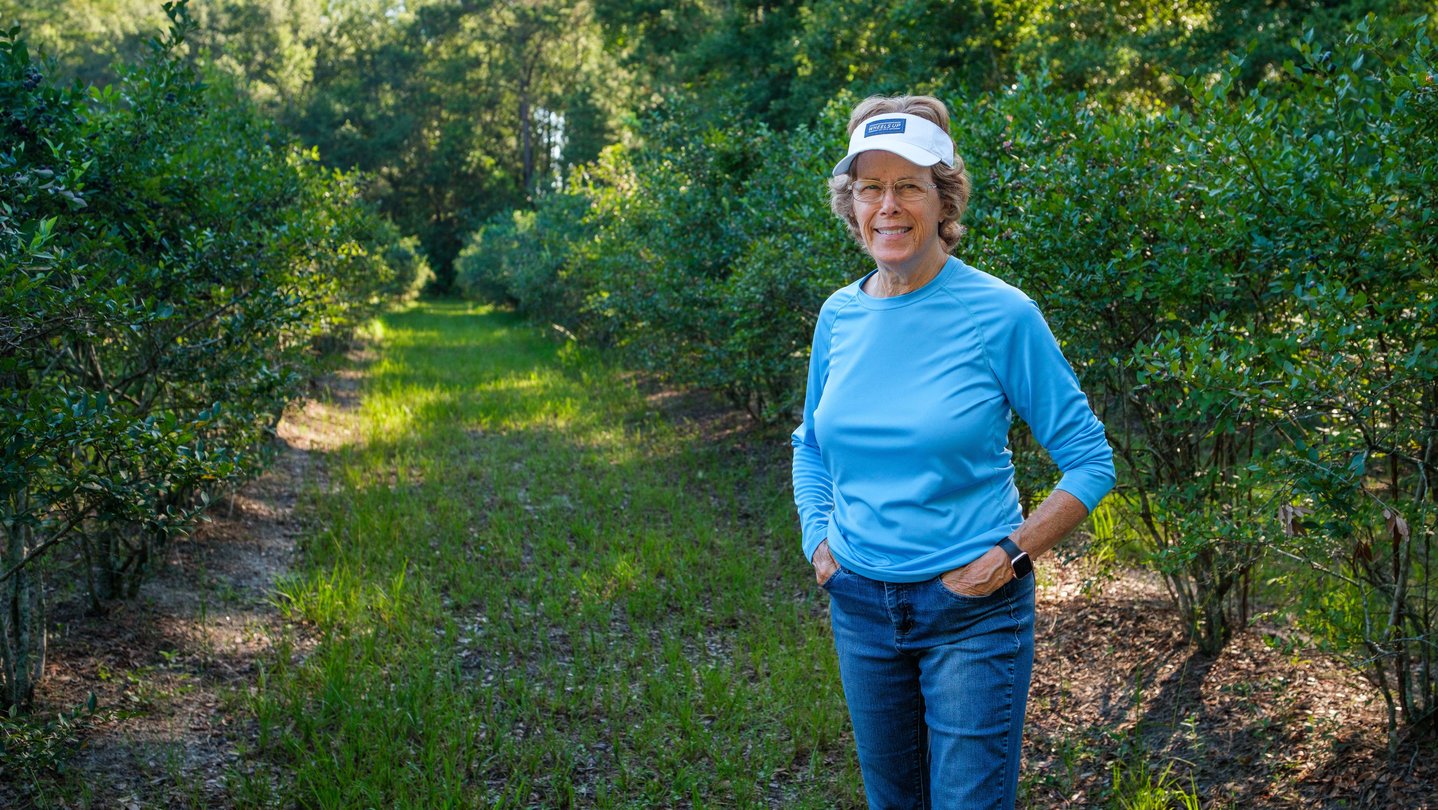
Linda Smith, owner of Heritage Hill Farm, stands between rows of blueberry bushes at her farm in Ludowici on June 24, 2026. (Justin Taylor/The Current GA/CatchLight/Report for America)
As Georgia’s blueberry season reaches full swing, Linda Smith, the owner of Heritage Hill Farm in Ludowici, is realizing her normal advice to customers is no longer valid.
At her all-you-can-pick fields, Smith would encourage visitors to explore the six acres she has under cultivation until they stumble upon a blueberry bush that makes them go “oh wow,” impressed by the fresh fruit. But she can’t share the same encouragement this year, because instead of being weighed down with plump, vibrant berries, this season’s bushes look different.
“I think I’m gonna have to admit that it’s an off year,” Smith, 78, said.
Because of a harsh winter and the ongoing drought, Smith and other Georgia farmers don’t have as many berries this year, a sign of trouble for the state’s largest fruit crop.
Georgia peaches may be iconic, but the state is third in the country for commercial blueberry production; in a 2025 study, U.S. Highbush Blueberry Council reported that blueberry growers contribute nearly $917.3 million toward the state’s annual economic output. Separate from commercial farming, ‘U-Pick’ berry farms are a popular way for visitors to pick their own fresh fruit from smaller farms.
Linda Smith, owner of Heritage Hill Farm, inspects and picks blueberries during the summer harvest in Ludowici on June 24, 2026. (Justin Taylor/The Current GA/CatchLight/Report for America)
Georgia’s blueberry economy is built on three main types of blueberries: rabbiteye, southern highbush and northern highbush. Juliet Chu, the University of Georgia’s blueberry breeder, said rabbiteye is native to Georgia. Southern highbush berries are also best suited for the Southeast region of the United States, making Georgia a perfect hub for the fruit.
“It’s like home for blueberries,” Chu said.
Smith said she started growing blueberries at Heritage Hill Farm, located about 50 miles outside of Brunswick, 18 years ago. The 550-acre farm has been in her late husband’s family for generations. Most farming responsibilities now fall to her son and granddaughter, but Smith still oversees the land.
In 2026, Heritage Hill only has six acres of blueberry bushes, down from 16 acres in years past.
Previously, Smith would use machines to pick the berries before hauling them to Alma for processing. Now, her whole operation is now U-Pick: Visitors fill their buckets with fresh fruit and pay her $10 per gallon. At the end of blueberry season, she donates the profit — which she said usually amounts to around $4,000 — to various charities.
Chu said since different blueberry varieties ripen at different times, blueberry season in Georgia can stretch from early April into late July. At Heritage Hill, Smith said she has two types of rabbiteye blueberries: Brightwell (named after UGA’s first blueberry breeder) and Powderblue. To accommodate their growing patterns, her farm’s blueberry season begins in June and goes throughout July.
Irregular weather, however, threatened her crop as far back as February.
“I think some of the blooms froze—well, I know they did,” Smith said. “I saw them. They were brown.”
Larger commercial growers rely on overhead irrigation and other proactive measures to reduce losses from early freeze damage. Many Florida blueberries were wiped out this year because their crops mature earlier, said Chu.
Smith previously used irrigation but doesn’t anymore, which left her berries susceptible not just to the freeze but also—and in her eyes, even more so—to the drought that Coastal Georgia has been suffering since April.
The lack of rain has left Smith’s bushes with smaller berries that are slower to mature. She said they’ll ripen eventually, and she still has plenty of berries, but it’s difficult to make up for months of dry weather.
“I’m not saying it, you know, ruined me this year or anything,” she said. “I just think I can see a little different now.”
Linda Smith, owner of Heritage Hill Farm, inspects and picks blueberries during the summer harvest in Ludowici on June 24, 2026. (Justin Taylor/The Current GA/CatchLight/Report for America)
Not all blueberry farmers have experienced the same weather related effects on their berries.
In Brunswick, Paul Oglesby of Oglesby Family Farm has a small “hobby farm” with U-pick blueberry bushes. The farm’s blueberry season is earlier than Heritage Hill’s; Oglesby said it ran from April 15 to May 20.
He said his berries have overhead protection and an irrigation system, so he wasn’t impacted by the weather.
“I don’t see any difference,” he said of this year’s crop.
Linda Smith, owner of Heritage Hill Farm, inspects and picks blueberries during the summer harvest in Ludowici on June 24, 2026.(Justin Taylor/The Current GA/CatchLight/Report for America)
At Ottawa Farms in Bloomingdale, owner Pete Waller said his U-pick blueberry season covers June and July. Now that it’s raining again, Waller said his bushes are in pretty good shape, but there were challenges earlier in the growing period.
“We’ve had an awful dry start this year,” Waller said. “We didn’t have no rain there for about 60 days. We got everything we got under irrigation, but it still needs a little rain once a while.”
Waller, who has been growing blueberries since the 1950s, uses a drip irrigation system, but he says fresh rainwater is also important for his berries. His bushes originally included two types of rabbiteye blueberries — Tifblues and Woodard berries developed in Georgia—and he is now growing Brightwell blueberries as well.
That fruit, however, isn’t Waller’s main revenue source. He makes most of his money from his work in the construction industry, Ottawa Farm’s cattle and community events held at the farm. But the berries are still a solid cash crop, Waller said, especially when he can rely on U-pick customers, instead of commercial pickers. Ottawa Farm visitors can pick the all-natural Woodard blueberries for $4 a pound, or the newer plants, which are sprayed and fertilized, for $3.50 a pound.
“One thing about a blueberry, when you plant him, he’ll stay with you,” Waller said. “You haven’t got to replant him, you haven’t got to do nothing. All you got to do is keep him trimmed up a little bit where people can pick the berries.”
On the first day of the season, Waller said visitors picked about 1,000 pounds of fresh berries on Ottawa Farm. In her first week of the season, Smith said she earned between $800 and $900. She monitors transactions through an “honesty drop box” where people leave their money, and while she said some people do steal, she always has berries left over and a solid sum to donate.
Chu said the demand for blueberries is year-round, giving her plenty of reason behind working to develop more resistant crop lines to evade freeze damage.
Chu said the 81-year-old UGA program significantly contributed to jumpstarting Georgia’s blueberry industry. Scientists like her are continuing to expand the work to ensure Georgia’s blueberry season can endure changing weather.
“The market is there, but then our Georgia growers just need to fight all the odds to put out the best berries for our consumers,” Chu said.
This story was provided by WABE media partner The Current.