Kamasi Washington on what's feeding him ahead of Atlanta Jazz Fest

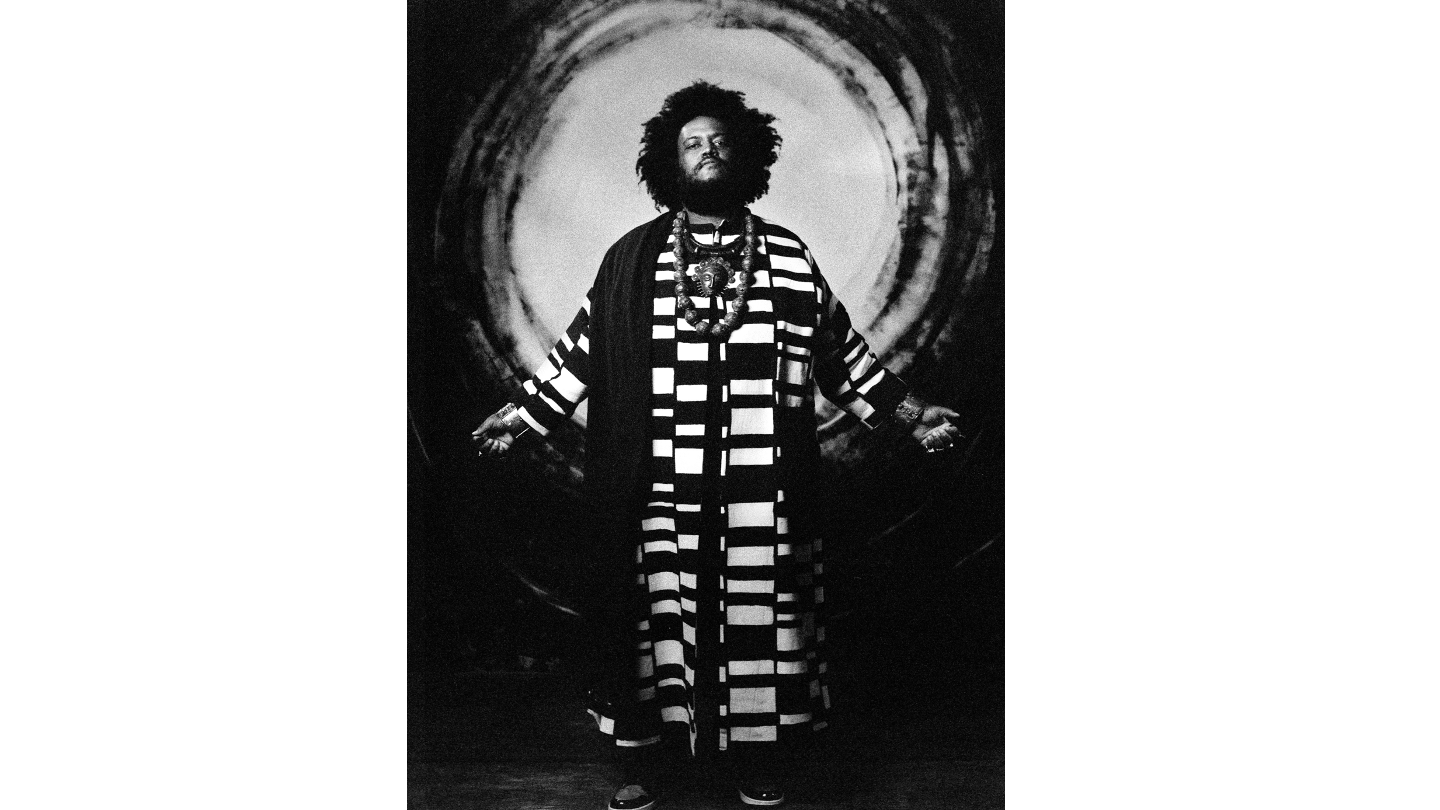
Kamasi Washington stands in bold black-and-white striped robes against a circular backdrop.
Kamasi Washington performs at the 49th Annual Atlanta Jazz Festival, Saturday, May 23. (Courtesy of Kamasi Washington)

Grammy-nominated saxophonist and composer Kamasi Washington headlines Saturday night of the 49th Annual Atlanta Jazz Festival. Ahead of his set, WABE Arts & Culture Editor Sherri Daye Scott spoke with Washington about what’s feeding him creatively, from his late-night reading habits to the record collection curated by his five-year-old daughter. 

Washington is one of the most distinctive forces in modern jazz. His catalog moves fluidly between jazz, hip-hop, soul and the cosmic. His 2015 debut, “The Epic,” a three-hour, triple-LP, won the inaugural American Music Prize. He arranged the horns on Kendrick Lamar’s “To Pimp a Butterfly”; scored the Netflix documentary “Becoming,” earning Emmy and Grammy nominations; and co-founded the supergroup Dinner Party with Robert Glasper, Terrace Martin and 9th Wonder.

He has a particular history with Atlanta. It was the first city he ever flew to for a gig, playing with poet and musician Kamau Daoud, a friend of his father’s. He estimates he has played Atlanta roughly 15 times since. When he’s in town, he said, he gravitates toward the city’s musicians, tapping friends like drummer and producer Lil John Roberts to find where the music is happening.


Comics and Khalil Gibran 

When Washington is not writing or performing music, he is reading — broadly. He returns often to the Lebanese-American poet and philosopher Khalil Gibran. But lately, his most consistent companion has been “Teenage Mutant Ninja Turtles;  The Last Ronin II Re-Evolution HC,” a graphic novel.  

Washington said the draw of comics and graphic novels is the same thing that draws him to music: the construction of worlds. 

“I’m pretty busy with limited imagination, and so that whole idea of creating worlds that are separate from the world we live in …” Washington explained. “It’s fun to me to go into these imaginary places and just kind of almost like survey the land.” 

Grounded at 3 a.m.

Ask Washington how he gets grounded, and the answer is quiet, solitary and nocturnal. He described standing at the wall in the middle of the night while everyone sleeps. Not meditating. Not practicing. Just thinking. He considers himself a “recreational thinker.” 

“It’s fun to me to just take an idea, a problem, or a question that obviously has no true or set answer and just think about it and just kind of explore possibilities of it,” he said.  

Life with a five-year-old daughter also provides inspiration and grounding. She, for example, is a sometimes curator of the household record collection. Her most recent contribution? An original Broadway cast recording of “Wicked” she spotted at a local vinyl shop.   

“I was probably a little bit outside of maybe what I would have gotten,” Washington said. “It was good. I liked it.” 

Who’s inspiring him now

Washington is quick to name the contemporary players he is watching. He cited saxophonists Emanuel Wilkins, Eben Dorsey and Jamel Dean, along with drummer Michael Sessions, who recently took on a leadership role with the Pan-African People’s Arkestra in Los Angeles. He also named Devon Daniels. 

“A lot of them, these young musicians, are just amazing,” Washington said. “There’s a ton of them that just are great.”

Kamasi Washington performs Saturday, May 23 at 9 p.m. at the Atlanta Jazz Festival.