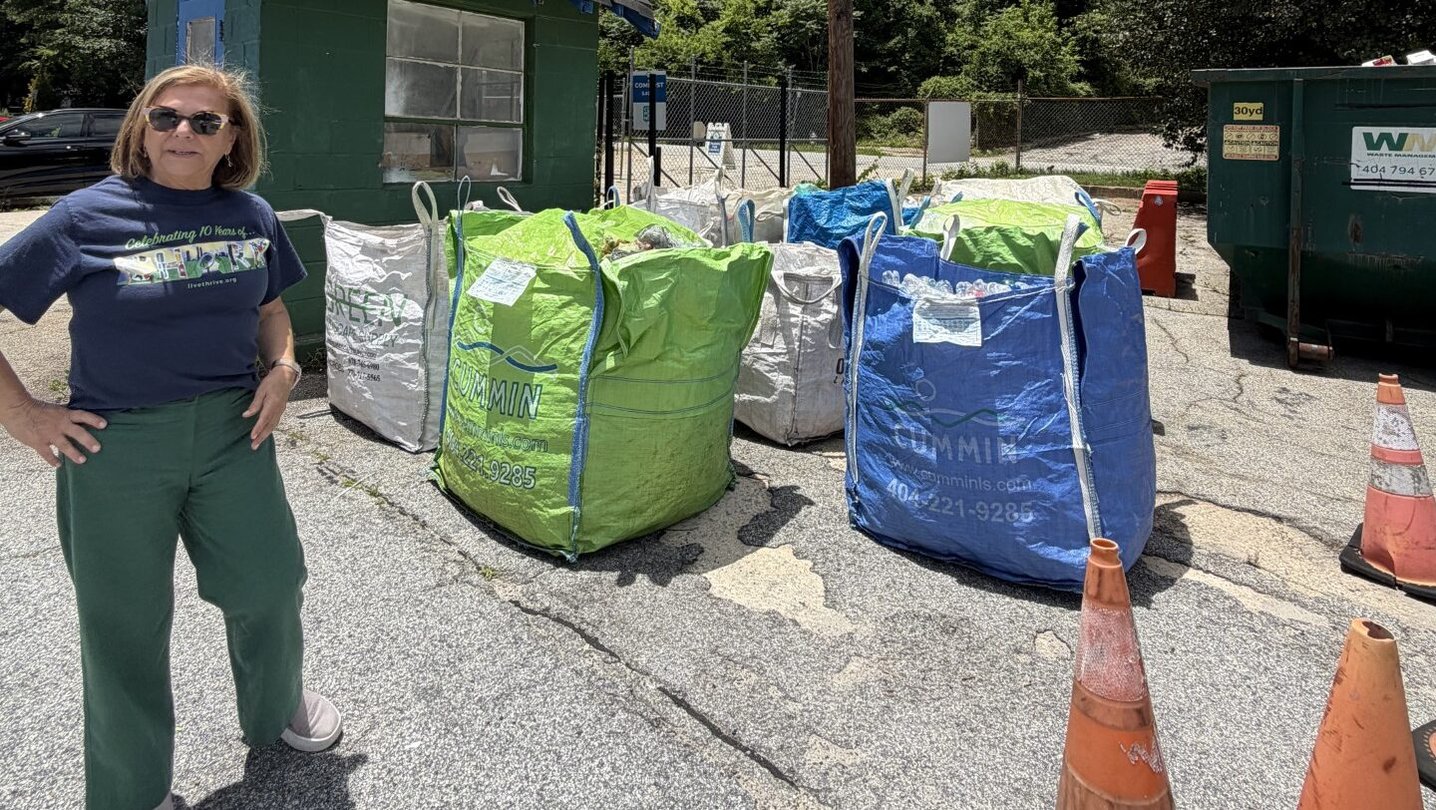
In a small lot off a new section of the Beltline, Peggy Whitlow Ratcliffe’s office is in a double-wide trailer sandwiched between heavy machinery. Her organization Live Thrive’s Center for Hard to Recycle Materials has been here for 11 years.
“It exceeded all expectations of how long we could be somewhere,” Whitlow Ratcliffe said.
She said she started this effort after her parents passed away, and while cleaning their home she realized just how many household items can’t go in the trash. From those long-fluorescent tube lightbulbs to paint and insecticide, she realized a lot of people run into this problem.
With the help of Atlanta City Councilmember Alex Wan, Whitlow Ratcliffe said her organization found its location through a partnership with the city of Atlanta.
“It was an abandoned Department of Public Works property, so they kind of gave it to us,” she said.
And since then, they’ve only scaled up. Open three days a week — about 140 days a year — Whitlow Ratcliffe said this facility has collected an average of between 5.5 million to 7 million pounds of material each year.
In 2025, 84,000 people visited CHaRM Atlanta, and another 60,000 already have this year. On top of folks dropping off recyclables, CHaRM also has thousands of visitors, like students each year coming to learn more about recycling.
Two years ago, Live Thrive opened a second CHaRM facility in DeKalb County.
She said it’s possible because of Georgia’s strong network of recycling facilities.
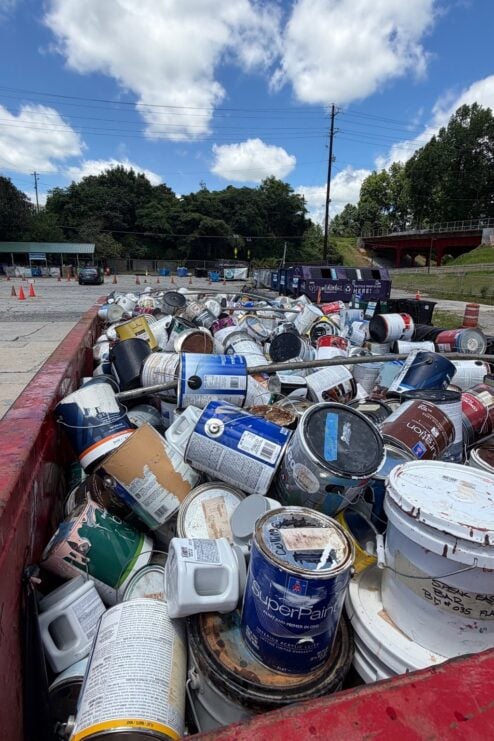
Used paint ready for recycling at the Atlanta Center for Hard to Recycle Materials. Whitlow Ratcliffe said Live Thrive runs a program connecting local artists with leftover paint. (Marisa Mecke/WABE)
The local circular economy
“Georgia is number two in the nation for remanufacturing recycled materials. Who knew?,” Whitlow Ratcliffe said. “The first time I read that, I went, ‘There’s no way, because we don’t even do curbside really well!’”
She said Live Thrive partners with these local and regional companies to manage all the materials CHaRM receives, allowing her to make sure they’re partnering with groups responsibly handling materials and ensuring they’re properly recycled and headed to reuse, not landfills.
“We have so many —but in the rural areas, there’s so many manufacturers — that cardboard, glass, the carpet industry receives more than 33% of all plastic bottles or water bottles in the country come here to support the carpet industry,” Whitlow Ratcliffe said.
From Coca-Cola using plastic water bottles to Novelis recycling aluminum cans, she said there are not only nearby users for CHaRM’s materials, but a whole workforce around it.
And because that circular economy is so local, it works fast.
“Strategic Materials is in College Park — it’s right around the corner — if you bring glass here within 60 days, it’s back on the shelf,” Whitlow Ratcliffe said.
She said the same goes for aluminum.
But with CHaRM’s growth, local development, and changes with the city properties — she said it’s time for CHaRM Atlanta to move.
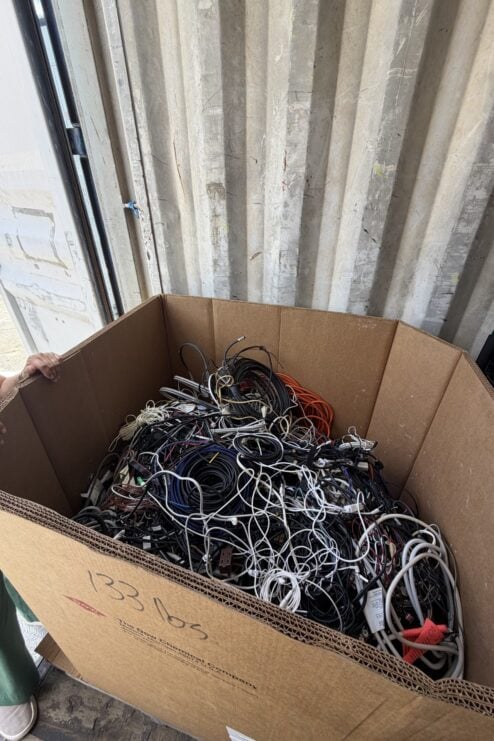
A box of used and damged wires at the Atlanta Center for Hard to Recycle Materials. (Marisa Mecke/WABE)
Where is CHaRM Atlanta moving to?
Live Thrive’s lease is up at the end of the year, and then Whitlow Ratcliffe said they’ll be moving to the Westside.
She said they’ll be partnering with the City of Atlanta’s Housing Authority. The new CHaRM location will be on the Bowen Homes site, former public housing that the city is planning to redevelop. Whitlow Ratcliffe said the CHaRM will be on a piece of land that can’t be developed into housing, and will be right down the street from a scrap yard they can partner with.
She said Live Thrive will open a drop off center first as it moves over all the equipment from its current location so there won’t be any disruption in service.
“We do plan on building an education center, which is the most exciting part for me,” Whitlow Ratcliffe said. “Instead of a double-wide trailer, we will have an actual — every girl’s dream is a double-wide trailer — but an actual brick and mortar that can be used for community.”
She hopes that the building will be open by 2028. It’ll serve as a place for students and visitors to learn about sustainability, host partners and have a permanent office location for Live Thrive.
She said this is a big transition for a lot of neighbors who have been coming to Atlanta’s location for years, so Live Thrive is considering doing pop-up events or other ways to remain connected with people in the Grant Park and Chosewood Park neighborhoods.