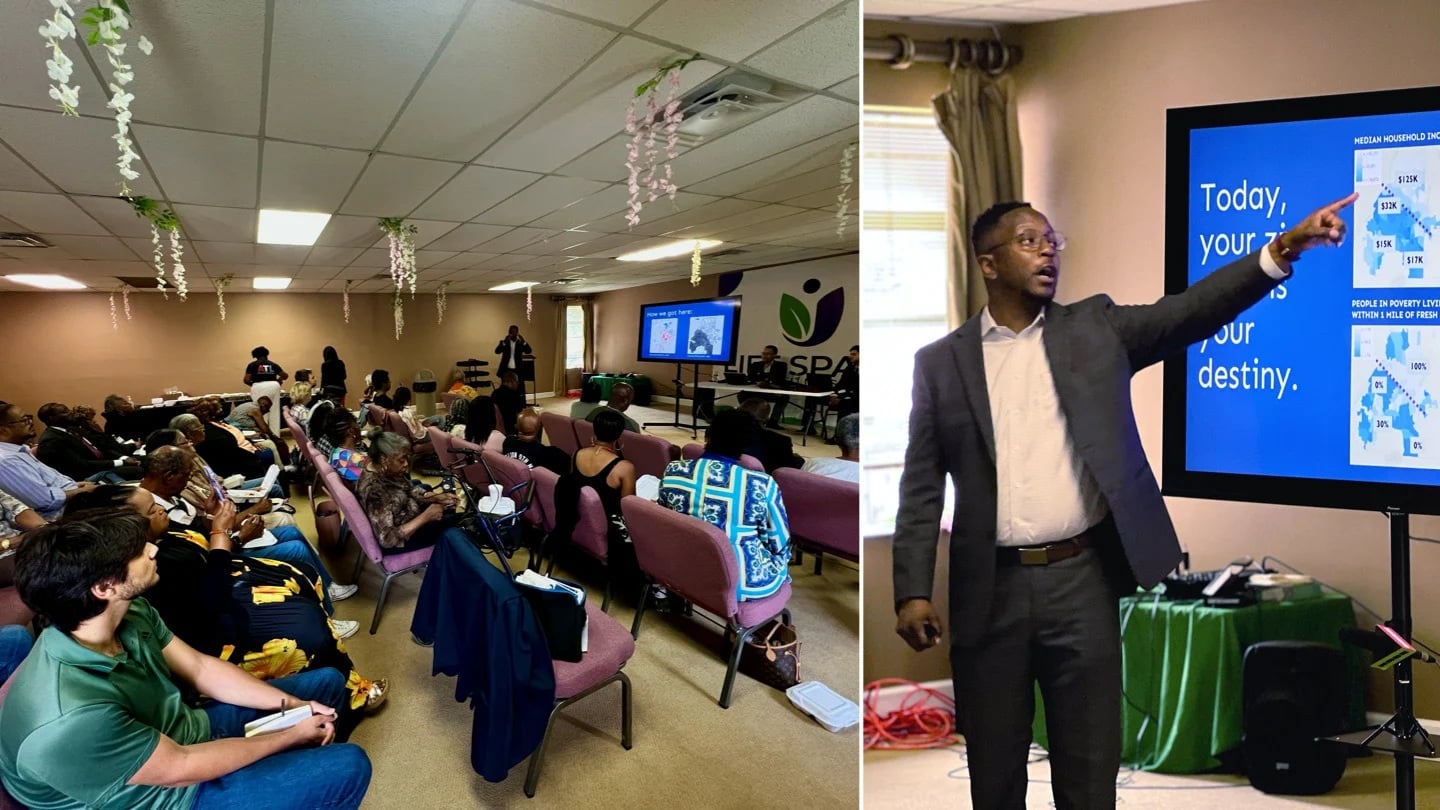
City of Atlanta chief of staff Courtney English (right) presents at a community meeting for input on the city's Neighborhood Reinvestment Initiative. (DorMiya Vance/WABE)
More conversations have come up about the possible extension of Atlanta’s tax allocation districts, known as TADs, and its new Neighborhood Reinvestment Initiative (NRI).
These matters have been gaining momentum as the city council continues to review legislation concerning the measures over the coming weeks.
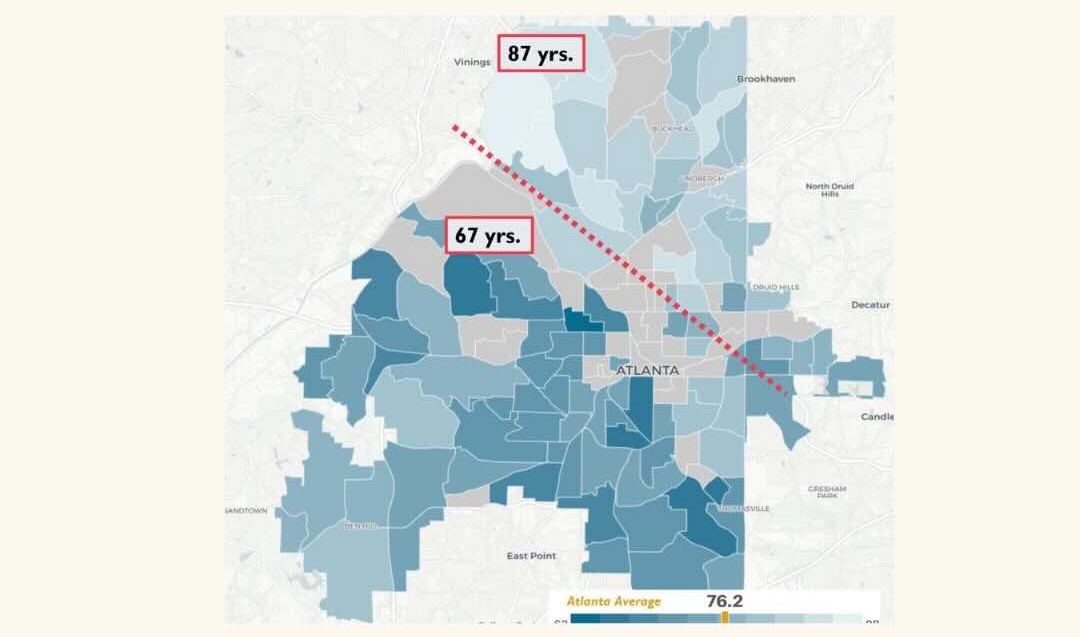
“There’s a tale of two cities that is playing out in the city of Atlanta,” said City of Atlanta chief of staff Courtney English during a NRI community meeting in late May.
“Where we are … where you are born in Atlanta can literally dictate how long you live. Your zip code can literally determine your destiny.”
Introduction of TAD + NRI legislation
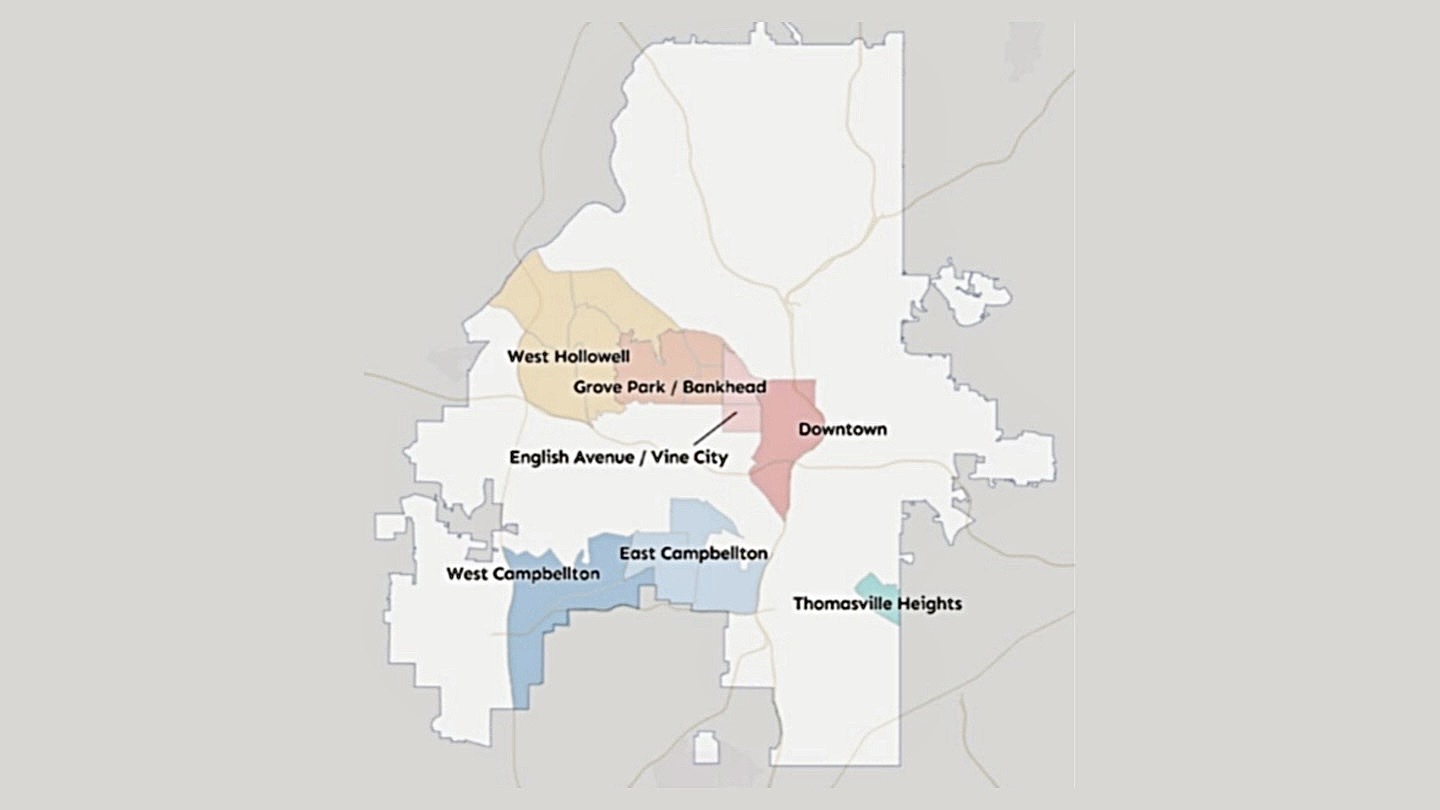
The map shows target areas for the Neighborhood Reinvestment Initiative. (Courtesy of City of Atlanta)
Around last October, Mayor Andre Dickens unveiled the NRI to improve underserved westside and southside communities, including some that are historically Black. Then, the program had a price tag of $5.1 billion.
“Social and economic inequalities have occurred in these communities and have resulted in higher poverty rates, sometimes poor health outcomes,” said Dickens during the 2025 NRI launch event.
“Additionally, a lack of concentrated investments in these areas has led to considerably less access to quality jobs, fresh food, and even manageable commutes has been hard to find.”
Legislation to extend the sunset dates of the city’s eight TADs to 2055 was brought forth shortly after the unveiling. However, the ordinance was held by two council committees until December.
TADs freeze property tax values, and any taxes from value increases would go back into developing an area rather than services like schools. Currently, the sunset dates of the TADs range from 2038 to 2050.
Critics have said TADs can play a role in racial and socioeconomic inequities in the city in how they operate. And the proposal to extend them faced pushback from residents and others for about two months.
By December 2025, the TAD extension proposal was “automatically terminated.”
“Council will not be moving forward with any TAD legislation … that is the desire of this council to continue working with our mayor and his team to work on this legislation,” said Councilman Jason Winston during a late 2025 committee meeting.
The Neighborhood Reinvestment Initiative makes progress
Just before the new year, city officials established an NRI Commission (NRIC) composed of 13 representatives from various entities, like Invest Atlanta and City Hall.
The group was tasked with providing “advice and recommendations concerning the design and implementation of Mayor Andre Dickens’ $10 billion Neighborhood Reinvestment Initiative, including expansion of the eight active Tax Allocation Districts (TADs).”
Fulton County Commissioner Dana Barrett is a member of the NRIC. In March, she expressed some skepticism over the coming recommendations.
“I’m just sort of struggling with how to land here in terms of being, you know, positive about the overall direction of reinvesting in our neighborhoods and finding the right ways to do it, but maybe objecting to some of the nuances in these recommendations,” Barret said.
The NRIC met over several months and had a few public input sessions to produce a 511-page report for the program’s implementation by the end of April, featuring 13 recommendations. As that was happening, city officials also held a handful of community meetings to gather resident input.
Some of the commission’s proposals included collaborative community-involved projects, independent nonprofit oversight, and updated displacement strategies.
However, the NRIC also suggested using money from the possible extension of TADs to fund the program. The commission presented the recommendations to city councilmembers, including Bryon Amos, during a late-April work session.
“All of the questions we’re asking now, in my opinion, have been answered. We have a case study called the Westside TAD that we can look at,” Amos said. “Development, not TADs, development does bring about some form of gentrification. But gentrifying is not all about economics. It’s about people who have decided not to participate in the growth of certain communities.”
So, in early May, the Atlanta City Council officially heard and adopted the NRIC’s recommendations. Only one councilmember, Kelsea Bond, voted no on the dais.
“I recognize that accepting recommendations from a commission doesn’t necessarily translate into an endorsement of policy, but … there are some statements made as a part of these recommendations that imply that an extension of the TADS is necessary to achieve the NRI’s goals,” Bond said.
Public input and what’s to come
The map shows life expectancy rates between the northern and southwestern sides of Atlanta. The map is part of a presentation for the Neighborhood Reinvestment Initiative. (Courtesy of City of Atlanta)
Dickens has since repackaged that NRI legislation, which features “a new framework for measuring the success of public investment not by what gets built, but by whether residents’ lives measurably improve as a result.”
It has a handful of integrated components, including six TAD extensions and a city council-controlled trust fund.
Still, more Atlanta residents have expressed varying stances on the NRI and TADs. The city has held additional community meetings to hear from residents in neighborhoods affected by disinvestment.
20-year-old Nasir Brown attended one of the community meetings with his grandma.
“I went to Kennessaw State, so there I was doing research on, specifically, the Beltline … once you get to the West End portion of the Beltline, it’s more underdeveloped,” Brown said. “But once you go to another place, you see more businesses, you see more interaction with the community up there, and it’s just like you see the drastic differences.”
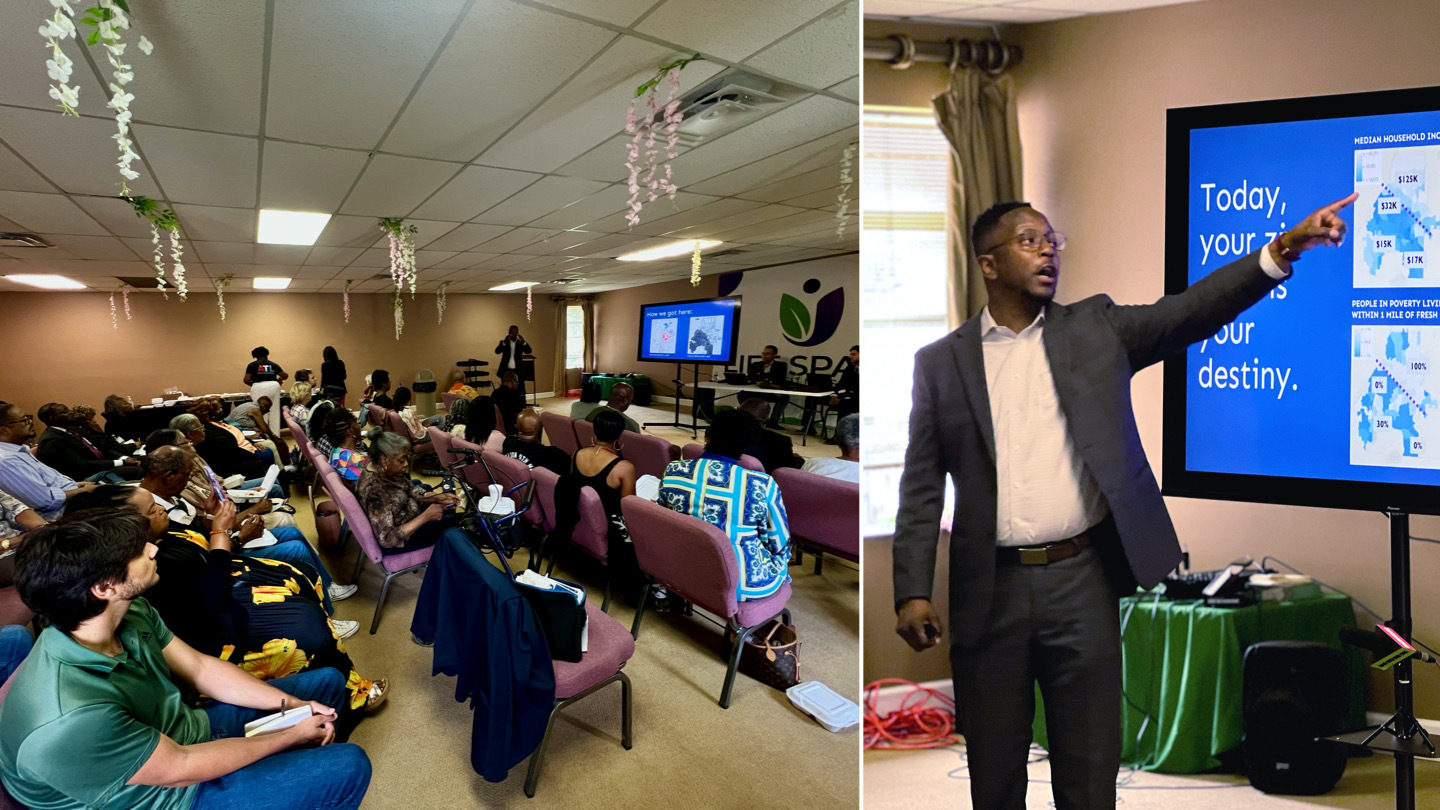
City of Atlanta chief of staff Courtney English (right) presents at a community meeting for input on the city’s Neighborhood Reinvestment Initiative. (DorMiya Vance/WABE)
Brown says he supports the NRI but wants city officials to be transparent and “straightforward” about the process.
Resident 56-year-old David Mitchell believes the legislation is the best he’s seen to help the underserved communities.
“People who have been here that have been overlooked and forgotten are now going to have an opportunity with this tool called TADs to get not millions, but billions of dollars invested in their communities,” Mitchell says.
His only critique would be the city moving fast to decide to solve the issues facing the impacted communities, including the Westside.
Others, like Mathewos Samson and Rodney Mullins, oppose the move. Both are Atlanta residents, with Samson running for a seat in the Georgia General Assembly.
“I’m very skeptical of their effectiveness … I felt pretty confident that it’s just a matter of fact that TADs take away money from our school system, and our school system has already been kind of struggling to make their budget work,” Samson said after a panel hosted by the Center for Civic Innovation on how TADs impact Atlanta schools.
“In its current condition, the NRI and the TADs are dysfunctional, which is why you have poor communities on the westside, and wealthy communities on the northside, and both of them have TADS,” Mullins said in a recent city council meeting.
Groups and nonprofits, such as the Center for Civic Innovation and the Atlanta Planning Advisory Board, have also taken positions amid the TAD and NRI conversations through an open letter and a position paper.
Still, Dickens has “made a case” for the looming legislation, calling it a “first step” toward addressing issues such as affordable housing and food access.
Meanwhile, the Atlanta Board of Education is proposing a Tax Allocation District Investment Review Committee to look into investment and redevelopment that impacts Atlanta Public Schools. APS currently participates in all eight of the city’s TADs.
Legislation on tax allocation districts extensions and the Neighborhood Reinvestment Initiative will be heard again in a committee meeting on June 9.