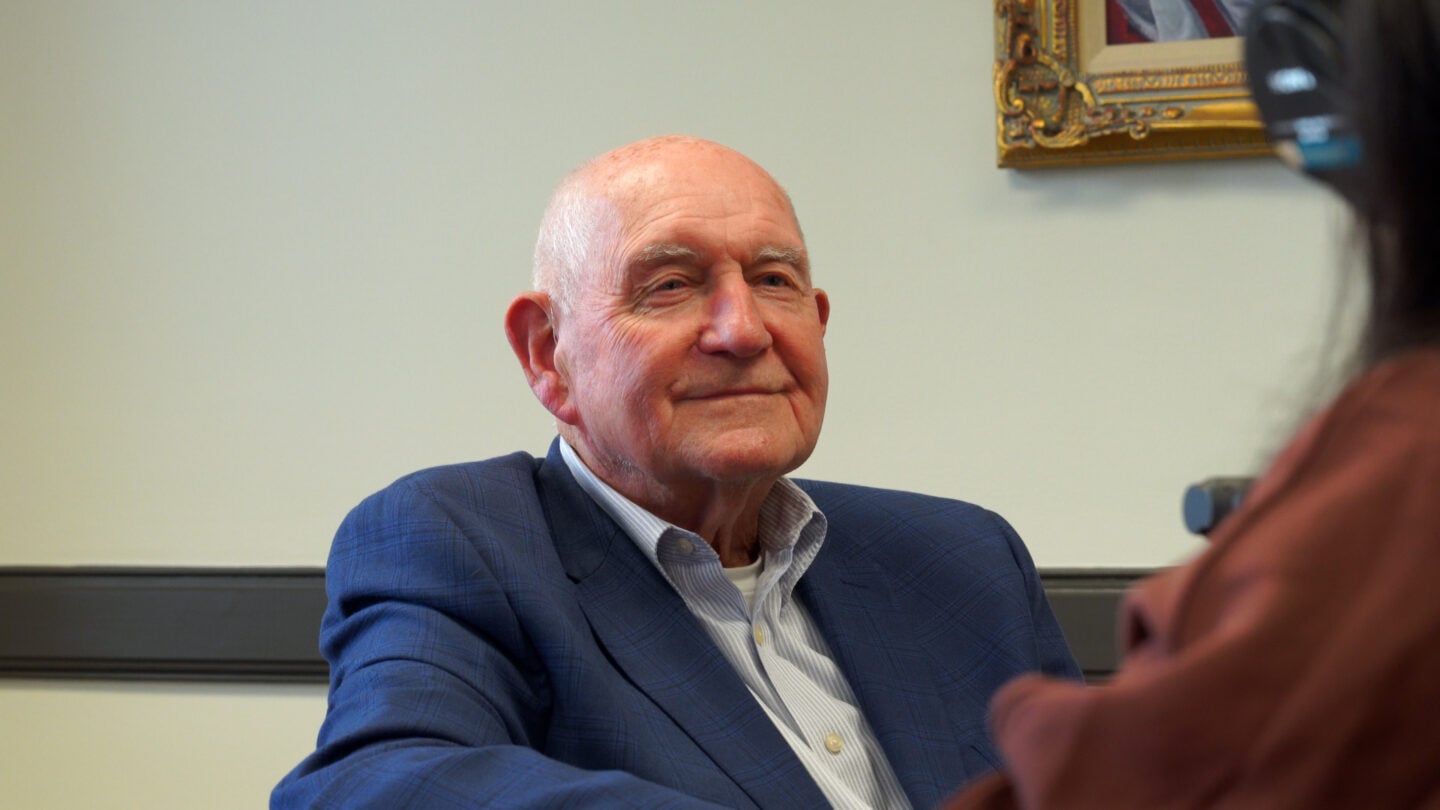
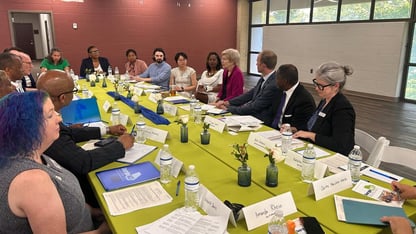
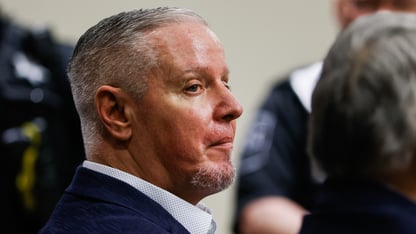
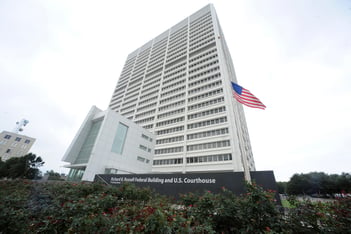
Chancellor Sonny Perdue at the University System of Georgia office in downtown Atlanta on June 10, 2026.
(Matthew Pearson/WABE)
University System of Georgia Chancellor Sonny Perdue said he’s not planning to pursue further public office after his retirement from the role at the end of the year, ending a long career spanning around four decades in various public offices, including two terms as Georgia governor and the U.S. Secretary of Agriculture in President Donald Trump’s first term.
He announced his retirement in April and recently told WABE he has asked the USG Board of Regents to keep him on until the end of 2026. After that, he plans to spend time with family.
“People ask me about retiring. I’m not sure I use that word actually because I’m blessed with great health. My wife and I are, and it’s her turn. I’m reporting to a new boss on January 1. Her name’s Mary Perdue,” Sonny Perdue said.
If approached with another opportunity in the future, he said he would “think about it.”
“My wife would probably say, ‘Yes, you will,’ but no, the fact is I don’t have any immediate plans,” he said.
He also said he’s not directly involved with the nationwide search for a new chancellor.
“That is the job of the Board of Regents. I am available to them for any advice and counsel that they may want to ask me about regarding the qualifications, the qualities, the characteristics of leadership that I believe this job needs,” he said.
Perdue said he realized the value of education as a young boy, since his mother was an English teacher.
“My mother was an English teacher for 42 years, and I tell people I still get PTSD over dangling participles, but nonetheless, she embedded in me the need for education,” he said. “It was not if, but where and what — where will you study and what will you study in that regard.”
He received a Doctor of Veterinary Medicine from the University of Georgia and later served as a Georgia state senator in the 1990s and early 2000s, where he chaired the Senate Higher Education Committee.
“We, up until that point, had suffered sort of a brain drain in Georgia. Our best and brightest students were going to the Dukes and the Stanfords and the Michigans and all over the country for higher education. I believed that we could do better here and as it turned out, we have done better here in that regard.” he said.
He said he’s sought to ensure that students don’t see Georgia’s public universities as a backup option.
“For many years, we just said, ‘Here it is, if you want it, come and get it.’ That’s not true anymore,” he said. “Our students have become customers, they have a lot of choices, and there are a lot of opportunities for them to attend universities and get a higher education. So we worked really hard.”
He also tipped his hat to the cooperation from the Georgia legislature and Gov. Brian Kemp.
“You don’t create an ecosystem by yourself, you do it with relationships. Again, the governor and the General Assembly have been very gracious and very generous to the university system. I think they understand that the university system investment returns a return on investment that is multiple times what the expenditures are,” he said.
House Speaker Jon Burns looks on as University System of Georgia Chancellor Sonny Perdue presents the annual legislative kickball game trophy to Lt. Gov. Burt Jones. (Matthew Pearson/WABE)
Perdue became the system’s 14th chancellor in 2022, leading Georgia’s 25 public universities and colleges. The executive firm tasked with selecting the next chancellor at the time withdrew from the search as critics questioned whether regents were facing political pressure to name Perdue as the chancellor.
“There was some consternation when my name was suggested there and went through a year of really discussion about whether I was the right person for the job or not,” he said.
However, he added, he’s been proud to connect and build trust with faculty and students since then.
“I think the one thing I’d be most proud of is the relationship that I’ve been able to enjoy with the faculty and the students,” he said.
He said the job has been “fulfilling” and “possibly the most impactful job I’ve ever had.”
“People asked me when I got the job, ‘Well, are you having fun?’” he said. “Well, it’s not really a fun job, but it is a very impactful, rewarding, fulfilling job because I get to see the creation and the sustaining of an ecosystem of 25, 26 campuses that literally have the opportunity to create an environment where people’s lives are changed one by one forever because, you know, you’ve heard it said, ‘They can’t take that education or diploma away from you.’”
“For many years, we just said, ‘Here it is, if you want it, come and get it.’ That’s not true anymore, Our students have become customers, they have a lot of choices, and there are a lot of opportunities for them to attend universities and get a higher education. So we worked really hard.”
Sonny Perdue, Georgia chancellor
Under Perdue’s tenure, the USG raised tuition rates for two academic years.
For the 2024-25 academic year, the Board of Regents approved increases of 2.5% for in-state undergraduate students tuition, 5% for out-of-state students and a 2% increase from the out-of-state rate for international students. And for the 2026-27 year, the Board of Regents approved increases of 1% for in-state students and 3% for out-of-state and international students.
The Board of Regents largely did not increase tuition for the 2022-23, 2023-24 and 2025-26 academic years for in-state students.
Shortly after Perdue became chancellor, the board also eliminated the Special Institutional Fee, which USG implemented in 2009 to offset budget cuts during the Great Recession.
Last year, Perdue approved the consolidation of Georgia Southern University and East Georgia State College, which took place Jan. 1 of this year, and the board has terminated hundreds of majors across the system due to what it says was underenrollment or inactivity in those programs.
According to the Western Interstate Commission for Higher Education (WICHE), the number of high school graduates will decline by 13% from 2025 to 2041. Nevertheless, WICHE projects that the South will see an increase in high school graduates of 3% between 2023 and 2041.
Perdue defended the landscape of higher education in Georgia against national concerns like the replacement of college graduates with artificial intelligence in the workforce and underenrollment.
“I realize there’s a national narrative about the value of a college education. I think that’s faddish. I think again that too shall pass in that regard,” he said. “We know that already even the data, recent data shows that it’s a strong financial reason to have a four-year degree.”
According to a study done by UGA’s Selig Center for Economic Growth, the university system contributed $23.1 billion to the Georgia economy in fiscal year 2024, and USG graduates earn on average $1.4 million more than those without a college degree.
Perdue touted recent enrollment increases under his tenure.
“Here in Georgia, we had a record enrollment last year of over 382,000, a record number of diplomas granted,” he said. “So I think we’re doing something right, and I think it matters to the state. I view higher education as part of a virtuous flywheel cycle of economic development. We provide the talent that our growing economy needs to do, to accomplish the things, the inventions, the innovations, the creations of all the things that are gonna make life better for humankind.”
Moreover, he said a college degree can provide important intangible skills to students.
“The kind of things you learn in a college education — to think critically, to make good decisions, to learn to work as a team, to communicate verbally and written — will always be in style in that regard,” he said.