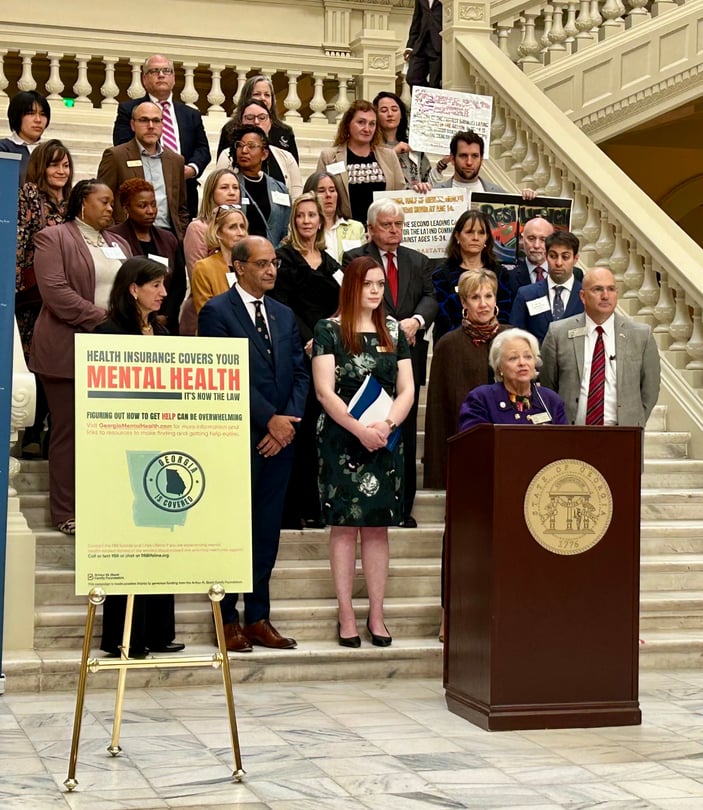
Georgians can now see how their health insurance plans compare when it comes to mental health coverage and compliance with the state’s 2022 Mental Health Parity Act.
Georgia’s landmark parity law, also known as HB 1013, requires insurers to cover mental health and substance-use on par with coverage for physical and surgical needs. And, it brought Georgia into step with federal parity requirements under the Mental Health Parity and Addiction Equity Act of 2008.
But Georgia insurers’ compliance has so far been slow, state insurance officials and patient advocates say.
Now, the nonprofit advocacy group Georgians for a Healthy Future has launched a new dashboard showing the progress — or lack thereof — of more than two dozen plans operating across the state.
The dashboard ranks 17 private individual and small-group health plans, and nine state Department of Community Health-overseen Medicaid, PeachCare for Kids, and related programs. It doesn’t list most large, employer-provided plans.
The rankings are based on an analysis of insurer performance across about half a dozen key metrics.
They include coverage for generally accepted standards of care, how plans determine ‘medical necessity’ for mental health care and addiction treatment, and whether and how plans limit patient access to care.
According to the dashboard, state-run plans are doing better than commercial, private ones, which earn nearly all ‘F’s.
“Mental health, behavioral health is a huge struggle,” and too many Georgians statewide are unable to access the services they need, said attorney Roland Behm.
Behm cofounded the Georgia Mental Health Policy Partnership and formerly chaired the Georgia Chapter of the American Foundation for Suicide Prevention board.
Still, he remains optimistic that progress will continue.
“Georgia’s law is the model. It is the best state parity act that’s out there. We’re not getting the enforcement we need. But once we get that enforcement, we will show you how to solve all of these things,” he said.
The state has taken steps to increase enforcement.
Earlier this year, after an examination of parity data, Insurance and Safety Fire Commissioner John King imposed nearly $25 million in fines on 22 insurers, ordering them to provide the state with corrective action plans to improve their compliance.
“I want insurers to know that I am serious about the health and wellbeing of all Georgia consumers. I will not hesitate to take action against any company that continues to violate the law – no exceptions,” King said.
He also promised additional enforcement actions for insurers that fail to comply.
In announcing the new dashboard, Georgians for a Healthy Future pushed for the state to go further.
“Plans that repeatedly submit inadequate filings or fail to address identified parity gaps should face meaningful follow-up, whether through corrective action plans, technical assistance requirements, or other enforcement tools available to DOI under HB 1013,” the group said in a statement.