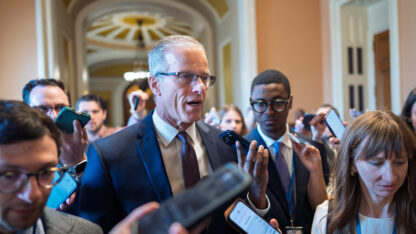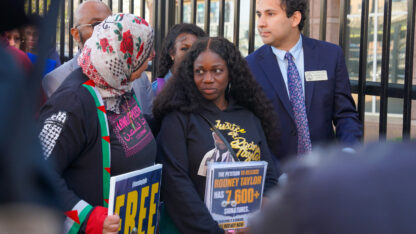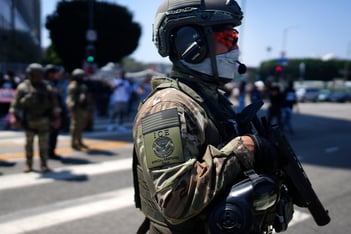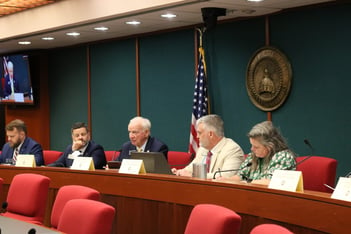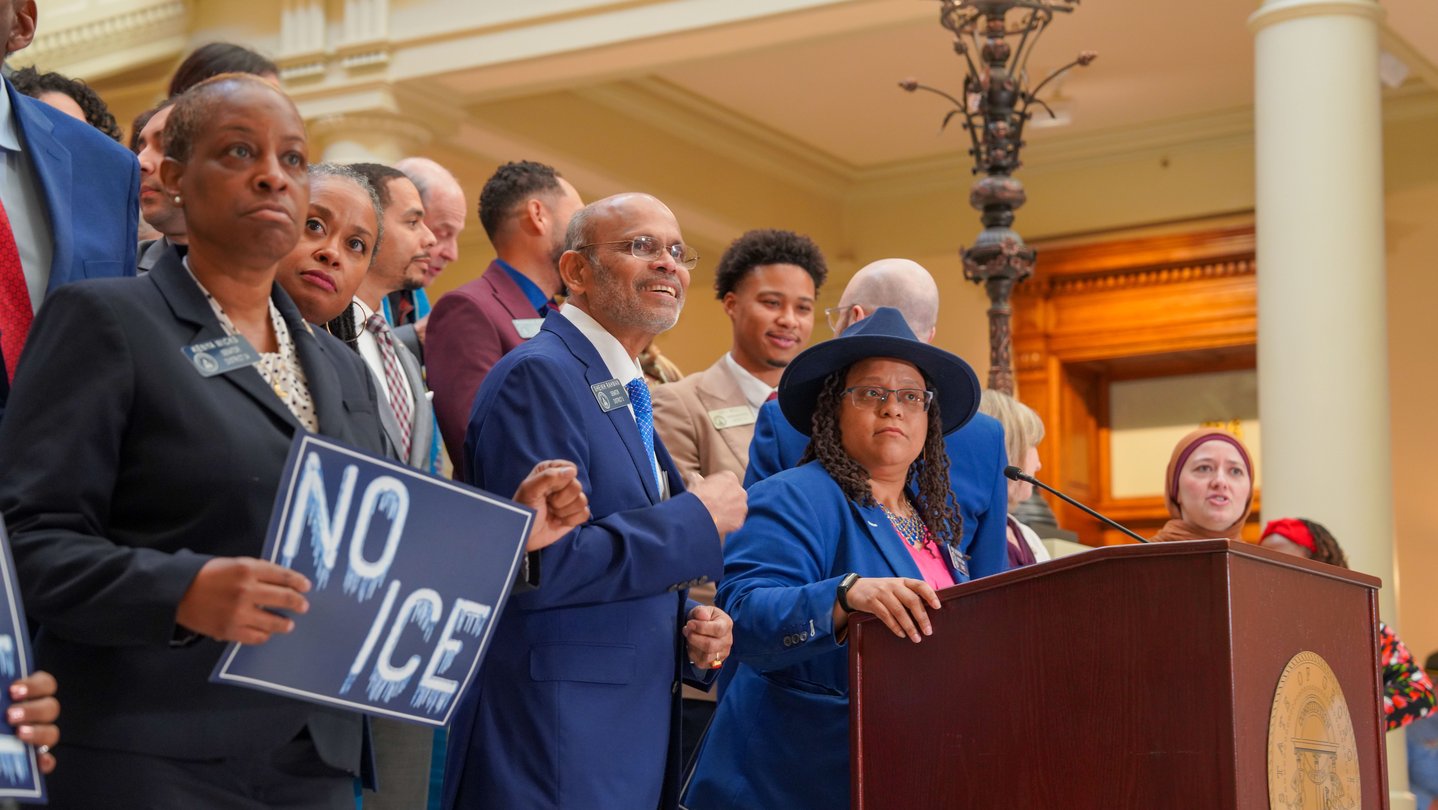
Democratic state lawmakers at the Georgia State Capitol hold a press conference on Tuesday, January 13, 2026, announcing legislation in both chambers to address concerns about Immigration and Customs Enforcement's tactics seen in Georgia and across the country. Democratic state Sen. Kim Jackson stands at the podium. (Matthew Pearson/WABE)
Democratic Georgia lawmakers announced four bills Tuesday introducing rules for how Immigration and Customs Enforcement officers and other federal agents could operate in Georgia.
The bills propose clear identification of ICE agents, legal protocol around immigration agents in places like schools and places of worship, the ability to bring a personal lawsuit against federal agents if they violate civilian rights during immigration enforcement, and permission from elected officials before the National Guard can be deployed within Georgia.
The lawmakers said at a press conference Tuesday they want to address a growing environment of fear within the state’s immigrant community and prevent further violence between immigration officers and civilians.
“I believe that we can create a state where we can see our law enforcement officers like we can today and know who they are and know whether or not we can trust them or find them if something goes wrong,” said Democratic state Sen. Kim Jackson. Her district in DeKalb County includes Clarkston, parts of Stone Mountain, and Pine Lake, where a large portion of the state’s immigrant and refugee communities live.
Jackson is introducing Senate Bill 389, which would ban ICE agents from wearing masks and require federal agents working on immigration enforcement to wear an identification badge.
The City of Denver recently banned ICE agents from wearing masks, and the Department of Homeland Security this week said it would not comply with the city’s ban. Tricia McLaughlin, DHS spokesperson, told Axios masks protect ICE agents’ identities to prevent them from being doxxed.
But Jackson said if Georgia police and lawmakers can do jobs that put them in danger and not wear masks, so can ICE agents.
Duluth Democrat state Sen. Nabilah Parkes is introducing SB 391, which would require federal agents to have a judicial warrant to enter schools, places of worship, hospitals, libraries and domestic violence shelters.
“Immigration enforcement should not occur in certain sensitive places,” she said.
Georgia state Sen. Nabilah Parkes, D-Duluth, speaks during a press conference at the Georgia State Capitol on Tuesday, January 13, 2026. (Matthew Pearson/WABE)
Judicial warrants are signed by a federal judge and come into play when there is suspicion a crime has been committed. A deportation order or notice to appear in immigration court would not fall into this category, according to the ACLU.
During last year’s legislative session, Senate Republicans introduced SB 21 to take away legal protections from local governments and their employees who violate immigration laws, preventing schools or governing bodies from adopting “sanctuary” policies. The bill passed the Senate but did not make it to a House vote.
Georgia Senate Minority Leader Harold Jones II introduced SB 390 to prohibit the armed state forces like the National Guard to come into Georgia without permission of its elected leaders.
Senate Minority Leader Harold Jones II speaks at a press conference on Tuesday, Jan. 13, 2026, at the Georgia State Capitol. (Matthew Pearson/WABE)
The fourth bill in the slate would allow people to bring personal lawsuits against federal officers who violate their rights during immigration raids. Democratic state Sen. Josh McLaurin, who represents North Fulton County, is introducing SB 397 to create a civil cause of action against federal officials who violate constitutional rights.
Democratic state Sen. Josh McLaurin takes the podium at a press conference Tuesday, Jan. 13, 2026, where Senate Democrats announced several pieces of legislation to restrict the activities of ICE officers in the state. (Matthew Pearson/WABE)
“Police officers, both local and state, have better training,” he said. “They check themselves before they act because they know that if they violate constitutional rights, they may face personal liability for their overreach. ICE does not currently face that threat in Georgia.”
Correction: An earlier version of this story mislabeled SB 390 as SB 392.