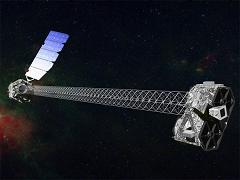
NASA launched its newest X-ray telescope into space this week. The Nuclear Spectroscopic Telescope Array or NuSTAR for short will examine a number of black holes never seen by human eyes before, and a local astrophysicist will be paying close attention, because he helped plan the mission.
Georgia Tech Assistant professor and Astrophysicist David Ballantyne says one of the goals for the high-energy X-ray telescope is to gain a greater understanding into the role black holes play in the formation of galaxies. A black hole is a celestial body with such a strong gravitational field that light cannot escape it. Based on measurements, Ballantyne and many other astrophysicists believe black holes and galaxies co-evolve together.
“One way of trying to understand this is that you have to look for growing black holes. If you can find growing black holes and then study the galaxies these growing black holes that these are situated in, you can hopefully learn about what processes that are going on that allows this co-evolution to go on.”
Read this story now for free
To continue reading, sign up for our newsletter and get unlimited access to WABE.org
You can select your preferences for news and local content. We will never share your email address. Learn how your newsletter sign-up will support WABE and Public Media