Georgians helped deliver the Voting Rights Act. Sixty years later, some are fighting to preserve its legacy

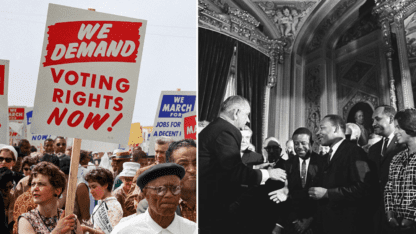
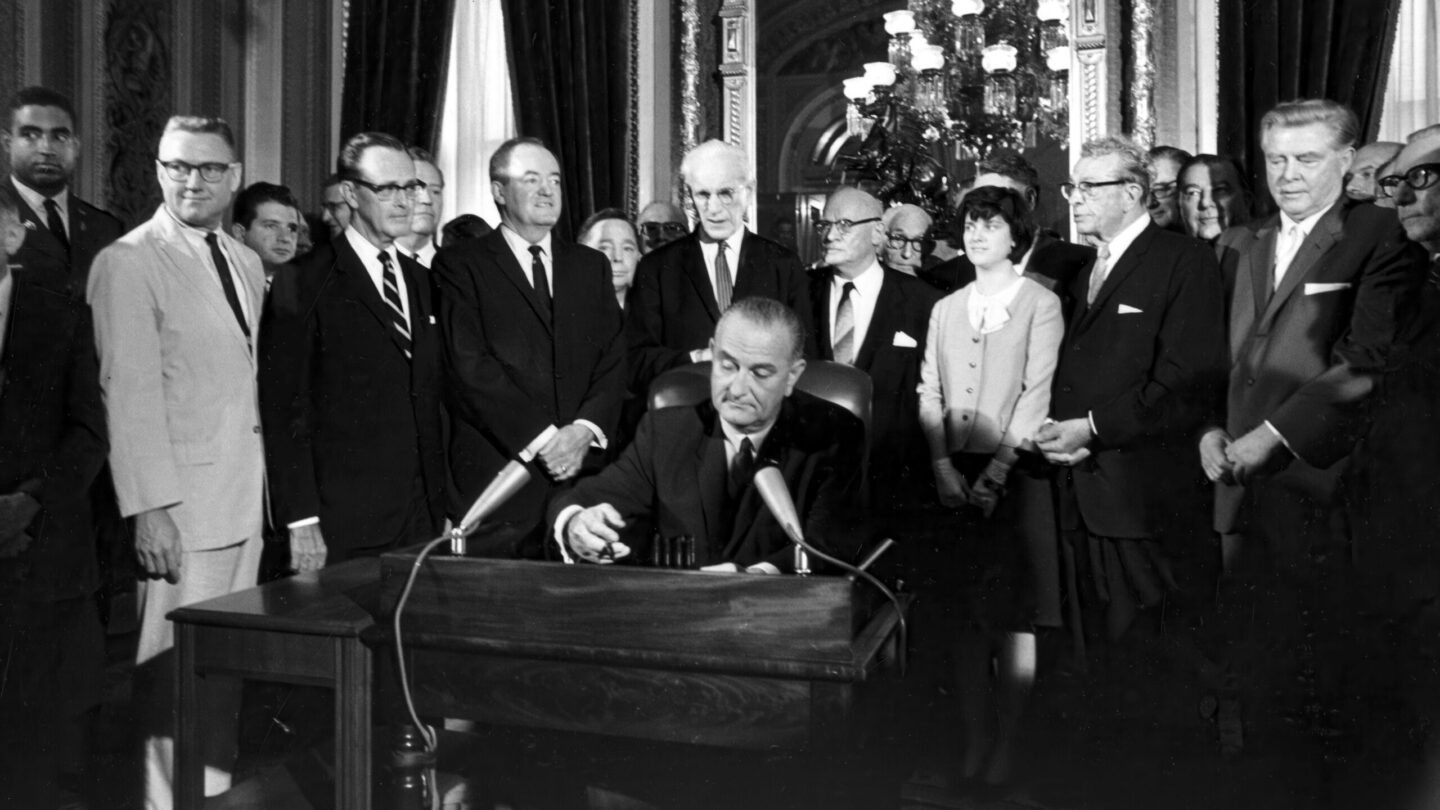
President Lyndon B. Johnson signs the Voting Rights Act of 1965 on Aug. 6, 1965. (AP Photo)

Wednesday marks the 60th anniversary of the federal Voting Rights Act of 1965. 

President Lyndon B. Johnson signed the landmark legislation after a hard-fought campaign led by Georgia civil rights icons like Martin Luther King Jr. and the late U.S. Rep. John Lewis.

Lewis was 25 when he helped lead a campaign to march from Selma to Montgomery for voting rights in the spring of 1965.


But as the marchers first attempted to cross the Edmund Pettus Bridge in Selma, they were violently attacked by state troopers on what became known as Bloody Sunday. 

“We were beaten, teargassed, some of us left bloody right here on this bridge,” Lewis recalled at an event in Selma commemorating the 50th anniversary of the march in 2015. “Our country will never be the same because of what happened on this bridge.”

John Lewis, chair of the Student Nonviolent Coordinating Committee, was beaten by state troopers as marchers attempted to cross the Edmund Pettus Bridge on March 7, 1965. (AP Photo)

The marchers reached Montgomery on March 25. The violence and the persistence of the marchers helped compel Johnson to act.

“It is the effort of American negroes to secure for themselves the full blessings of American life,” Johnson said in a televised address to Congress. “Their cause must be our cause too because it’s not just negroes, but really it’s all of us who must overcome the crippling legacy of bigotry and injustice. And we shall overcome.”

Johnson signed the Voting Rights Act of 1965 that August, banning literacy tests and other barriers to the ballot box. Since then, Black voter participation skyrocketed. More Black candidates were elected to office. The legislation also helped other voters, like Native Americans and Asian Americans.

Why some Georgia Democrats say the Voting Rights Act is being eroded

But Democrats, like U.S. Sen. Raphael Warnock of Georgia, say that legacy is under threat.

“Nothing is more important right now than passing the John Lewis Voting Rights Advancement Act,” Warnock said last week after Democrats reintroduced the bill, which has been stalled since 2021.

That legislation would modernize the law and again require jurisdictions with a history of voting discrimination to pre-clear changes to voting rules with the U.S. Department of Justice. Georgia was among the states subject to pre-clearance under the Voting Rights Act until the U.S. Supreme Court struck down the requirements in 2013 in the decision Shelby v. Holder.

Since then, changes to voting rules have been considered after the fact in the courts. In 2023, a federal judge ruled Georgia’s congressional maps violated the Voting Rights Act by diluting the power of Black voters. The maps had already been in place for one election cycle by the time they were invalidated and redrawn ahead of the 2024 election.

U.S. Sen. Raphael Warnock (D-Ga.) speaks about the John Lewis Voting Rights Advancement Act at a press conference outside the U.S. Capitol on July 29, 2025. (AP Photo)

An updated form of pre-clearance could become relevant as states like Texas pursue mid-decade redistricting to bolster Republicans’ chances of keeping control of the U.S. House of Representatives in next year’s midterm elections.

The bill would also strengthen Section 2 of the Voting Rights Act, which allows individual voters to challenge discriminatory voter laws. Recent court decisions have eroded that provision.

Once bipartisan, Republicans have opposed reauthorizing the Voting Rights Act in recent years, calling for other policy changes like voter ID laws.

Democratic U.S. Rep. Nikema Williams, who now holds the seat once occupied by Lewis, is sponsoring a broader package of 10 voting bills.

“As we mark the 60th anniversary of the Voting Rights Act, we are unfortunately facing the same struggle for voting rights,” Williams wrote in a statement. “The tactics of voter suppression may look different, but the intent remains the same.”

Outside the U.S. Capitol last week, Warnock said he has been thinking lately of a story told by Ambassador Andrew Young about a meeting between King and Johnson. Young was a top aide to King and later the mayor of Atlanta.

“Dr. King said, ‘Mr. President, we need a voting rights law.’ And the president said, ‘You’re right, I just don’t have the power to do it right now.’ And Dr. King looked at the staff and said, ‘Well if the president doesn’t have the power, I guess we’re going to have to go and find the president some power.”

In the present day, with many Republicans in Congress arguing the Voting Rights Act is no longer needed, finding the power to renew it continues to prove elusive.

President Lyndon B. Johnson gives Dr. Martin Luther King a pen used to sign the Voting Rights Act of 1965 on Aug. 6, 1965. (AP Photo)