Georgia’s 14th District race heads into May primary after high-profile special election

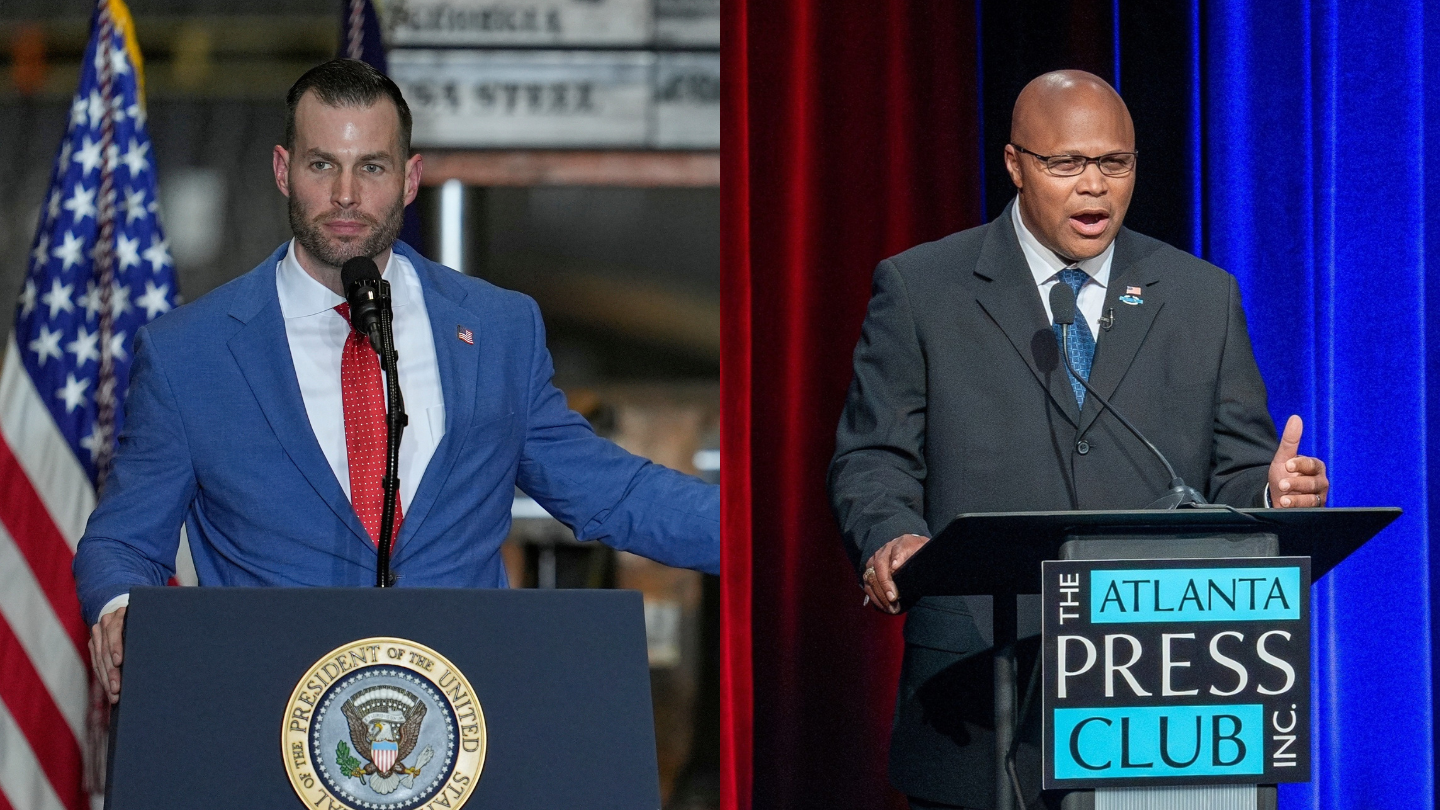
Clay Fuller stands on the left behind a podium and Shawn Harris stands to the right behind a podium.
Clay Fuller (left) at a rally in Rome in February and Shawn Harris (right) at a debate in Atlanta in February.

(George Walker IV and J. Glenn Photography/AP)

The fight for Georgia’s 14th Congressional District is heading into another round of voting just weeks after a closely watched special election to replace former Republican U.S. Rep. Marjorie Taylor Greene.

Republican U.S. Rep. Clay Fuller and Democrat Shawn Harris are now back on their respective party ballots for the regularly scheduled May primary election, after facing each other in the April special election runoff to fill the remainder of Greene’s term.

The primary election is scheduled for May 19. If no candidate secures more than 50% of the vote, the top two finishers will proceed to a June 16 runoff to become the nominee of their party.


Georgia’s 14th Congressional District was created after the 2010 census and has never elected a Democrat to Congress. Harris, a retired Army brigadier general and cattle farmer, finished first in the March special election jungle primary with about 37% of the vote before losing the April runoff to Fuller, an Air National Guard officer and former district attorney endorsed by President Donald Trump.

Greene won reelection in 2024 by almost 30 points, while Fuller defeated Harris in the April runoff by roughly 12 percentage points.

2026 Georgia Midterm Elections

Stay in the know with WABE’s 2026 Georgia Midterm Election page, where you can find the latest election news, important dates, voting locations, candidate info, results and more.

The northwest Georgia district, which stretches from the Tennessee line through Rome and Dalton all the way to parts of Cobb County, has long been one of the state’s most conservative congressional seats. But Democrats have pointed to Harris’ performance in the special election as a sign that the party may be improving its standing in the region.

The unusual back-to-back elections followed Greene’s resignation from Congress earlier this year after a public break with Trump.

During an interview with WABE, University of North Georgia political science professor Carl Cavalli said the special election drew national attention partly because it became an early test of Republican unity in the post-Greene era.

“One of the biggest takeaways is this is another example of a Democrat, even in maybe one of the most Republican districts in the nation, overperforming,” said Cavalli.

More than a dozen Republicans entered the March special election, splitting the conservative vote and helping Harris emerge as the top finisher in the first round. Republicans later consolidated behind Fuller in the runoff.

Nine of those Republican candidates are running against Fuller again in the primary, including Star Black, Reagan Box, Beau Brown, Eric Cunningham, Tom Gray, Nicky Lama, Colton Moore, Brian Stover, and Jim Tully. Harris is unopposed in the Democratic primary.

Still, Democrats say Harris’ performance reflects changing political dynamics in parts of northwest Georgia.

Cavalli framed the race as a potential warning sign for Republicans, even though the GOP ultimately held the seat.

Fuller leaned heavily on Trump’s endorsement during the special election campaign. At a candidate forum for the special election race Fuller said, “When I’m up in D.C…. as the representative for Georgia 14, the number one job will be up there fighting for President Trump’s agenda.”

Harris, meanwhile, emphasized his military background, rural roots and economic issues affecting working families.

In an interview with WABE, Harris said voters across the district are frustrated with rising costs and political division. “Many Republicans actually say to me all the time, ‘I’m not a Democrat, however the current Republican Party has left me behind … you’re talking about kitchen table issues,’” said Harris.

The race has also highlighted broader tensions inside Georgia’s Republican Party. Trump’s endorsement of Fuller helped elevate him in a crowded field that included former state Sen. Colton Moore, a far-right conservative who had built a loyal following among some MAGA supporters.

Cavalli said the special election demonstrated both the continuing strength of Trump’s influence with Republican voters and the limits of that influence in a fractured field.

He said turnout patterns in the district will be one of the key questions heading into the May primary and the general election later this year.

“You’re going to get at least a handful of voters who are going to say to themselves, ‘Well, I just voted in that election,’” said Cavalli.

But he said he expects the primary results to mirror those of the special election, following so soon after.

“There’s every reason to expect that Clay Fuller will win the primary, pretty much by as large a margin as before,” said Cavalli.