It was during her second trimester of pregnancy when doctors told Kaycee Maruscsak her fetus no longer had a heartbeat. Just the day before, the family had held a party to reveal that Maruscsak would be having a daughter.
“In a matter of seconds, we went from preparing to welcome her into our lives to trying to figure out how to say goodbye,” she said.
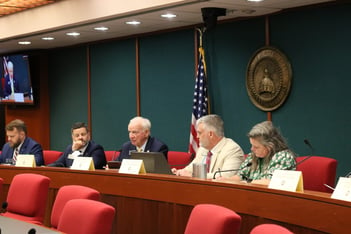
Maruscsak spoke at a Senate Urban Affairs Committee hearing on Georgia’s abortion law Tuesday, held to mark the third anniversary of the Supreme Court Dobbs v. Jackson Women’s Health Organization ruling that overturned Roe v. Wade abortion protections.
Maruscsak learned she would need a procedure to remove the fetal tissue from her uterus.
“My doctor was sympathetic, but because of the restrictive abortion law, my care was limited to a list of abortion clinics,” she told lawmakers at the hearing.
Georgia’s abortion law House Bill 481, which took effect following the Dobbs decision, bans abortion after around six weeks of pregnancy, typically when an ultrasound can detect cardiac activity in an embryo. State law allows for some medical exceptions, including miscarriage and ectopic pregnancy.
But for two days, Maruscsak said she called clinic after clinic trying to get an appointment as her symptoms worsened.
With increasing symptoms of sepsis, she went to the ER, where she continued to bleed as staff took blood and urine samples before discharging her, she said.
“I spent seven hours there in pain and grief and in shock, only to be discharged with no treatment, no resolution, and once again, no care,” she recalled.
“However, we did learn I had a condition called placenta previa, meaning that if my body had tried to complete the miscarriage on its own, I could have hemorrhaged, I would have lost my ability to have children, or I could’ve lost my life, and yet still nobody helped. I was forced to walk around for more than a week carrying Sawyer, who was no longer alive.”
Eventually, Maruscsak found a provider affiliated with Emory Healthcare who performed the surgery she needed.
At the hearing, Maruscsak told the committee that Georgia’s abortion law doesn’t allow for what can happen during real-world pregnancy complications like hers, or clarify what doctors can and can’t do to treat patients legally.
“I should not have had to wait eight days to have a dead baby removed out of me. Nobody deserves that, no mother deserves that. No woman deserves that, nobody deserves that,” she said.
“Whatever you agree with or don’t agree with, that’s not fair. And that’s the law that caused this.”
Under Georgia’s law, providers found to violate the six-week abortion ban could face prosecution and up to a decade in prison.
And since H.B. 481 took effect, dozens of OB-GYNs have warned the law interferes with patient care.
Supporters of the restrictions maintain the law does not worsen maternity care and should not prevent a person from accessing treatment for pregnancy complications such as miscarriage or stillbirth.
Abortion-rights groups in Georgia continue to push for state lawmakers to pass the Reproductive Freedom Act, a bill introduced in the state legislature in 2023.
“The bill would repeal all existing abortion bans and restrictions. It would expand access to abortion care, and it would affirm the right to make pregnancy decisions without fear of criminalization,” Amplify Georgia Collaborative executive director Allison Coffman said at the hearing.
“And that is so important because it is this fear of criminalization that is stopping people from seeking care that they need and tying the hands of providers from providing lifesaving care,” Coffman said.
Former members of Georgia’s Maternal Mortality Review Committee have linked Georgia’s abortion ban to delayed emergency care, and the deaths of at least two women in the state, as ProPublica reported.
Among them was 28-year-old Amber Nicole Thurman, who died three years ago after an infection and being unable to access an abortion. The state’s maternal mortality review committee found her death was preventable, as ProPublica reported.
“They withheld care from her for 20 long hours, just a procedure that would have saved her life. It was denied,” said Thurman’s mother, Shanette Williams, at the hearing.
Thurman left behind a son, who is now eight years old.
Williams told lawmakers she wants Georgia’s law changed.
“Today I am here, and until I take my last breath, I have dedicated my life to advocating for women, for families, for fathers, for children, for nieces, nephews, because I never want another mother or family to feel the devastation that my family and my grandson feels today.”