UGA researchers say meteorite that hit metro Atlanta home is older than Earth

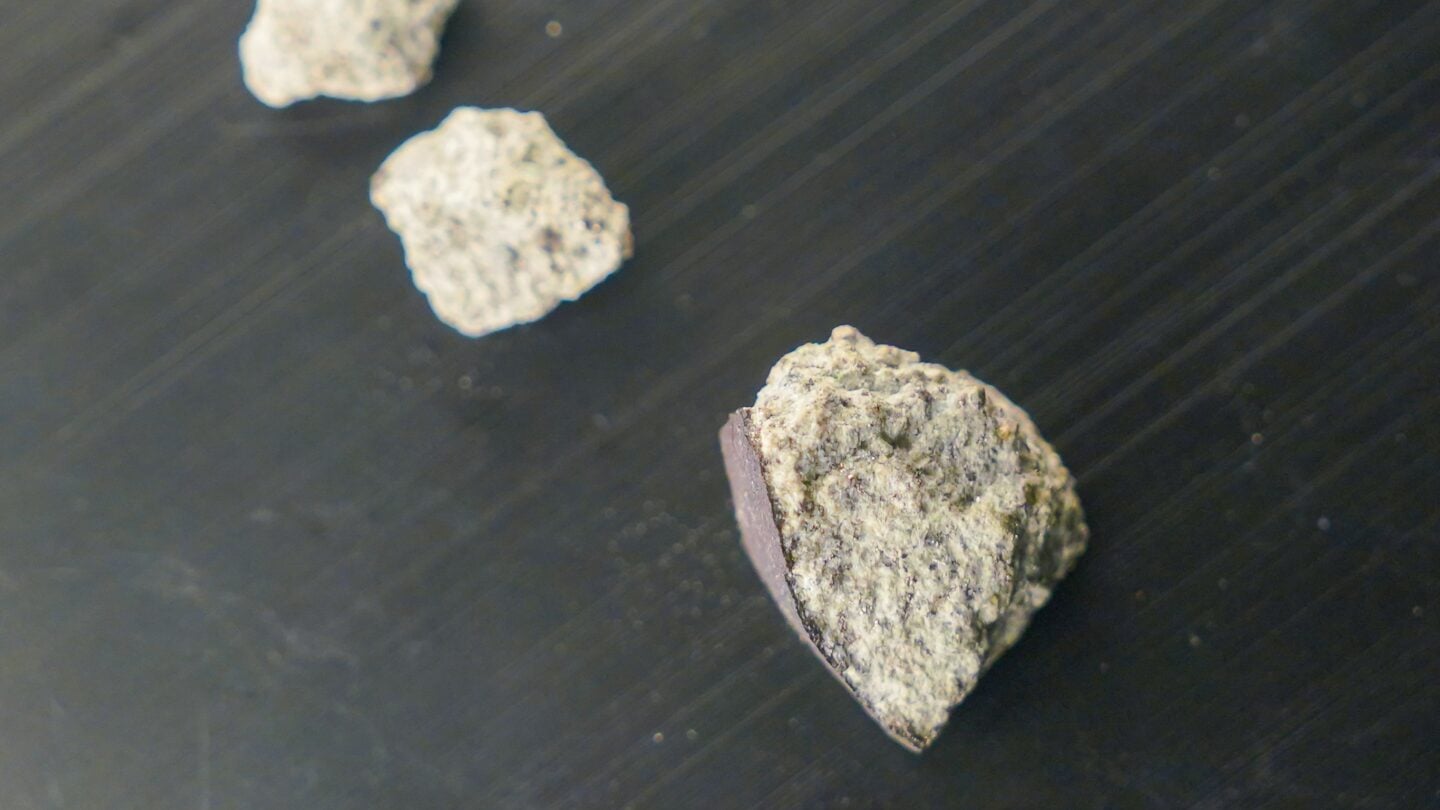
Pieces of the meteorite that crashed into a McDonough, Georgia, home in June 2025. (Matthew Pearson/WABE)

Researchers at the University of Georgia have named a meteorite that crashed into a metro Atlanta residence earlier this summer, and they estimate that it formed over 4.56 billion years ago.

The “McDonough Meteorite,” named after the Henry County city where it was found, crashed through the roof of a residential property on June 26.

The owner of the property described the encounter as sounding like the equivalent of a close-range gunshot. Outside of damage to his roof and HVAC duct, he also reported a solid dent left in his living room floor from the crash.


Roughly 23 of the 50 grams of fragments retrieved from the location were then given to a UGA geologist, who examined the pieces to determine the type of rock and classify it within a specific group of asteroids.

According to Scott Harris, a researcher in the UGA Franklin College of Arts and Sciences’ department of geology, the meteorite is older than Earth itself.

“It belongs to a group of asteroids in the main asteroid belt between Mars and Jupiter that we now think we can tie to a breakup of a much larger asteroid about 470 million years ago,” Harris said in a UGA press release on Friday. “But in that breakup, some pieces get into Earth-crossing orbits, and if given long enough, their orbit around the sun and Earth’s orbit around the sun end up being at the same place, at the same moment in time.”

Additional pieces of the meteorite will be displayed publicly at the Tellus Science Museum in Cartersville, with the meteorite stored in UGA labs for future inspections.

Harris said UGA is collaborating with colleagues from Arizona State University to submit both their findings and the name “McDonough Meteorite” to the Nomenclature Committee of the Meteoritical Society. Final documentation will be published in the Meteoritical Bulletin, a source for information on new meteorites.

The June crash marked only the 27th meteorite recorded in Georgia’s history and the sixth to be witnessed by the public, according to UGA researchers.

Harris says he is in the process of publishing a paper about the McDonough Meteorite’s composition, speed and dynamics to help the public understand the potential threat of larger and more dangerous asteroids.

“One day there will be an opportunity, and we never know when it’s going to be,” he said. “For something large to hit and create a catastrophic situation. If we can guard against that, we want to.”