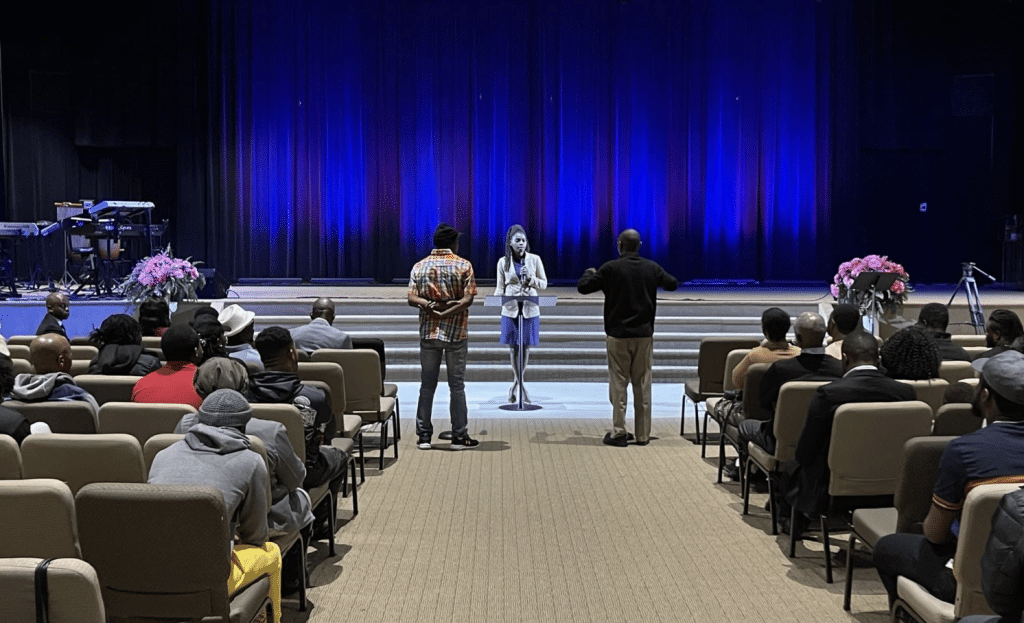
The other day, Mardochée Pardieu was having a conversation with a parishioner at the Lawrenceville church where he pastors. Like most of the congregation at Good Samaritan Haitian Alliance Church, the parishioner had come to the United States from Haiti, and she told Mardochée that she was thinking about going back.
Here in the U.S., she isn’t able to work, and she thought that her chances of securing asylum were low. Plus, her husband and children were in Haiti. “So she’s saying, ‘With all these factors, Pastor, I’d rather be with my family,’” Mardochée recalled. “’If we are going to be attacked, at least we can be attacked together.’”
The parishioner is among the 11,000 Haitians in Georgia, and among the over 300,000 in the U.S., who came here on Temporary Protected Status (TPS) — a form of deportation protection granted to people from countries currently experiencing armed conflict, natural disaster, or other conditions that might threaten their safety if they returned. Haiti has been a designated TPS country since 2010, following earthquakes that killed hundreds of thousands in the small island. That designation expired today, about a month after the Supreme Court upheld a Trump administration policy revoking TPS status for people from Haiti. The ruling effectively leaves thousands of Haitians vulnerable to deportation back to a country that the United Nations has described as in the midst of a humanitarian and political crisis.
Conversations about going back to Haiti are increasingly common at Good Samaritan, said Mardochée, which is among the largest Haitian churches in metro Atlanta. “Every day we deal with this situation.” About half of his congregants have had legal status through the TPS program at one point or another, the pastor said.
Over 1.2 million people have been internally displaced by violence in Haiti; over 6 million people are in need of humanitarian assistance, and more than 16,000 people have been killed since 2022, according to the United Nations.
“Displacement sites are extremely congested. There is no space to sleep or live with dignity. There’s no space to install the most basic services, such as latrines or cooking areas. People are living on top of each other,” Maria Moita, a director for the UN’s International Organization for Migration, told reporters in early July during a visit to the Haitian capital of Port-au-Prince, which armed gangs have largely controlled since 2023. “Schools have become shelters. Communities have been uprooted. Safe space is almost nonexistent in Haiti.”
Still, the parishioner who confided in Mardochée wasn’t convinced she should stay in the U.S. “She’s resolved that that’s one of the things that she may be doing, returning to Haiti, and we know the instability, the gang violence, and everything else that comes with it,” he said.
Mardochée, along with the church’s staff and a small army of volunteers, are fielding questions from their community constantly – on everything from applying for asylum to where to find healthcare to what’s happening with their jobs.
Around 200,000 Haitians with TPS – a status that makes them eligible for work permits – have been in the workforce, according to data from Fwd.us, a policy organization that advocates for immigration reform. Over 22,000 work in warehouses, more than 20,000 as caregivers or nursing assistants, and 15,000 as packers or stockers at warehouses. The federal government has been notifying many of their employers that those permits are expiring. (The Supreme Court decision also affirmed a Trump policy to revoke TPS for people from Syria.)
That’s led to some confusion, as well as terminations: Nearly two dozen of Mardochée’s congregants recently lost their jobs at nursing homes, chicken factories, and warehouses, he said.
The pastor and volunteers have been driving people to and from church, to doctor’s appointments, and to the grocery store. “Everything is tied to immigration, and then you have to deal with the transportation, employment, the lack that comes with it, you know, I can’t pay my housing, food as well,” he said. “And of course the weight that an immigration status places on them, we as leaders carry it as well.”
Like Mardochee, Dr. Dorothy Crisostomo of the Georgia’s Haitian American Nurses Association (HANA), also knows of Haitians who plan to self deport. She founded the local chapter in 2010, the same year TPS was granted to Haiti following the earthquake. She remembers traveling to the country with fellow nurses from Georgia, bringing food and medical supplies and helping treat the wounded. As the earthquake led to an exodus of Haitians to Georgia and Florida, HANA also supported their community here in the Atlanta area.
Now, Dorothy is busy responding to the man-made disaster unfolding in front of her: “People ask questions about their status, about their health, about their mortgage,” she said. She knows of two who have gone back to Haiti. “I don’t know their particular situation, but they decided they were not going to be humiliated. They were not going to be embarrassed. They were not going to be arrested. They were not going to get in situations that compromise their integrity.”
The termination of TPS has already been felt in the medical community: “A lot of the Haitians do work in the nursing homes. They work in assisted living facilities. They work in the hospitals.”
In her own office in Tucker, she had been training some students to be registered behavioral technicians, to help kids and adults, especially those with autism. Since the TPS decision, she hasn’t been able to reach the three Haitian students who weren’t U.S. citizens. She suspects that’s because they’re worried about their status: “You don’t come to a place, learn a trade, and then disappear.”
“Two of them that decided they were leaving on their own. They just left and went to and went back home. They went back to Haiti. I don’t know their particular situation, but they decided they were not going to be humiliated. They were not going to be embarrassed. They were not going to be arrested. They were not going to get in situations that compromise their integrity.”
Dr. Dorothy Crisostomo, Haitian American Nurses Association Georgia chapter
Mardochée says he’s been taking heart in the people around him. After the Supreme Court ruling, people born in the U.S. started reaching out, he said. “People are calling, they give you a word of encouragement and telling us that they stand with us, and also to help us with some financial means.” The biggest need right now, he said, is help with legal immigration fees, as many are filing asylum applications, as well as rental assistance, as they wait for their work permits to come through.
He’s frustrated with stories in the media that frame Haitians as victims, he said: “It’s not congruent to what we are made of.” Haiti, he pointed out, was home to the most successful slave revolt in history—the insurrection against French rule that culminated on January 1, 1804, when the country became the second republic established in the Western Hemisphere after the U.S., and the first Black republic in the world.
Days after the Supreme Court ruling was announced, Mardoché addressed his congregation. “We are processing all these feelings and also, just like the verse says, yes, we are distressed but not defeated,” he said. He reassured them, “Those who are persecuted, they have a place in heaven, in the heart of God.”
Wherever they decide to go, he’s certain about one thing: “We believe that God will make a way for us, whether here in America or somewhere else.”
This story was provided by WABE media partner 285 South.