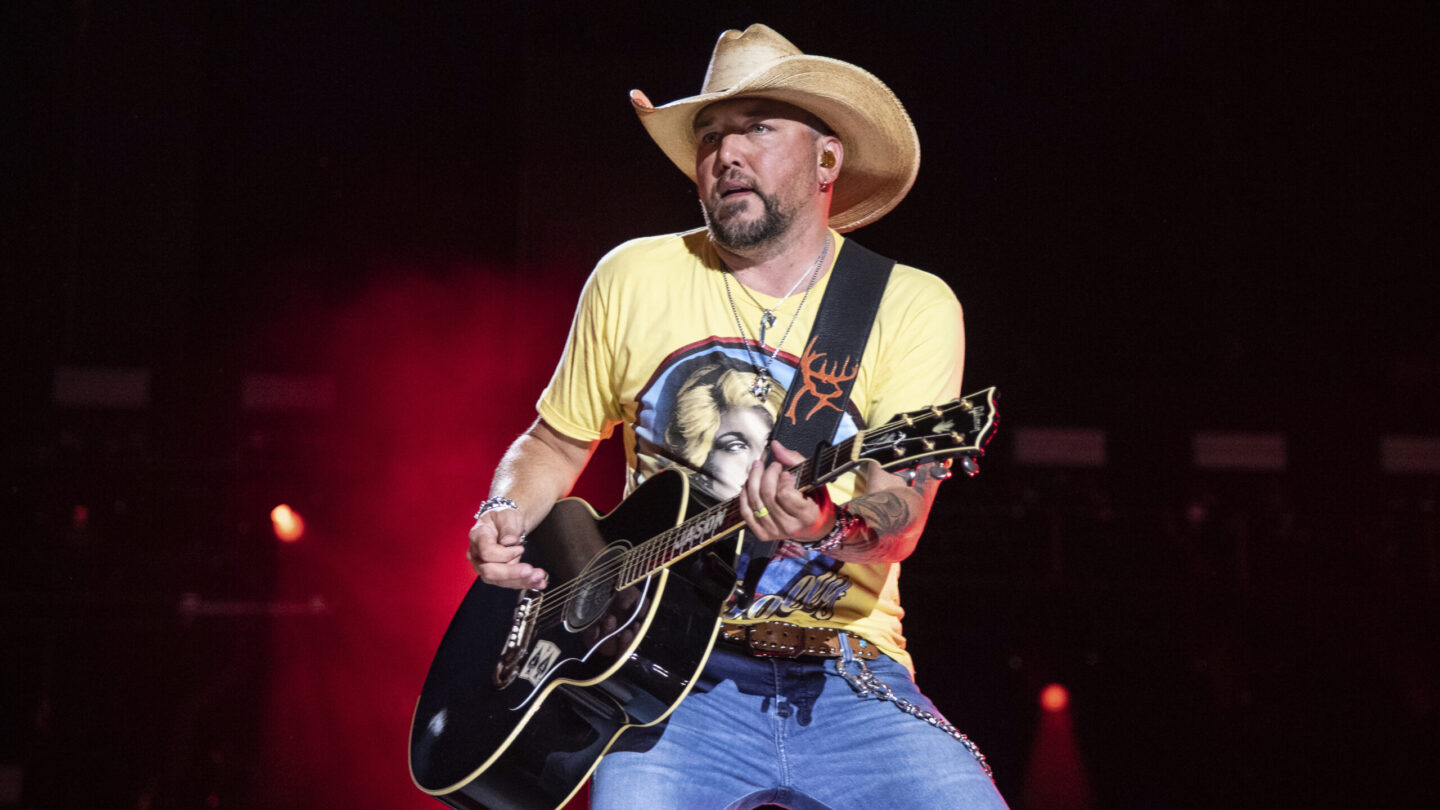
Jason Aldean’s “Try That in a Small Town,” which ignited controversy this week over claims that the song and its new video promote white supremacy and violence, is far from the first country song to attack cities using racist dog whistles. “Try That” is most clearly a descendant of Hank Williams Jr.’s “A Country Boy Can Survive” (1982), which claims, “You only get mugged if you go downtown,” while warning: “I got a shotgun, a rifle and a four-wheel drive, and a country boy can survive.” But Aldean’s latest release invokes and builds on a lineage of anti-city songs in country music that place the rural and urban along not only a moral versus immoral binary, but an implicitly racialized one as well. Cities are painted as spaces where crime, sexual promiscuity and personal and financial ruin occur, while the “country” is meanwhile framed as a peaceful space where happiness reigns.
The urban-versus-rural divide, and the antithetical moral characteristics projected onto them, is not unique to country music and has roots hundreds of years deep, at least. Raymond Williams’s 1973 book, “The Country and the City,” analyzes this binary in literature dating back to the 16th century. The Bible contains cautionary tales against leaving home in search of indulgence, as described in the Parable of the Prodigal Son.
The discourse over city and country has evolved over time, and taken on its own identity within country music. Songs that pine for an idyllic rural past have been a part of country music since the genre was first invented as a marketing category for rural white Southerners in the 1920s. Some of the earliest country songs, like Fiddlin’ John Carson’s “Little Old Log Cabin in the Lane,” recorded in 1923 and often celebrated as one of the first country records, yearns for a rustic home. Carson’s song, like many others in popular music at the time, was a minstrel tune, commonly performed in Blackface, and written in 1871 and presented from the perspective of a former slave who longed for a pre-emancipation past. Carson also regularly performed at KKK rallies.
Read this story now for free
To continue reading, sign up for our newsletter and get unlimited access to WABE.org
You can select your preferences for news and local content. We will never share your email address. Learn how your newsletter sign-up will support WABE and Public Media