A roadless area in the Chattahoochee National Forest near Clayton, Ga. The Trump administration has proposed allowing new roads to be built in areas like this one for the first time in decades.
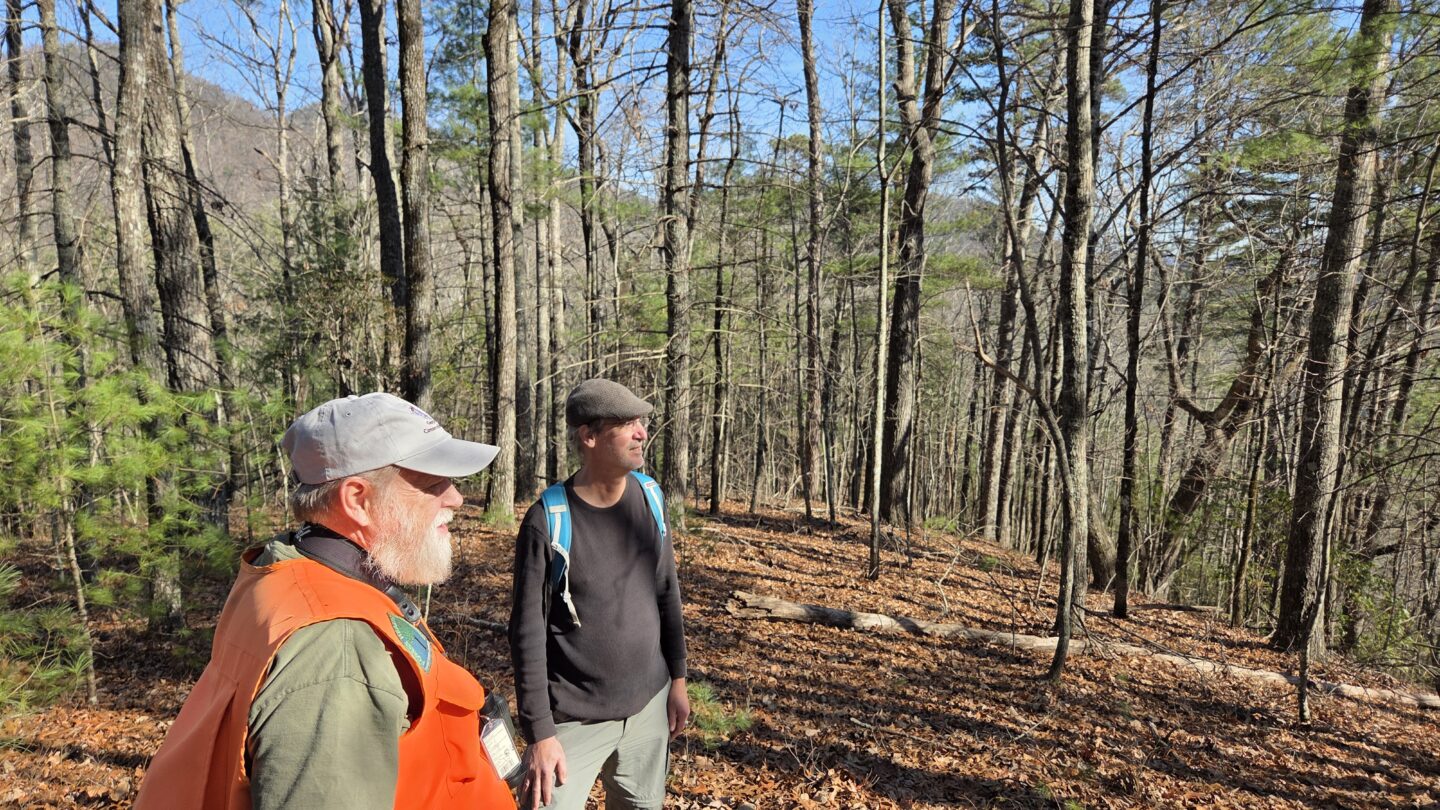
A narrow, heavily potholed dirt road stretches deep into the Chattahoochee National Forest outside the tiny north Georgia mountain town of Clayton — a moderate hike on foot, or a fun, if bumpy, ride on a mountain bike or all-terrain vehicle. But scramble up the steep slope to one side, through the leaf litter and scattered branches, and you’ll crest a ridge overlooking an expanse of woodland with no roads at all.
Pines, oaks and twisty mountain laurel roll down the mountainside. Off in the distance, another peak rises into the sky.
It’s beautiful — and remote.
The Chattahoochee National Forest covers roughly 751,000 acres in the Appalachian foothills of north Georgia. Just 7% of the forest, a tapestry of winding streams, steep ridges and mixed woodland, remains free of roads.
The road-free valley stretching out below the ridge near Clayton feels vast and untouched — a rarity in the East. But that beauty comes with risk.
“If lightning hit one of those peaks and started burning, starting a fire, it would get a fair way before they could maybe do much about it,” said JP Schmidt, an ecologist with the advocacy group Georgia Forest Watch.
Citing that concern — access for firefighting, as well as for recreation — on a national scale, the U.S. Forest Service is proposing to revoke the so-called roadless rule, which blocks roadbuilding and logging in areas like this.
Adopted in 2001 during the final days of the Clinton administration, the Roadless Area Conservation Rule, as it is formally known, grew out of a realization within the U.S. Forest Service that it had built more roads than it could afford to maintain.
Many were crumbling into streams, fragmenting habitat and degrading drinking water, alarming agency scientists. The rule barred road construction and logging in nearly 60 million acres of undeveloped national forest in 39 states.
While most national forest acreage is west of the Mississippi, in Georgia and other eastern states, these areas provide rare pockets of ecological and natural relief in a densely developed region.
The Trump administration began its repeal effort last fall with an unusually short 21-day public comment period — far shorter than the usual timeframe, which can be as long as 90 days.
Still, it drew more than 220,000 responses, nearly all of them opposed, according to an analysis by the advocacy organization Roadless Defense. Most cited concerns about wildlife, tourism, and water quality.
Still, the administration plans to press ahead. The rollback is part of a broader push to expand logging and remake the nation’s second-largest land management agency.
Last month, the Trump administration shuttered 57 of the 77 research stations the Forest Service operated nationwide, many of which studied the impacts of climate change, invasive species, and wildfires on woodlands. The shakeup included plans to move the agency headquarters to Salt Lake City, Utah, from Washington, D.C., and shutter nine regional offices.
Since his return to office last year, President Donald Trump has pushed federal agencies to intensify timber production, an effort that includes making it easier to use legal loopholes to fell trees. With the Department of Agriculture aiming to overturn the roadless rule this year, the debate is shifting from Washington to the woods. Now, the future of these forests — and the communities that rely on them — is in question.
The Department of Agriculture, under which the Forest Service falls, argues that the roadless rule limits its ability to reduce wildfire risk, maintain access for firefighters and promote forest health.
Secretary of Agriculture Brooke Rollins has called the policy an “absurd obstruction” and “overly restrictive.” She says its repeal would give the Forest Service greater flexibility to protect woodlands and support rural economies.
Agency officials say that without roads, firefighters may struggle to reach blazes quickly, giving fires ample opportunity to grow larger and more dangerous. In 2016, the Rough Ridge fire tore through 28,000 acres of the Chattahoochee National Forest, underscoring those fears.
James Sullivan (left) and JP Schmidt of Georgia Forest Watch look out from a ridge in a roadless area of the Chattahoochee National Forest. (Emily Jones/WABE)
“It was a fire that they were unable to keep up with,” said James Sullivan, also with Georgia Forest Watch. The blaze, which burned for about a month, threatened small mountain communities like Tate City and Betty’s Creek. Though firefighters defended those areas, “the rest of it burned on its own.”
Allowing a fire to run its course — so long as people and homes are protected — isn’t necessarily a failure of forest management, though. It clears leaf litter, thins crowded saplings and reduces debris buildup.
“You’ve got all these fuels taken care of,” Schmidt said. “And there’s much less threat of a major fire again any time soon.”
It wasn’t always that way. The Forest Service was founded in 1905 with aggressive fire suppression as a key policy. That began to change in the 1960s, and today some blazes burn themselves out under careful supervision. In fact, many public lands are managed with fire, a technique Indigenous peoples used for millennia to promote forest health.
“Prescribed fire is one of the most effective tools for reducing hazardous fuels and maintaining healthy, fire-adapted forests in the Southeast,” said Laura Fitzmorris, a Forest Service spokeswoman.
Roadless areas make up only a sliver of the Chattahoochee and are “generally small and interspersed with nearby communities, roads, and recreation sites.” Access, she said, is “one of many operational factors considered” in wildfire response.
But access cuts both ways — because roads allow more than fire trucks in.
“If there were more roads, there would be more access,” Schmidt said. “So people might start fires, purposely or accidentally.”
Human activity is by far the leading cause of wildfires. From Virginia to Texas, people sparked 23,980 fires in 2024, according to the National Interagency Fire Center.
Lightning strikes caused just 809. Many of those human-caused fires start near roads, the result of cigarettes tossed from passing cars, hot exhaust pipes or dragging tailpipes throwing sparks. Car campers can start them when they fail to extinguish campfires. And then there are those who intentionally start a blaze, using roads to get in and out easily.
In all of these cases, said Sam Evans, the National Forests and Parks program leader at the Southern Environmental Law Center, “roads are the common denominator.” The roadless rule already exempts firefighting, and he called the administration’s argument that repealing it would make that job easier “malarkey.”
“They’re trying to trick the American people into thinking that timber production is somehow making us safer from wildfire,” he said. “It’s not.”
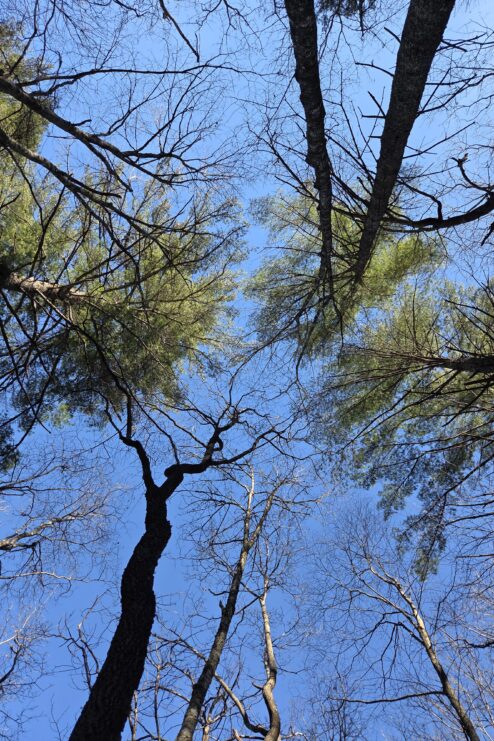
Trees overhead in the Chattahoochee National Forest. (Emily Jones/WABE)
Throughout the East, advocates are similarly skeptical of the Trump administration’s justification for repealing the roadless rule and of the potential consequences if the proposal goes ahead. Allowing more roads and more logging, they argue, would degrade the rare pockets of wilderness that the rule protects.
In Vermont’s Green Mountain National Forest, for instance, areas that fall just outside the designated roadless zone have already been clear-cut for timber in recent years. It presents a stark contrast: stumps left behind after clearing, then lush, undisturbed forest, on opposite sides of an invisible line through the woods.
“There’s little to stop the logging of this place, except for the roadless rule,” said Zack Porter of the New England forest advocacy group Standing Trees. “Look how easy it would be for someone to drive a logging truck in here.”
Allowing logging would also hamstring forests’ ability to trap and store carbon dioxide, which forests in the East are currently very good at.
“Eastern forests are middle-aged,” typically between 80 and 120 years old, said Richard Birdsey, a senior scientist at the Woodwell Climate Research Center and former U.S. Forest Service researcher.
“That’s a period when they are optimally removing carbon dioxide from the atmosphere and storing it in biomass and the soil.”
Outdoor business owners who rely on forests are also skeptical of the Trump administration’s claims that repealing the roadless rule would boost local economies with more recreation. In fact, some argue the opposite is true — more roads would degrade the wilderness, making it less appealing for visitors.
On the banks of the South Mills River near Brevard, North Carolina, on a foggy winter day, outdoor guide Heath Cartee kicked at a bit of loose dirt and watched it fall into the frigid water.
“They can’t even keep up with what they got,” he said. “See my point? That’s silt. It goes into the river.”
Cartee stood on what had once been a road, long abandoned and leading to a footbridge broken and tangled by Hurricane Helene.
The river and the surrounding 8,600-acre tract are part of the state’s 172,000 acres of inventoried roadless forest.
Over the years, the guide has seen many decaying Forest Service roads crumble into waterways, filling riffles and rocky creekbeds with sediment where salamanders, trout and other aquatic animals lay their eggs and live out their lives.
“Those interstitial spaces don’t exist anymore, and therefore that life doesn’t exist anymore, and it begins to sterilize the river,” he said.
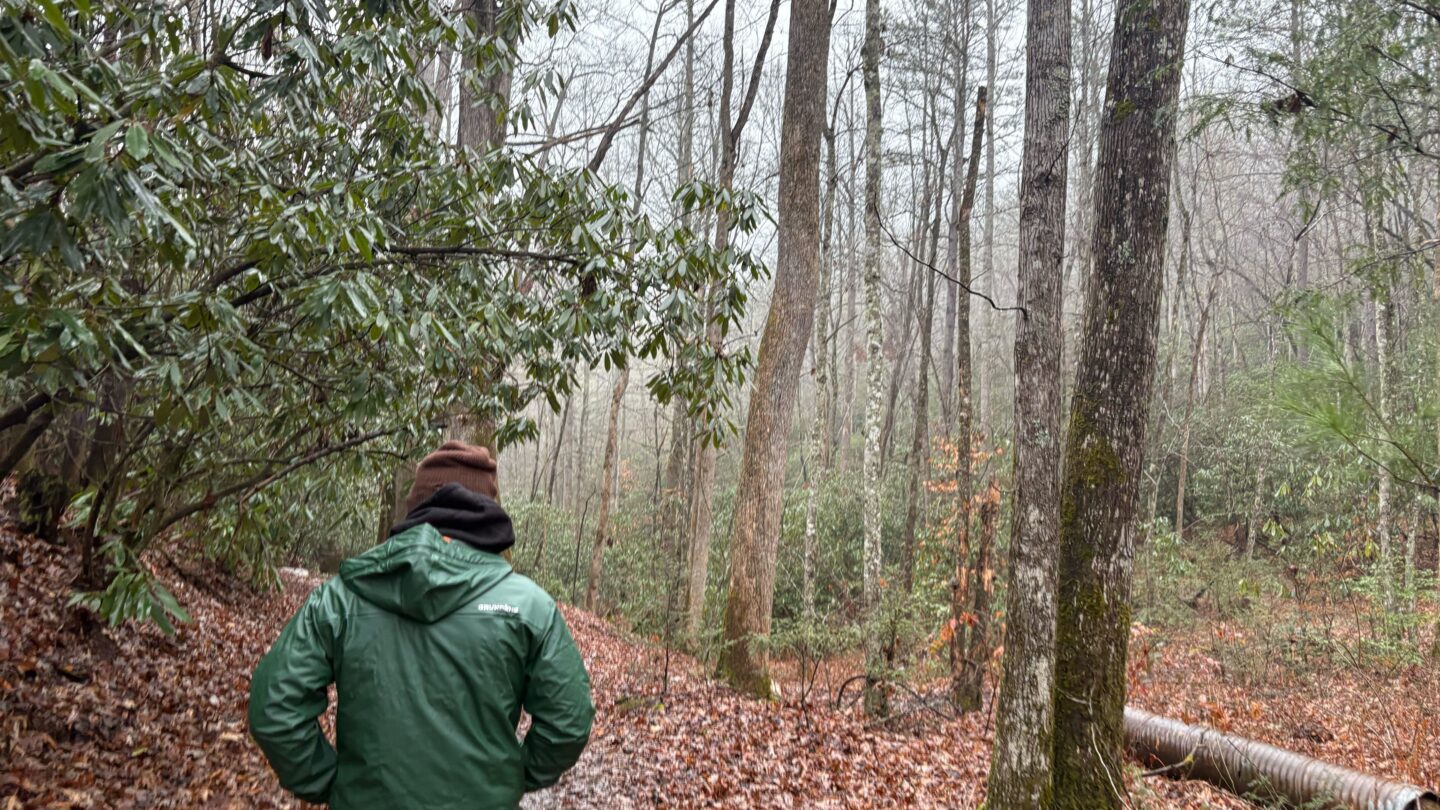
Heath Cartee hikes along the South Mills River in Pisgah National Forest. (Katie Myers/BPR)
South Mills is one of 32 roadless areas within the Pisgah and Nantahala National Forests of western North Carolina. This stretch alone runs for nearly 12 miles along the river. Reaching the best fishing holes means strenuous hikes and multiple stream crossings — work that, for clients of Cartee and other guides like him, is part of what makes the trip worthwhile.
“People want to have that challenge of, ‘Hey, I hiked 8 to 10 miles, camped out, and came out with these birds, this trout, and one of the most amazing deer I’ve ever seen in my life,’” said Jordan Linger, a bowhunter and representative of the nonpartisan advocacy organization Backcountry Hunters and Anglers. The group has made its displeasure with the proposal known — Linger said that as many as 600 have called the organization and said, essentially, “Hey, this isn’t going to fly with us.”
At first glance, South Mills looks a lot like other forests in Western North Carolina — rhododendron, mountain laurel, a gentle trail on a former logging road.
But Cartee would rather spend time there than in other parts of the Pisgah National Forest, which he says has been degraded by too much access and development.
Without places like South Mills, he says, people would lose the chance to understand what a real wilderness is — the way you can’t explain the taste of chocolate cake to someone who’s never had it.
Over his lifetime, Cartee has seen dirt roads become gravel roads and gravel roads become paved roads that grow ever wider, fragmenting the forest he grew up in. He feels that loss deeply.
With each new byway and highway, it’s more than quiet, and the habitat that disappears. It’s that elusive sacredness that Cartee feels when he encounters something larger than himself.
“When you go to the wilderness, you have to go there for spirituality,” he said. “It doesn’t mean that you’re going to find ‘God’. It also doesn’t mean that you’re going to find the devil. You’re likely to find both.”
As Cartee drove out of South Mills and the rhododendrons gave way to fences and highways, he reflected on the deeper meaning of roadless areas.
For him, and for many of his clients, a night in the wilderness makes you confront your humanity, your primal connection to the natural world, and your mortality as a being that came from the dirt and will someday return to it.
“Part of engaging with the woods and the forest and the wilderness and getting away from society is engaging with both,” he said. “Because they’re both part of you.”