Atlanta stitchers tell story of Haitian soldiers who fought for American freedom as their tapestry starts national tour

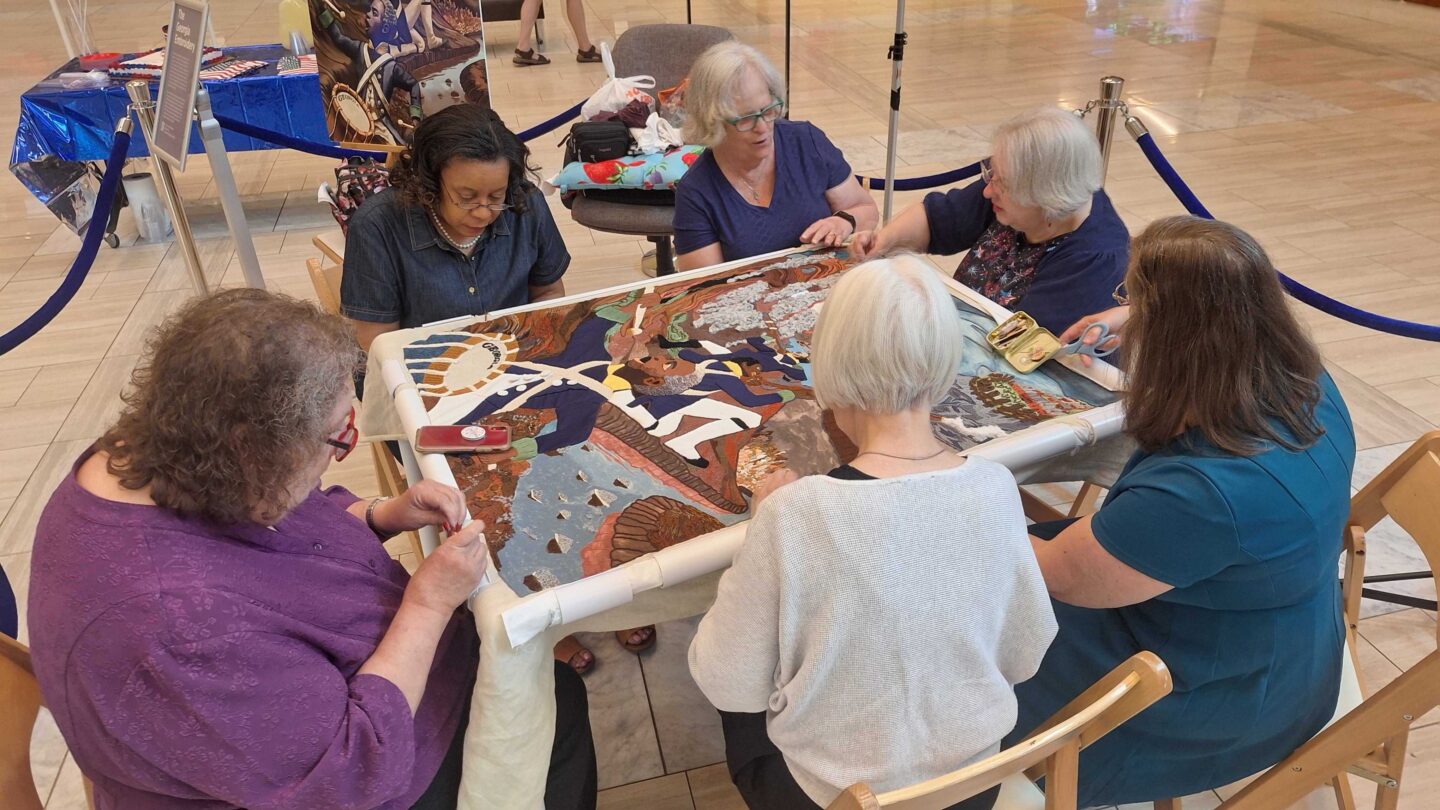
A group of people sit around a table while working on a tapestry
Robin Starnes (front left) with fellow stitchers Randy Maynor, Vicki Coco, Brenda Jordan, Dorothy Waits and Sheila Dixon completing the tapestry on April 28, 2026 at the Atlanta History Center.

(Melissa Feito/WABE)

A tapestry, handmade by Atlanta stitchers, will soon be on display in Virginia to commemorate America’s 250th anniversary.

It’s part of a year-long exhibition and tour called “America’s Tapestry.”

Conceived by 28-year-old costume designer and fiber artist Stefan Romero, the collection of tapestries highlights important moments in each of the original 13 colonies. 


Romero organized groups of artists and crafters in each of those states to create those pieces, which will soon come together at their first stop, the Muscarelle Museum of Art in Williamsburg, Virginia.

On a rainy morning at the Atlanta History Center in April, six embroiderers put the final stitches in Georgia’s panel.

It portrays the Chasseurs Volontaires de Saint-Domingue, a Haitian militia unit that fought in the Battle of Savannah, also called the Siege of Savannah, in 1779. 

The over-500 men were the largest group of Black soldiers to participate in the American Revolution. 

Details of the tapestry featuring the Chasseurs Volontaires de Saint-Domingue, a Haitian militia unit. The battle would eventually inspire, in-part, the Haitian Revolution in 1791. (Melissa Feito/WABE)

In deep blue, cream, brown and green, the tapestry depicts a dynamic scene featuring three men; two soldiers with muskets, with a warship looming behind them, and a drummer boy. According to Haitian legend, the latter is said to be Henri Christophe, the future leader of independent Haiti.

Robin Starnes led the group that made the tapestry. She and six other women from the Dogwood Chapter of the Embroiderer’s Guild of America were at the History Center that morning to finish the job. Many have years of experience in the craft. 

“I’ve been embroidering since 1980, so it’s been a long time,” Starnes says. 

They and other stitchers in their group spent more than a thousand hours over 13 months creating the tapestry… even learning new skills to complete it. 

“On this one, I did the uniforms, so I learned a lot about applique,” she laughs. 

And they did most of it in public, in the History Center’s atrium. Timothy Frillingos is Director of Exhibitions.

Members of the Dogwood Chapter of the Embroiderer’s Guild of America with the finished tapestry on April 28, 2026. (Melissa Feito/WABE)

“It’s really been great to see them interact with our visitors and answer questions of young and old who want to talk about the piece,” he says. 

Starnes says her group is doing more projects like this in public because embroidery is increasingly a dying art. 

“And we’re seeing that a lot. We have aging people in our group, and we’re trying to get younger people in to learn about it and enjoy it.” 

More than anything, she wants people who are impressed by the tapestry to know that anyone can do it. And that there are real benefits to learning a craft, like stress relief. 

“It’s not your grandmother’s embroidery anymore,” she says.

Frillingos says he hopes to welcome Georgia’s tapestry back, with its counterparts, sometime in the next few years.

In the meantime, Georgia’s tapestry will be traveling around the country until at least early 2028.