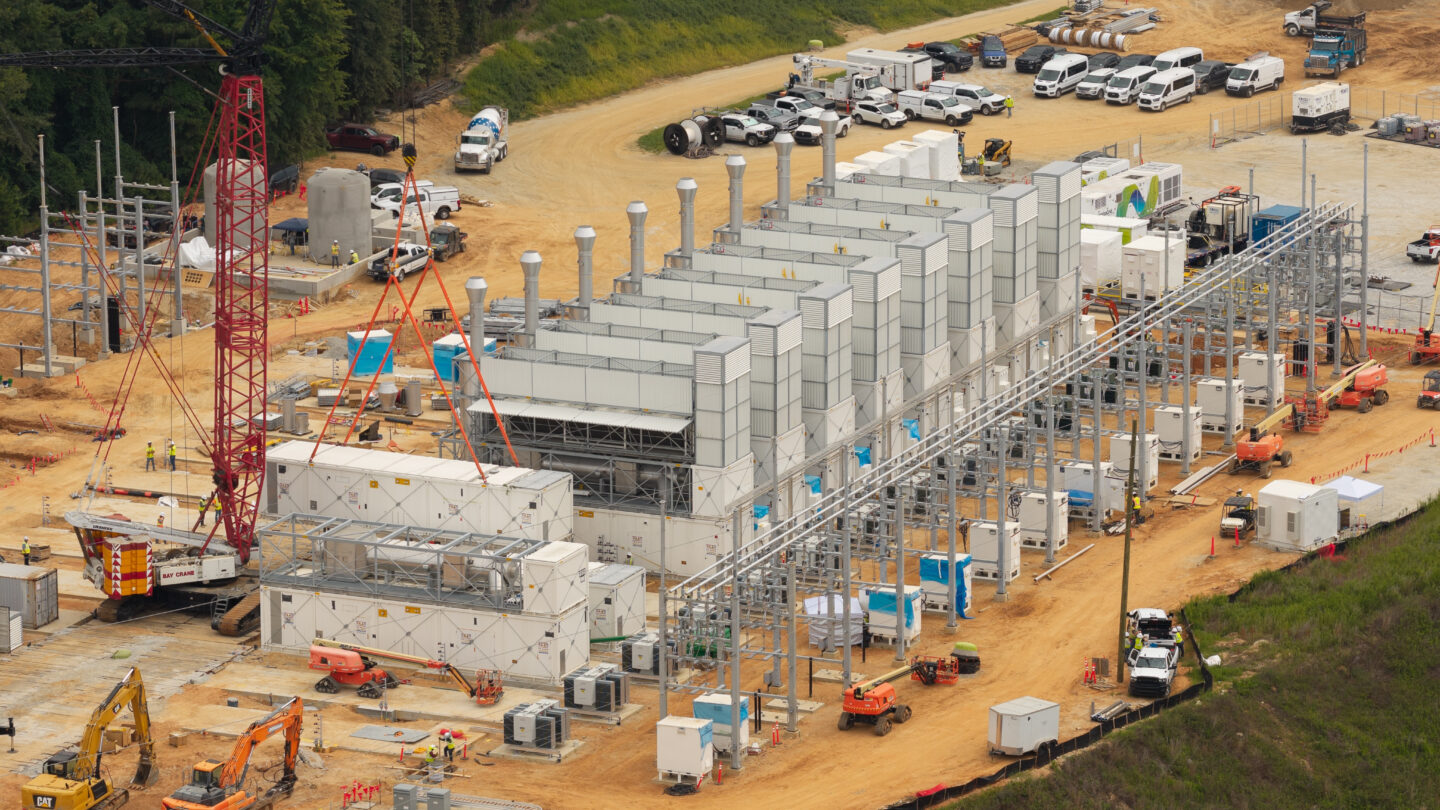
The Georgia Environmental Protection Division has issued notices of violation to two companies over a new power plant that environmental groups said is being built without permits, according to the Southern Environmental Law Center. The plant is for a planned data center in the Atlanta area.
Microgrid company VoltaGrid and data center company Serverfarm have applied for state permits to build a pop-up power plant and a data center with backup generators in Covington, southeast of Atlanta. The power plant, which would be the first of its kind in Georgia, would consist of 33 internal-combustion engines providing “alternative, rapidly deployable prime power” to the data center, according to Voltagrid’s permit application.
Public comments on the request have raised concerns about air pollution from the diesel- and natural gas-fired units. But several environmental groups now claim construction is already underway without the necessary permits even being issued.
In a letter to the Georgia Environmental Protection Division, the Southern Environmental Law Center, Altamaha Riverkeeper and Sustainable Newton urge the agency to investigate and take enforcement action.
“The construction activities at VoltaGrid in particular are troubling,” the letter reads. “In short, by jumping the gun, VoltaGrid and Serverfarm are ignoring not only EPD’s legal requirements, but are wholly disregarding the public participation process and the concerns of those living downwind of the facility.”
Data centers aren’t inherently a problem, said Nancy Schulz of Sustainable Newton. There’s already a large Meta data center in the area and an Amazon one under construction. She described both of those companies as good community partners in her view.
“We want them to be responsible and accountable to our community, and that means following the rules and following our state laws and our federal laws,” Schulz said. “That means get your permits before you construct.”
The letter includes aerial photos of what the groups describe as the engines that make up the pop-up power plant and emergency generators for the data center, some completed and some under construction. They request that EPD order a halt to “all prohibited construction activities” and assess penalties for alleged violations of Georgia law and the federal Clean Air Act. The agency issued notices of violation after inspecting the facility, SELC said Tuesday.
Georgia’s recent data center boom has provoked opposition on many fronts. While some municipal and economic development officials around the state are eager for the investment and tax revenue that a data center offers, residents and local leaders have opposed them in many places due to their environmental impacts and other concerns.
Data centers, especially the large ones known as hyperscalers that drive generative AI, run on enormous amounts of electricity and use lots of water to cool their banks of computer servers.
Georgia Power is adding 10 gigawatts of energy to power new demand coming mostly from data centers. That expansion has upset advocates and customers, who are worried ordinary households and other businesses may end up covering some of the costs. Some also worry that most of the new energy will come from climate-warming fossil fuels.
A project like the one VoltaGrid and Serverfarm have proposed could address the first concern by bypassing electric utilities — meaning there isn’t new infrastructure that could potentially show up in customer rates or fuel charges — though it’s unclear whether the plant is intended as a permanent solution. The idea of data centers bringing their own energy instead of relying on the grid has been suggested by officials and advocates as the Georgia Public Service Commission and state legislature have grappled with the centers’ sky-high energy needs.
But bring-your-own power plants for data centers don’t necessarily address critics’ concerns about climate-warming emissions. The engines for the VoltaGrid-Serverfarm project would be powered by diesel and natural gas, both fossil fuels. Some tech companies are pursuing small nuclear reactors to power data centers, but that technology is still years away, meaning such projects are likely to rely on fossil fuels for energy at least in the near term.
VoltaGrid, Serverfarm and the Georgia EPD did not reply to requests for comment.