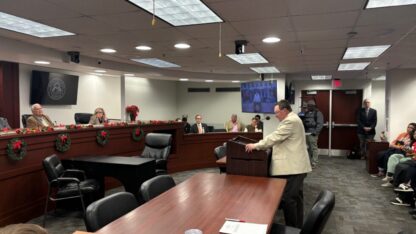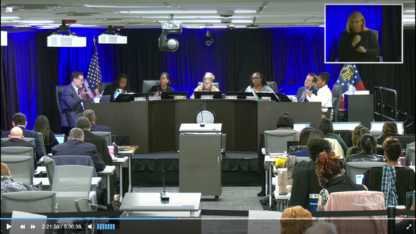
DeKalb County Commissioners Mereda Davis Johnson, Nicole Massiah, Michelle Long Spears, Chakira Johnson, LaDena Bolton, and Ted Terry, joining virtually, deferred a data center ordinance and proposal during a meeting on Nov. 20, 2025. (Zoe Seiler/Decaturish)
The DeKalb County Commission is considering a resolution that would allocate 50 percent of tax revenue generated by high-technology data centers to support resident equity and environmental restorations.
Commissioner Ted Terry introduced the “Establish a DeKalb For The People AI Tech Dividend Fund and Fiscal Stability Policy” resolution during the commission meeting on Jan. 6, according to a news release. The Finance, Audit and Budget (FAB) Committee will discuss the resolution on Tuesday, Jan. 13. The committee meets at about 3:30 p.m.
Of the allocation, 25 percent would go toward libraries, senior and youth services and beautification. The other 25 percent would go to the general fund reserves until the county has a 90-day operating fund balance.
“Data centers are here and knocking on DeKalb County’s door. I am proud DeKalb County has committed to developing strong regulations that will ensure community protections if one may be built,” Terry said. “But we can’t stop at regulations.”
The goal of the ordinance is to establish land-use regulations for data centers. It includes requirements about permitted locations, plans to be submitted with an application, architecture, noise and maintenance. The draft consists of a use table listing four permitted classifications for industrial areas.
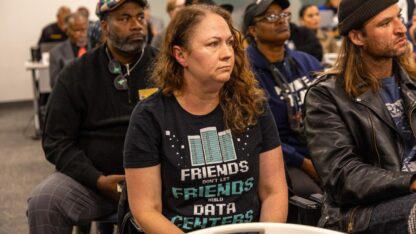
(Zoe Seiler/Appen Media)
A developer is proposing a data center campus in Ellenwood in South DeKalb County. According to a county staff report, the 95-acre site, located at 4280 and 4358 Loveless Place and 2281 Pineview Trail in Ellenwood, would be a data center facility with an outdoor electric substation. Three two-story buildings would be located on the site, which borders Clayton County. Since the buildings are multi-story, the facility would be 2 million square feet of server space.
Terry added that the county must ensure that ad valorem tax revenues are returned to the community that may be burdened by the facilities.
“That these funds purchase greenspace, build sidewalks, assist with energy burden through weatherization projects, provide job training infrastructure, and so much more the community may need,” Terry said. “That is environmental justice for our DeKalb residents.”
The fund would prioritize primary impact zones, defined as neighborhoods within a 3-mile radius of a data center or a heavy industrial area. These areas would be given priority for greenway connectivity and energy relief.
The resolution also outlines “Equity Priority Areas [where] funding shall be targeted toward census tracts meeting Justice40 criteria and having high Social Determinants of Health (SDOH) burdens, ensuring the dividend reaches those with the greatest need,” the news release says.
The resolution highlights “Humanity First” pillars for qualifying funding expenditures for funding.
The energy equity pillar: Direct residential utility assistance and grants for home solar/weatherization to shield families from industrial-driven grid inflation.
The AI Workforce Transition Pillar: Scholarships and retraining via WorkSource DeKalb to “future-proof” residents against AI-driven economic shifts.
The Digital-to-Green Trust: Funding of the countywide Green Infrastructure Network—composed of trails and sidewalks and buffer land acquisition—connecting neighborhoods to parks and schools, with an emphasis on creating physical forest buffers in industrial zones.”
This story was provided by WABE media partner Decaturish.