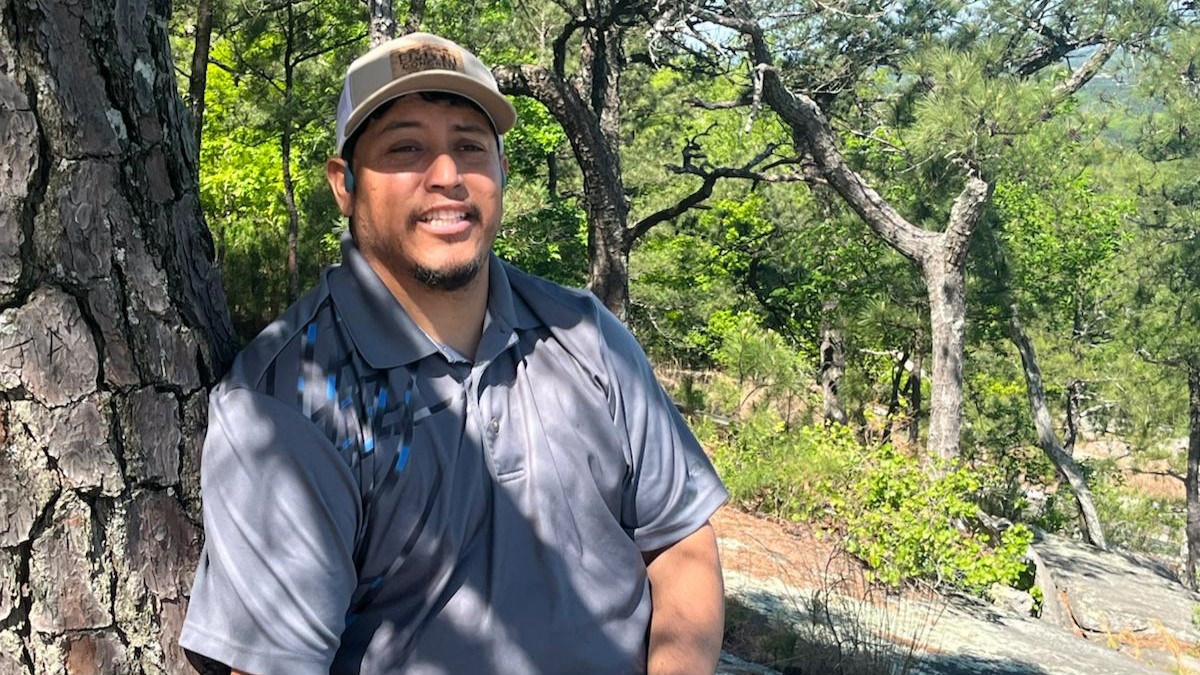
Antonio Aguirre Villa on a hiking trail with his family and two dogs. (Photo courtesy of Clara Ruiz)
In late June, Antonio Aguirre Villa was driving to work at a Gainesville construction site when he was pulled over by the Georgia State Patrol. Officers said it was because his windshield was cracked.
According to a police report obtained via public records request, a state trooper pulled Villa over in a grocery store parking lot. Originally from Mexico but living in Georgia since 2009, Villa presented his Maryland driver’s license. The officer contacted Homeland Security Investigations — a law enforcement agency within the U.S. Department of Homeland Security — to confirm Villa’s citizenship status.
“They notified me that Mr. ANTONIO was in the United States illegally and will come pick him up of [sic] further investigation,” the report reads. “ICE Agents arrived on scene and took custody of Mr. ANTONIO.”
In Maryland, immigrants without U.S. citizenship and immigration documents can apply to obtain a driver’s license or an identification card, which are considered federally “noncompliant” and can’t be used for things like boarding domestic airline flights.
Villa’s wife, Clara Ruiz, said he told her that the people who picked him up didn’t have badges or identification to indicate they were federal agents affiliated with ICE, or U.S. Immigration and Customs Enforcement.
Villa was taken to a federal prison in Atlanta and then, after about two weeks, was sent to the Folkston ICE Processing Center in Southeast Georgia. He began making daily phone calls to his wife and four children, who are between 11 and 17 years old.
In early August, Ruiz said, the nature of the calls started to change. Villa started to talk about being harassed by guards and other inmates. He told Ruiz there was a rumor circulating about him being a “sexual predator” — a claim that both Ruiz and Villa’s attorney say is false. The guards, Villa told Ruiz over the phone, said he would be transferred to a federal prison for sex offenders, and pressured him to sign his deportation papers. Although she was worried, she encouraged him to stay strong and ignore them.
285 South reached out to ICE for a request for comment. An ICE spokesperson acknowledged receiving the request, but didn’t provide a response to the allegations.
Situation of Gainesville man detained by ICE begins to deteriorate
Villa’s situation appeared to grow worse on Monday, August 18, when Ruiz received a disturbing call from her husband: “He told me they tried to hurt him and that’s why he wanted to take his own life,” Ruiz told 285 South, struggling to speak between tears. “He told me to take care of our children and I told him that he wasn’t alone.” After that alarming conversation, Ruiz didn’t hear from Villa for a week, despite repeated efforts to reach him. She contacted the Mexican consulate in Atlanta for help, as well as Villa’s attorney.
Villa’s attorney, Helen Vargas-Crebas, had trouble reaching Villa too. The same Monday she heard the news from Ruiz, she emailed the detention center and multiple email addresses for ICE.
The detention center replied they would forward her request to see her client to the appropriate channel, but it took days to get more clarity about what had happened with Villa.
“It has been very challenging to have any type of cooperation from anywhere,” Vargas-Crebas told 285 South. “It’s really hard to receive a callback, a response, or even to speak with someone over the phone.”
Getting information about what is happening inside Folkston or other immigration centers has historically been challenging. According to the nonprofit the American Immigration Council, ICE has “routinely failed to ensure reliable and accessible phone calls in its facilities for decades.” In a 2022 inspection conducted by the Department of Homeland Security’s Office of the Inspector General, investigators found that “Folkston did not meet standards for facility conditions, medical care, grievances, segregation, staff-detainee communications, and handling of detainee property.”
On Thursday, August 21, Vargas-Crebas was able to secure a virtual appointment with Villa for the morning of Friday, August 22. But just before their meeting started, she was informed by the detention center that Villa didn’t want to speak with her or her family. Ruiz became more worried and sent family members to visit him in person over the weekend at the Folkston facility. They were denied entry.
Vargas-Crebas was finally able to speak with Villa over the phone later that day and confirmed that he is on suicide watch — the reason why he couldn’t speak or meet with any family members, she said.
He appeared to be having a mental breakdown, she said, and is currently in isolation in the medical unit so that he cannot harm himself again. Vargas-Crebas has been trying to access his medical records to get a better understanding of his current state, but so far, she doesn’t have anything.
She’s also working on trying to get him released through a habeas corpus filing or another legal strategy to bring him home.
“He said he wanted to stay and continue to fight for his case,” Vargas-Crebas said.
Antonio Aguirre Villa with his wife, Clara, and four children. (Photo courtesy of Clara Ruiz)
Family left to cope with Villa’s detention
Since Villa was detained, Ruiz has been left to take care of their four children on her own. Formerly a gardener, she has stopped working to focus on getting Villa out of detention, and is relying on the family’s savings to pay the bills.
Villa’s niece, who didn’t want her name published, told 285 South that her uncle’s detention has been harrowing: “It’s just been a very traumatic experience for his family now that his wife is left alone financially and she’s just hiding the burden to take all of this in by herself.” Villa is a happy person, the niece said, who enjoyed hiking with his family and two dogs, and attended Catholic church every Sunday. “He’s never done anything bad,” she said.
Speaking from her home in Gainesville, Ruiz told 285 South that she fears for her husband’s life and that it has been an extremely painful situation to go through: “This is something very serious. It is heartbreaking for me and my children. It is really painful.”
Since he was detained, it has been a nightmare, Ruiz said, because they used to spend a lot of time together as a family. “My children and I are frightened,” she said.
This story was provided by WABE media partner 285 South.