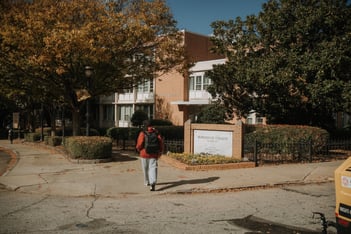
Arrests are made as Atlanta Police Department and Georgia State Partrol order Pro-Palestinian and "Cop City" protesters to disperse from the quad on Emory University campus on Thursday, April 25, 2024. (Matthew Pearson/WABE)
The chancellor of the University System of Georgia says the state’s public colleges and universities are receiving an influx of out-of-state undergraduate applicants because of how administrators handled campus protests over the Israel-Hamas war.
But admissions data suggests a more complicated picture about who is applying — and why.
Chancellor Sonny Perdue made the comments earlier this month at a biennial gathering of lawmakers. He told the gathering he has heard some prospective students and their parents were impressed by the system’s swift moves to dismantle encampments and penalize protesters.
“Did you see the differences between some of the universities in the country and the universities here in the state of Georgia?” he asked the audience.
Some university presidents around the country have faced criticism for not doing enough to address anti-Semitism on campus and permitting encampments, sit-ins and vandalism. Others have been knocked for using force to crack down on student protesters, including at the University of Georgia and Emory University, which is a private institution not affiliated with the state university system.
Perdue’s comment touting Georgia’s response received applause from some lawmakers – and also rebuke from groups like the Georgia chapter of the Council on American-Islamic Relations.
But do application numbers back up the chancellor’s claim?
A spokesperson for the university system says system-wide data on out-of-state vs. in-state applicants is not immediately available. But admissions data obtained from two of the system’s flagship universities, the University of Georgia and the Georgia Institute of Technology, offer some clues.
Chancellor Sonny Perdue and Hyundai Motor Group Executive Chair Euisun Chung, hold up a new memorandum of understanding for future mobility collaboration during a ceremony on Georgia Tech’s campus in Atlanta, Ga. on Tuesday, September 19, 2023. (Matthew Pearson/WABE)
Applications on the rise
Georgia Tech has experienced a roughly 14% rise in applications as of Dec. 11, though that could grow since the early application period is still ongoing. UGA saw a roughly 15% bump in early action applicants. But that growth has been driven roughly equally by in and out-of-state students at both schools.
WABE compared UGA’s early action application numbers over the last several years, since applications continue to come in ahead of the regular decision deadlines next year. Georgia Tech could not provide annual early action data, so WABE looked at all applications, with the caveat that this year’s numbers will grow through the regular admissions deadline on Jan. 6.
The number of applications overall have also been increasing over the last several years, due in part to draws like affordability.
“The Early Action 1 applicant pool is stronger than ever,” Mary Tipton Woolley, interim executive director of the Georgia Tech Office of Undergraduate Admission, wrote in an announcement this fall. “I’m also grateful to our admission counselors for completing all the training and work to successfully review more applications than ever before in this applicant pool.”
At UGA, while early action applications from Georgia and out-of-state students grew at roughly the same rate this year, out-of-state students do comprise a greater proportion of the pool than a decade ago.
As schools like Georgia Tech and UGA attract more prospective out-of-state students, they have adopted two-tier early action deadlines, admitting in-state students first. UGA says the school aims for a roughly 80% in-state freshman class.
Setting aside why students may be drawing more interest from out-of-state students, Perdue said more of these applicants is not bad for the state.
“Our goal and our job, we hear you loud and clear, is to take care of Georgia students first,” he told lawmakers. “But let me tell you, there’s some best and brightest students coming from a lot of other places in this country that want to get their education here. And if they come here and get an education, guess what they’re more likely to do? Stay here.”
Enrollment is up across the system’s 26 colleges and universities, though that is driven mostly by in-state students. But that may not last.
Georgia’s birth rate has peaked
UGA demographer Taylor Hafley told lawmakers that Georgia births peaked in 2007.
“That would be our high school class of 2025, folks who are seniors right now,” Hafley said. “So we might anticipate this will be the peak number of high school students in the state as a whole.”
Hafley acknowledged that assessment does not consider in-migration, which is driving Georgia’s population growth. And demographers predict 30% of Georgians will be under age 25 in 2030.
But Hafley says Georgia’s declining natural population growth, the difference between births and deaths, could have big implications for Georgia’s workforce, K-12 education and yes, college enrollment.