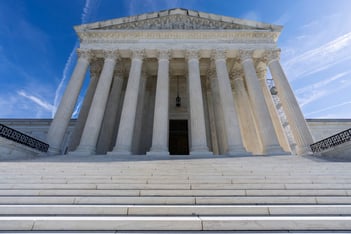
As the final rulings of the U.S. Supreme Court’s term were being released at the end of June 2015, most eyes were on a landmark case — Obergefell v. Hodges, the case that could determine the legality of same-sex marriage.
But the court doesn’t announce which rulings it’s releasing on which days.
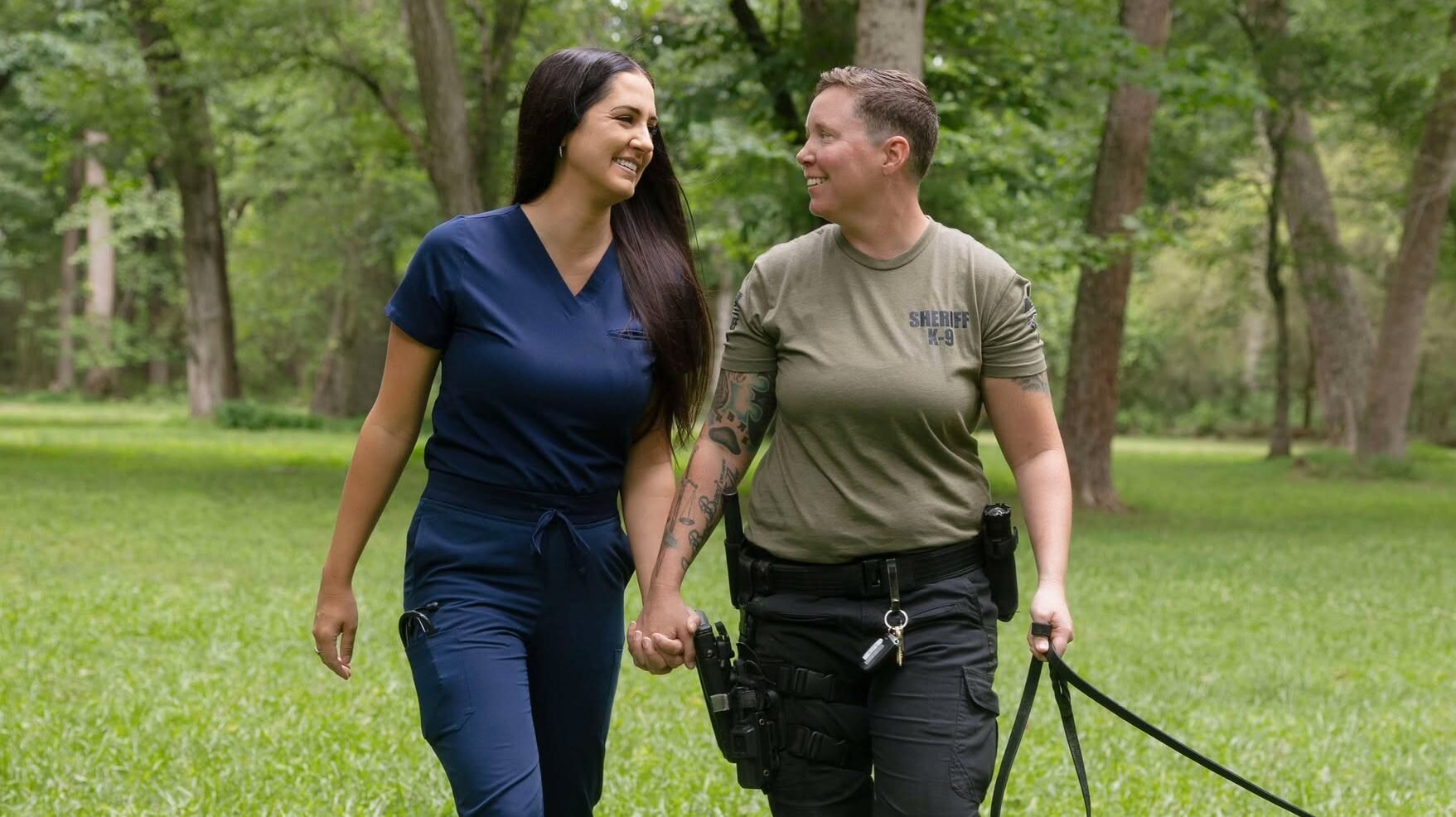
Metro Atlanta couple Kelly and Taylor Martinelli didn’t wait to find out.
They started showing up at the Gwinnett County Courthouse day after day in the final week of June, waiting for hours so they could get the chance to marry each other if the court ruled that gay marriage was legal.
“We would go up there every day and they’re like, ‘Yeah they might vote on it today, we don’t know. It might be today, it might be tomorrow.’ So we just kept going back, kept going back,” Taylor said.
Finally, just after 10 a.m. on Friday, June 26, 2015, the ruling was announced — a 5-4 decision. The Supreme Court said the right to marry was guaranteed to same-sex couples under the 14th Amendment of the U.S. Constitution.
And the wait was over for Kelly and Taylor and so many other same-sex couples in Georgia and across the country.
“It went through, and it was such … a surreal moment that we just got in line and we’re like, ‘We would like to apply for our marriage license,’” Kelly said.
That was 10 years ago on Thursday. Over 430,000 same-sex couples have married in the U.S. since then, according to the Williams Institute at the UCLA School of Law.
U.S. adults’ support for legal recognition of same-sex marriage has risen from 60% at the time of the 2015 ruling to 68% this year, according to Gallup.
But there are cracks in the foundation of that landmark ruling.
Ten days before it happened in 2015, Donald Trump came down the golden escalator at Trump Tower in New York to announce his campaign for president. He would go on to appoint three conservative justices to the Supreme Court in his first term, solidifying a conservative majority.
He has significantly rolled back LGBTQ protections in his second term — particularly transgender rights — and could have new Supreme Court appointments to make before he leaves office.
Two of the current justices are on the record as wanting to revisit the Obergefell ruling. And after the court eliminated the constitutional right to an abortion in 2022, it’s clear no decision is settled law with the current makeup of the court.
Couples line up in Fulton County after gay marriage ruling
Jeff Graham was a speaker at an LGBTQ symposium at Georgia Tech on the day of the Obergefell ruling. But he secured a backup to replace him in case the decision came out.
Then he saw it come across his phone.
“I just stood up and I said to the whole room of folks that … the Supreme Court just ruled that we all had the freedom to marry, and I had to go down to the Fulton County Courthouse to help start marrying people,” he said.
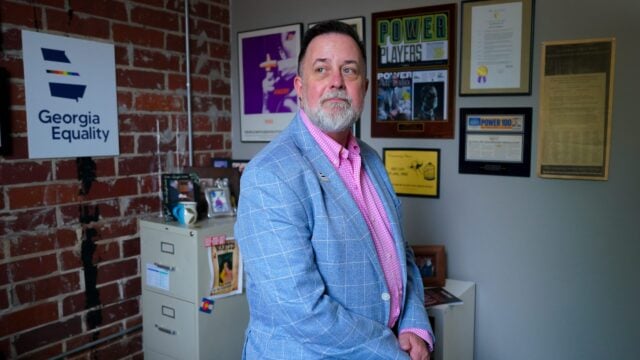
Graham, the executive director of the LGBTQ advocacy group Georgia Equality, worked closely with the Fulton County government to make sure things went smoothly if gay marriage was legalized.
Fulton County State Court Judge Jane Morrison, one of the first openly LGBTQ judges in Georgia, took a break from a DUI case to preside over the first marriage of the day — Petrina Bloodworth and Emma Foulkes.
“We actually think they may have been the first in the country,” Graham said. “No one has been able to prove me wrong in over a decade when I said that.”
The ceremony took place in Morrison’s chambers. By that time, same-sex couples had started lining up at the Fulton County Government Center to get married.
“I don’t even know how many couples I witnessed get married that day,” Graham said. “We had other folks that got married with officiants on the street. Everything was just such a great celebration.”
Among those present was Nikema Williams, then with Planned Parenthood.
Graham recalled, “She just came up and she said, ‘Jeff, I need your help. Leslie and I had our wedding ceremony [5 years earlier], but we did not actually want to sign the wedding certificate until all of our friends had the same rights that we do. And they’re not letting Leslie and I get married today because we’re not a same-sex couple. Is there something you can do?’”
So in the middle of the crowd of same-sex couples getting married that day, Williams was making it official herself, before she was a state senator and then a congresswoman representing Georgia’s 5th Congressional District.
“Leslie and I made a commitment before our friends, family, and God with a wedding ceremony on June 5, 2010,” Williams told WABE in a statement. “We didn’t turn in the paperwork to Fulton County, though, because we felt that until the government recognized all marriages, we didn’t want them involved in ours.”
“When she was first elected to Congress, I had a lot of folks say, ‘Is this woman really an ally?’ I was like, oh my gosh, yes she is, she is really an ally to the community,” Graham said.
Georgia Republican leaders abided by gay marriage ruling
The vast majority of Democratic officials in Georgia supported same-sex marriage by the time the Obergefell decision was announced, helped facilitate the marriage process and publicly praised the Supreme Court’s ruling.
Before the ruling, Republican leaders here tried several legal avenues to preserve the state’s same-sex marriage ban, which Georgia voters overwhelmingly passed in 2004 with about 75% of the vote.
After LGBTQ legal group Lambda Legal filed a lawsuit on behalf of several Georgia couples challenging the ban in 2014, then-Attorney General Sam Olens tried to have it dismissed. Then he petitioned the U.S. Supreme Court to uphold Georgia’s 2004 vote.
Both efforts failed, but Olens and then-Gov. Nathan Deal wouldn’t do what Republican leaders in Alabama and other states tried to do: stand in the way of the Supreme Court’s ruling.
“We had a strong working relationship with [Olens], who was advising Governor Deal to make sure that clerks around the state were issuing marriage licenses,” Georgia Equality’s Graham said.
Olens also ensured that an open enrollment period was created, allowing state employees to add their same-sex spouses to their health insurance plans, Graham said.
Once the ruling came down, Olens reiterated his guidance in a memo to all state agencies and department heads.
“Georgia’s local governments are now constitutionally required to issue marriage licenses to same-sex couples, to issue those licenses in the same way and via the same procedures employed for all other applicants, and to recognize same-sex marriages on an equal footing with all other marriages,” Olens’ memo said.
“I do think it’s important to really recognize that … [Republican leaders in Georgia] felt that that was their job,” Graham said. “The law of the land had changed, and they’re not big LGBT advocates, but they took their jobs of protecting the Constitution and protecting the rights of all Georgians very, very seriously.”
Is the Supreme Court’s gay marriage ruling safe?
What remains to be seen is whether that constitutional right to same-sex marriage will stand.
In the 2022 Supreme Court ruling striking down the constitutional right to an abortion, Justice Clarence Thomas — a Georgia native appointed by President George H.W. Bush — wrote in his concurring opinion that the court “should reconsider” the 2015 Obergefell decision. Justice Samuel Alito has also repeatedly urged the court to revisit the ruling.
Emory University law professor Fred Smith says this may encourage states to pass laws that would trigger a legal challenge that would be brought before the Supreme Court.
“The question really is, will there be states out there that are willing to test this by passing laws that attempt to — in various ways — undo marriage equality?” he said.
One possible firewall for gay marriage rights in the U.S. is the Respect for Marriage Act passed by Congress in 2022, which Smith said would be “crucial.” The law makes it clear that one state must recognize same-sex (and interracial) marriages performed in another state.
Theoretically, even if Obergefell were struck down, a couple could travel to a state where same-sex marriage is legal, and their state would be required to recognize it.
“What would happen in Georgia is a little bit trickier,” Smith said.
Georgia’s 2004 same-sex marriage ban is still on the books and could go into effect if Obergefell is struck down.
“When there’s a law that’s in effect [like the 2004 Georgia ban] and it’s declared unconstitutional by the court, and then later the court changes its mind about what the Constitution means, what that means for the old law — there’s not a lot of precedent for that,” Smith said. “So it’s not actually clear how the Georgia Supreme Court would understand whether or not that old law could be enforced.”
The next U.S. Supreme Court term starts in late September.
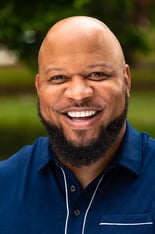
Georgia Equality executive director Jeff Graham in June 2025. (Matthew Pearson/WABE)
Broader threats to LGBTQ rights beyond gay marriage
For LGBTQ people in Georgia and across the U.S., gay marriage being outlawed is only one of the threats they’re facing.
Attacks on transgender rights in particular have been numerous. Georgia Equality’s Graham — who has been an LGBTQ activist for over 40 years — urged all LGBTQ people to stand up for those rights.
“If the broader movement is not there to defend transgender folks today, it is true that we will all eventually lose,” he said. “And I think that some people have conveniently forgotten that or conveniently choose to ignore it from their own bias because they feel that the issues of transgender folks don’t impact them, and nothing could be further from the truth.”
“It’s not a political thing, it’s a basic human right to be able to get married.”
Taylor Martinelli
He’s afraid the political and legal attacks on LGBTQ people could get worse before they get better, but he’s hopeful.
“I honestly do believe that we as a community will get through this if we don’t lose our resolve to get through this,” he said.
The 10th anniversary of gay marriage being legalized in the U.S. is also, of course, the 10th anniversary for the couples who got married the day of the Obergefell decision, like Kelly and Taylor Martinelli.
But they both have to work that day. Kelly is a K9 handler for the Barrow County Sheriff’s office and Taylor is a nurse at a level one trauma center, so their schedules can be chaotic.
But they’ll celebrate the milestone of that marriage when they’re together again.
Taylor said she would be “distraught” if legal recognition of it is taken away.
“It’s not a political thing, it’s a basic human right to be able to get married,” she said.
This story is part of the ongoing series Beyond Pride, in which WABE reporters take a deeper look at the issues affecting LGBTQ people in Georgia. Plus, hear LGBTQ Atlantans in their own words, check out a Pride events calendar running through the fall, LGBTQ coverage from other NPR stations across the South and more.