Georgia is losing farmland fast. A new state program aims to help save it

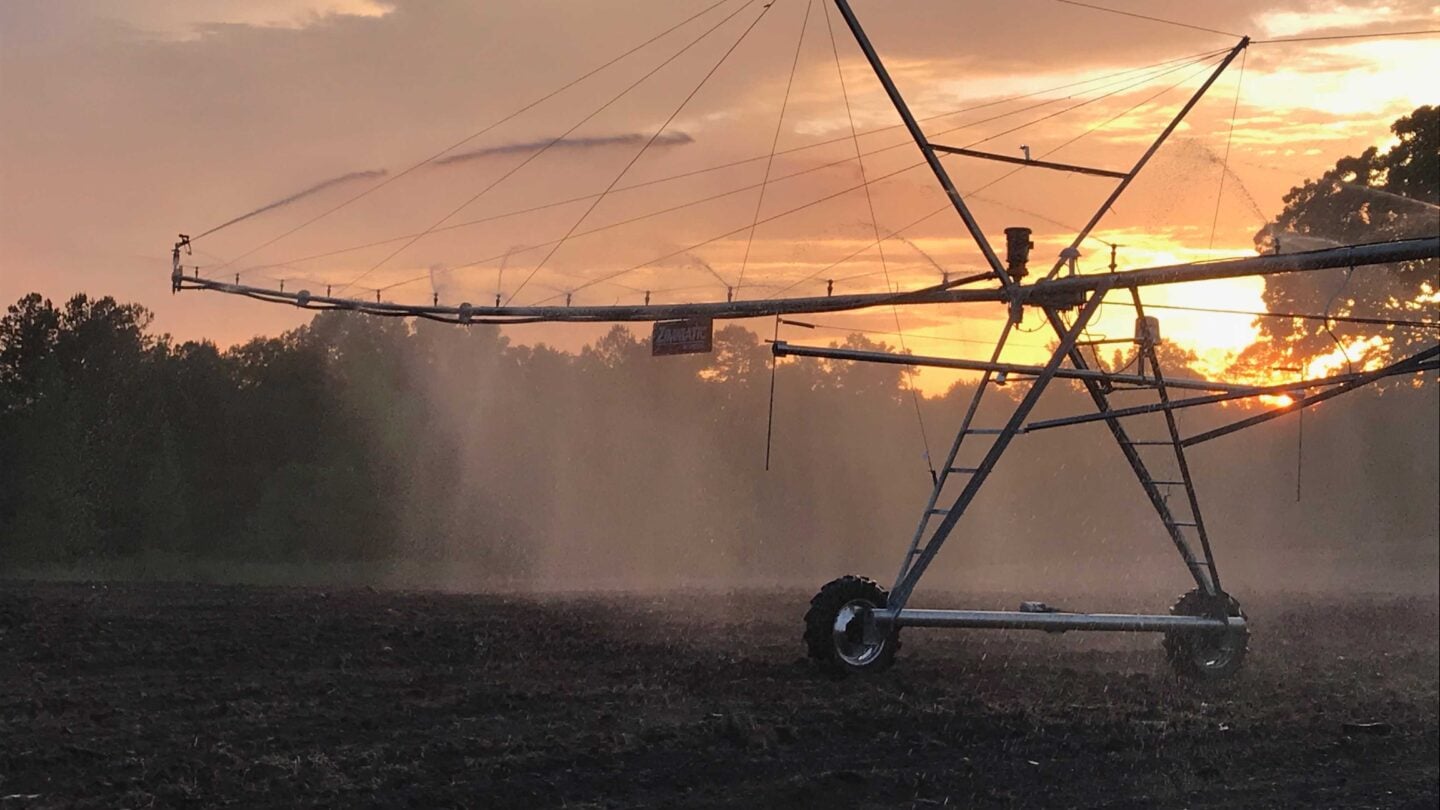
An irrigation system is shown on farmland in Georgia
The irrigation system at Russ Moon's family farm outside Athens, Ga.

(Russ Moon)

Russ Moon grows corn, soybeans and strawberries and raises cattle on his family farm in Madison County, Georgia, outside of Athens. 

His family has worked that land for four generations, around 100 years. And he said he wants to keep it that way, and pass the farm on to his kids one day. 

“Selling the land is really not an option,” he said. “I intend on remaining in agriculture for as long as possible.” 


But he’s watched more housing and development come to the area over the years. It’s appealing to many, he said, to live near the University of Georgia in Athens and also enjoy the bucolic rural setting. Other farms around him have already sold, he said, and he’s worried that if left unchecked, the development rush will fundamentally change his community.

Moon said he’d only sell if he had to. But some day his kids could find themselves forced into the decision. Farming can be an unstable business, subject to weather and changing crop prices and global markets.

“There may be a day where they have to sell, but I don’t want the land to be developed,” he said. “That’s my desire, that’s my family’s desire.”

In an effort to help farmers like Moon, Georgia’s legislature created a new program a few years ago meant to protect farms. 

The Georgia Farmland Conservation Fund will help farmers sell development rights while keeping their land. The first applications are now in, and property owners will find out in August if they’ve been selected to receive some of the $2 million allocated for this first round of funding. 

Funding conservation

The Fund coordinates federal, state and local match funding for conservation easements, and creates an advisory council to review and approve proposals.

Easements allow landowners like Moon to sell the future development rights for their property to outside organizations, like land trusts. The landowner receives an upfront payment, half of which comes from state funds under the new Georgia program. The rest could come from a land trust, local government or the U.S. Department of Agriculture, which allocates $450 million annually to match dollars in state conservation programs. 

The landowner can continue farming, grazing livestock, growing and harvesting timber, or however else they use their land. They can even sell the land — just not to a developer who will turn it into housing, a strip mall or an industrial site.

“It’s a compelling alternative to our farming landowners that are feeling a lot of financial crunch and are just being inundated with offers for selling out,” said Katherine Moore, president of the Georgia Conservancy, which advocated for the new state fund.

Though this is a new program for Georgia, it’s not a new idea. Some 30 states already have what are known as Purchase of Agricultural Conservation Easement programs, though the amount of funding varies a great deal from state to state. Texas allocates $2 million annually, while Florida set aside $300 million in 2022 and $100 million in 2024. 

Georgia’s law, modeled after these initiatives, was adopted in 2023. The state legislature passed the initial round of funding in 2024, and the first round of applications closed May 20.

“It is unprecedented for Georgia to have such a program, which is a little wild when you think that, you know, agribusiness in total is our number one economic engine in the state,” Moore said.

Balancing business

Even though agriculture is Georgia’s leading industry, farmers face mounting pressure to sell to developers for housing, warehouses, data centers and other uses. The state could lose some 800,000 acres of farmland by 2040, according to the Georgia Department of Agriculture.

“That means 10% of our farmland will be gone in the next 15 years or so,” said state agriculture commissioner Tyler Harper. “And that’s a staggering statistic.”

It’s a concern not only because farms provide food and jobs and are a big part of the state’s economy, but also because farming is a way of life in much of Georgia. 

State leaders often tout the booming economy, proudly calling Georgia the number one state to do business. But that gives Moon pause.

“The whole time we keep being the number one place to do business, we’re hurting our number one industry,” he said.

And then there are the potential climate impacts. 

Converting farmland to other uses can increase greenhouse gas emissions, according to the American Farmland Trust. Topsoil is often removed, releasing the carbon that’s stored in it. Residential development and industrial operations often produce more emissions than farming does. 

Conservation easements, on the other hand, can encourage farming and management practices that sequester more carbon, and they often protect non-agricultural land adjacent to fields — like woods and wetlands.

Some of Moon’s land is already in a conservation easement, which he entered into directly with a land trust in 2019. He said he hopes that getting more farmland into conservation can help maintain some balance before it’s too late.

“Once you develop a piece of property, you’re never gonna – it’s never gonna go back,” he said. “You lose farmland, it’s gone forever.”