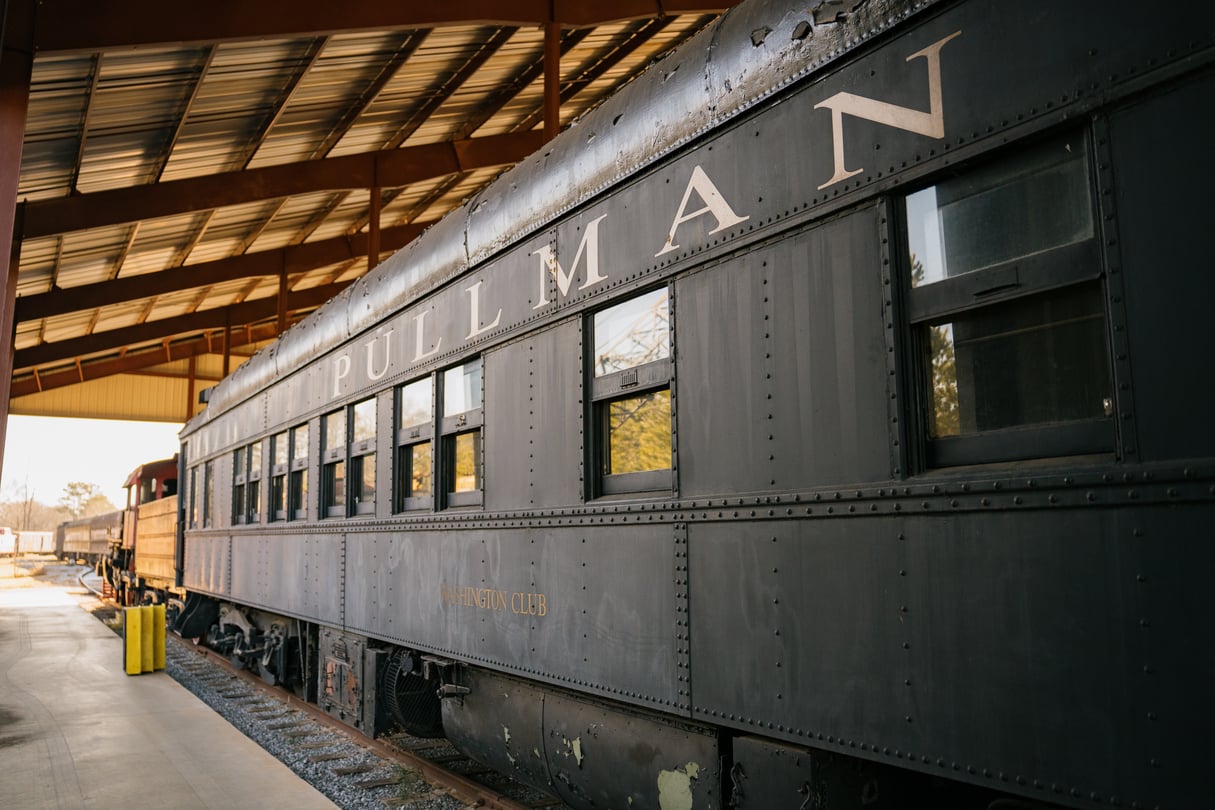
Spanning 35 acres, The Southeastern Railway Museum is one of ten historic state locations featured on The Georgia Trust for Historic Preservation's 2025 Places in Peril list, a list meant to highlight buildings, structures, districts, archaeological sites and cultural landscapes that are threatened by demolition, neglect, lack of maintenance, inappropriate development or insensitive public policy. (Courtesy of Connor Franklin Leland)
Screenshots via Instagram. Annotation by NPR / Netflix
The Georgia Trust for Historic Preservation released its annual list of 10 Places in Peril on Wednesday, featuring two locations in the metro Atlanta area.
Founded in 1973, the organization advocates for preserving and revitalizing some of the state’s most diverse and sacred historic resources.
According to a recent press release, the list is meant to highlight “buildings, structures, districts, archaeological sites and cultural landscapes that are threatened by demolition, neglect, lack of maintenance, inappropriate development or insensitive public policy.”
“This is the Trust’s twentieth annual Places in Peril list,” said W. Wright Mitchell, president and CEO of Georgia Trust. “We hope the list will continue to bring preservation solutions to Georgia’s imperiled historic resources by highlighting ten representative sites.”
This year’s selections, some of which were constructed as early as 1795, all meet three major criteria factors set by the organization: They are listed or eligible for listing in the National Register of Historic Places or the Georgia Register of Historic Places, are subject to a serious threat to their existence or historical, architectural, and/or archeological integrity and have community support for their preservation.
The locations include Collier-Toomer House (Chatham County); Crossroads Rosenwald School (Brooks County) Gaissert Homeplace (Spalding County); Miami Valley Peach Packing Barn (Peach County); Historic Nicholsonboro Baptist Church (Chatham County); Powell Opera House (Early County); Historic Rock House (McDuffie County); Buckhead Town Hall and Jail (Morgan County); 148 Edgewood Avenue (Fulton County); and Southeastern Railway Museum (Gwinnett County).
Located on Georgia State University’s campus, 148 Edgewood Avenue SE sits nestled to the campus’ Greek life housing.
The facility lies only blocks from the Historic Sweet Auburn district, which has also seen calls for property resurgence in recent years.
Constructed in 1926 and currently owned by Georgia State University, 148 Edgewood Avenue SE is at risk of being demolished to make way for a parking lot. (Courtesy of The Georgia Trust for Historic Preservation)
Constructed in 1926 by Georgia Railway and Power Company, the property was bought by Georgia State University in 1964 and has been used for various purposes.
Despite the building’s longtime presence in the community and its historical presence, Georgia State has begun proposals to demolish the facility to create a surface parking lot.
“The university, along with the Georgia Board of Regents, asserts sovereign immunity, exempting it from the historic preservation zoning ordinances that would typically protect the site from demolition,” according to Georgia Trust’s website. “With a demolition permit signed by Governor Kemp, GSU continues discussions about the destruction of this contributing building in an already threatened National Register District.”
The first floor interior of 148 Edgewood Ave. (Courtesy of The Georgia Trust for Historic Preservation)
Located in Duluth and spanning 35 acres, the Southeastern Railway Museum has been a fixture of the Gwinnett County city since 1970.
The facility, which is hosted in a former industrial site, displays artifacts related to railway transportation, ranging from the early 1900s to the Civil Rights Movement.
Founded in 1970, The Southeastern Railway Museum holds artifacts that highlight American railway and transportation history. (Courtesy of Connor Franklin Leland)
“With a vast collection of over 90 pieces of historic railroad rolling stock, the museum is limited in its capacity to stabilize and restore all of it,” a description read on Georgia Trust’s website. “The museum thrives thanks to the dedication of a small staff and volunteers, whose contributions are essential to its success, however they are facing insufficient funds and skills to care for the whole collection.”
The museum is open from 10 a.m. to 5 p.m. on Thursdays, Fridays and Saturdays, and from noon to 5 p.m. on Sundays.