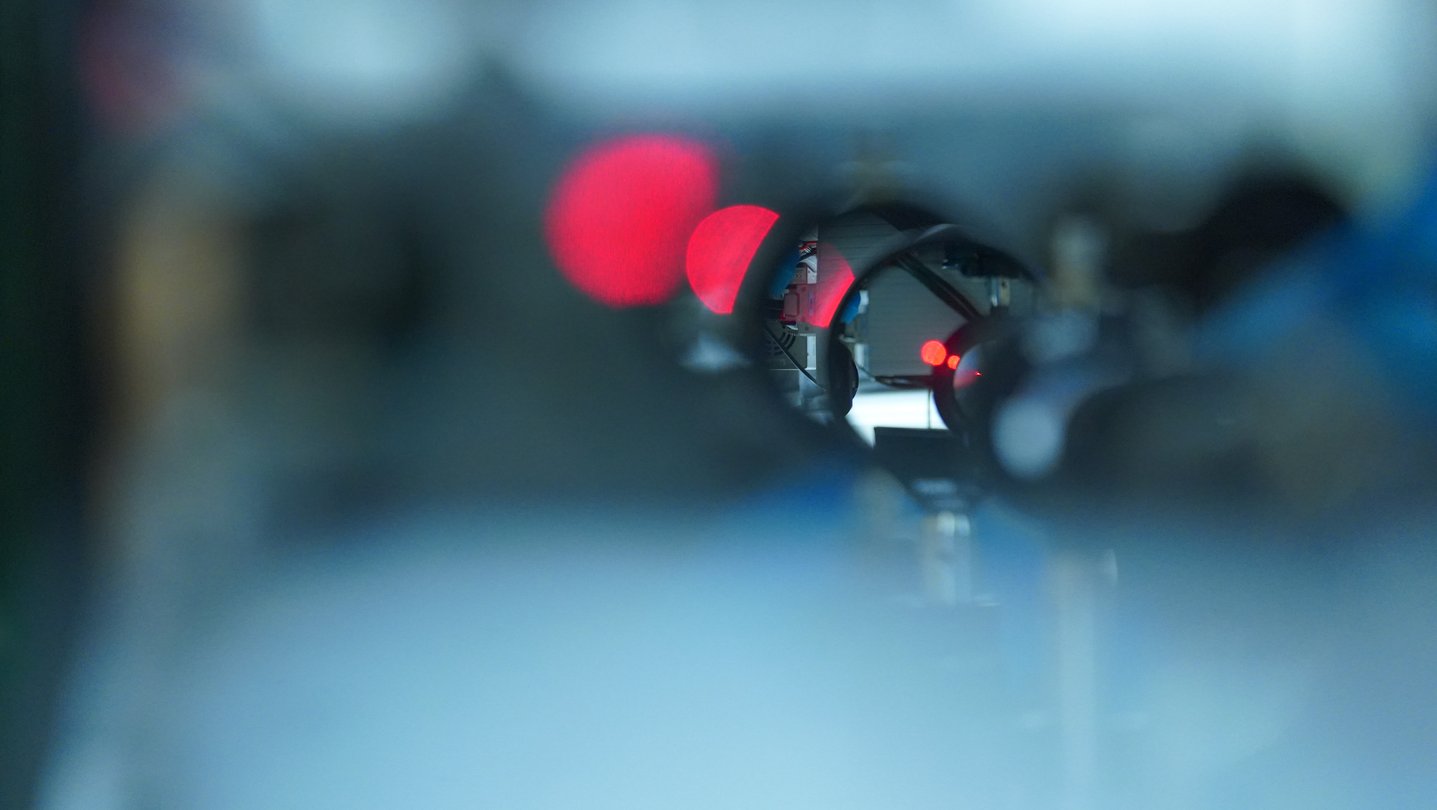
Lenses in the Georgia State University lab where a team is working on a telescope to search for life on planets orbiting other stars.
(Matthew Pearson/WABE)
In a windowless couple of rooms in the basement of a building on Georgia State University’s Downtown Atlanta campus, students, professors and researchers navigate between tables piled with computers, mirrors, lenses and lasers.
They’re building pieces of a telescope. If the telescope they’re designing now works, they plan to build an even bigger one. That larger one, the ExoLife Finder, or ELF, will be used to search for signs of life on planets outside our solar system.
“This is like a holy grail problem,” Professor Stuart Jefferies said.
There are many other people working to find evidence of life in space – searching for life on planets and moons in our solar system and beyond.
This team hopes this telescope could eventually be the way to do it.
“We know there are thousands of exoplanets,” said Fabien Baron, an astronomer at Georgia State.
However, he admits that we don’t know a ton about them. Do they have water? Oxygen and carbon dioxide? Oceans and continents?
The international group working on this telescope, led by the Institute for Astrophysics in the Canary Islands, wants to answer those questions. And they want to map exoplanets.
“That’s the big new thing that we’re trying to do,” Baron said.
The smaller version of the telescope they’re working on now, the prototype of the ELF, is called the Small ELF, or SELF.
It will be made with a bunch of mirrors, mounted in a circle like petals on a flower. Those mirrors bounce light to more mirrors in the middle, which combine all the light into an image. So the telescope is really sort of like multiple telescopes, working in unison. It’ll use AI to make tiny adjustments to keep everything in focus.
Scientists won’t be able to look through a lens and map what they see – don’t picture an old-timey sailor peering through a telescope at land. Instead, they’re aiming to measure the total amount of light reflected from distant planets, track how that light changes, run it through algorithms and make a map from there.
This is difficult for many reasons. One of them is that exoplanets are so hard to see.
“Starlight will completely overwhelm the signal and the light coming from a planet,” said Lexi Azoulay, a PhD student at GSU working on that particular problem.
The light from a star can be billions of times brighter than the light from a planet orbiting it.
“So we’re doing a bunch of manipulation to the light that’s coming in from the star to create a space for the planet’s light to shine through,” she said.
Another problem: Earth’s atmosphere.
Looking up at space through our own skies is like being in a pool, looking up through the water, grad student Billy O’Brien explained.
“You notice that like the light shimmers and it kind of degrades the image of what you’re seeing at the bottom of the pool,” he said. “Our atmosphere does the same thing.”
That’s what O’Brien is tackling: mirrors for the telescope that can be bent to fix the distorted view.
Professor Stuart Jefferies and former student Dan Johns in the lab. (Courtesy of Georgia State University)
The grad students say this is a fun place to work. “It exists at a really good intersection between science and engineering,” O’Brien said.
“I like building instruments. I think it’s really cool to get my hands dirty and put things together,” Azoulay said.
“Everybody’s working on things that, if you explain them in their technicalities, they don’t seem related. But then you start thinking about the whole big picture.”
TheSELF could be up and running by 2030, Jefferies said.
If the technology works, the team will look for funding for the big version, the ELF. It could be looking for signs of life in 10 to 15 years.
“Imagine if we were back several 100 years, okay, the implications would be huge, right?” Jefferies said.
“You’d be thinking about how the church would be all up in arms. But now I think we’ve all watched enough Star Trek and everything like that. I think if you were to go out and do a survey, I bet a large fraction of people, you say, ‘Do you think there’s life out there?’”
And he said, they’d probably say, with a shrug, “Yeah.”