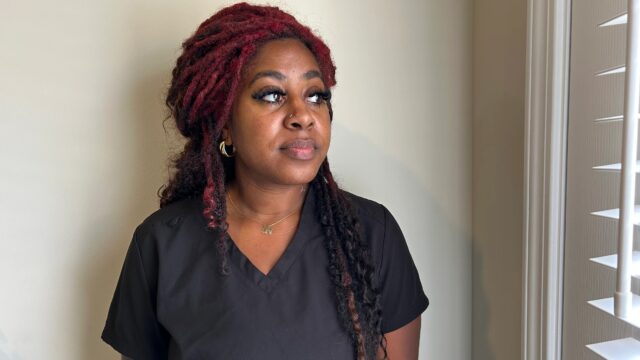
Veteran and Atlanta resident Keyana Francis served nearly six years in the Air Force, first in the United States and later at a base in Japan. The 29-year-old got out last year. She’s now working as a civilian IT business analyst while finishing a PhD in cybersecurity.
Her military service left her with chronic health problems, including a heart condition.
“I still see a cardiologist,” Francis says. “During my time I had a mold exposure. I never had any heart issues before then. Somehow that mold exposure impacted my heart. My heart randomly just starts beating fast.”
So, when she got pregnant after leaving the service, her heart condition put her at high risk for complications.
Cardiovascular conditions, including cardiomyopathy, were the leading cause of pregnancy-related deaths in Georgia between 2020-2022, according to the state’s Maternal Mortality Review Committee.
But, with regular prenatal care and visits to a maternal-fetal medicine specialist, her pregnancy went smoothly. She and her then-partner were excited to welcome a child.
“I was nervous and scared to become a mom and then I hit the excitement towards the end, so I was like, I’m ready for her to come out. I want to see her personality,” Francis says. “I am going to put her into everything — ballet, soccer, softball, everything.”
But when she was 7 months pregnant, something went wrong.
“I was actually getting ready for my maternity shoot at the time, and I was just like something feels weird. I go to the restroom and then the water just starts rushing out. I’m just like, babe, babe! And he’s like, what? And I’m like um, I think my water just broke.”
Her umbilical cord was hanging out.
What happened next is still a blur, she says. They called for an ambulance. Her heart rate remained dangerously high on the way to the hospital. Francis remembers fading into and out of consciousness.
At the hospital, doctors performed an emergency C-section. Francis needed more than one blood transfusion to save her life.
“And then the next thing I know I’m waking up,” says Francis.
She woke to the worst news she could have imagined. Her baby daughter, who the couple had named Nyla Remi, was in the neonatal intensive care unit.
“They thought that she was having seizures at first. She was brain dead. They said she lost too much oxygen,” Francis says.
A complicated maternal picture for veterans
“The mortality and morbidity numbers are increasing instead of decreasing. So we’re trending in the wrong way for our women,” says Kathleen O’Loughlin, who leads the Atlanta VA Medical Center’s Women Veterans Program. “It’s not just veterans, it’s everywhere.”
Georgia is one of the most dangerous places in the U.S. to be pregnant and give birth, federal health data show, especially for Black women, who are nearly three times as likely to die during and after pregnancy than other women, according to the CDC.
For women veterans, the complication risks can be even higher. The U.S. Dept. of Veterans Affairs reports military deployments and exposure to combat are also linked with physical and mental health conditions, including posttraumatic stress disorder or PTSD, that can increase the risk for preeclampsia, gestational diabetes, preterm birth and substance use.
It’s a nationwide problem. It’s urgent in Georgia. The state has one of the fastest growing populations of women veterans in the nation.
They often enter pregnancy with illnesses and injuries specific to their military service that require specialty maternity care, says O’Loughlin.
“With VA staff that have special training and understand how those impacts will impact their physiology, their mental health, their fertility,” she says. “Having those people with the special training is really important. It’s crucial in delivering that care.”
Pregnancy can exacerbate the risk for mood disorders, depression, anxiety, PTSD, obsessive-compulsive disorder and other mental health conditions that impact both mothers and infants.
“Sometimes that might be like the first time a woman has experienced those symptoms, sometimes it’s exacerbation of preexisting mental health conditions or symptoms coming back that maybe were successfully treated before. So that’s what makes that perinatal period so important for mental health treatment,” says Dr. Emily Hylton, a clinical psychologist with the Atlanta VA Health Care System.
But that care can be hard to come by in Georgia, especially in rural areas.
More than a third of Georgia counties lack access to maternity care, the March of Dimes reports. Georgia ranks 46 in the nation for access to mental health care, according to the latest State of Mental Health in America report. And, Georgia has one of the nation’s highest uninsured rates, KFF reports.
Filling gaps in support
To help fill the gaps in care for Georgia’s pregnant and postpartum veterans, the VA Women Veterans Program matches them with a dedicated provider team that includes doctors, nurse practitioners, psychiatrists, social workers, physical therapists and maternity care coordinators.
The team makes sure veterans get to their OB-GYN appointments. It also assists with other needs they may have, such as housing or transportation, mental health or substance-use treatment.
So far, roughly 500 women veterans are participating. Officials say demand is growing.
The Atlanta VA recently expanded its postpartum services. It’s added more maternal mental health clinicians. It’s also following veterans’ health for a full year after their babies are born — when most pregnancy-related deaths happen in Georgia, according to the state’s Maternal Mortality Review Committee.
“After they deliver,” O’Loughlin says, “we’re noticing that there are different issues associated with their blood pressure or bleeding.”
Missed signs
That’s what happened to Air Force veteran Keyana Francis.
After her emergency c-section, her incision wasn’t healing properly. She experienced worsening pain and swelling. She says she couldn’t reach her regular doctors.
But she did get a hold of the Atlanta VA Womens Program, where advocates intervened to get her seen by a specialist right away.
“If it wasn’t for the women’s program I could have possibly died. I could have had an infection and not known about it,” says Francis.
Francis is still trying to make sense of what happened.
“I want a family of my own. And it was kind of like all of that crumbled in a matter of like a couple of seconds when my water broke.”
Looking back, she says moving between states and switching VA hospitals and OB-GYNs could have complicated her already high-risk pregnancy care. But she says providers missed warning signs.
“When I moved back here, I was trying to get care. I was telling them something’s wrong. I couldn’t get off the couch for a week because I was in so much pain, coming to find out those were contractions,” she says. “And they kind of like brushed me off. So that was rough.”
It’s been more than a year since losing her daughter and suffering her own health crisis.
On the sofa at her impeccable Northwest Atlanta townhome, Francis’ long red hair is pulled back revealing a gold pendant at her neck.
“It was given to me by my best friend when my daughter passed away. She sent me a memorial box for her stuff with her bracelet and her blanket and all of that kind of stuff that I got from the NICU. I try to wear it everywhere I go, to remember that she’s with me in spirit.”
WABE’s news series “Invisible Scars: Women veterans in Georgia search for healing” is part of the Rosalynn Carter Fellowships for Mental Health Journalism