No money? No insurance? No problem.
It’s not the typical formula for low-income health care delivery in the U.S., but this model has worked for Mosaic Health Center, a clinic serving mostly refugee immigrants in Clarkston, Georgia, since its doors opened a decade ago.
And amid an ever-changing landscape of health care funding, it could serve as a model for others.
Mosaic’s mission to better the community’s health profile is evident through a number of initiatives, big and small.
One example is a recent series of diabetic-friendly cooking classes.
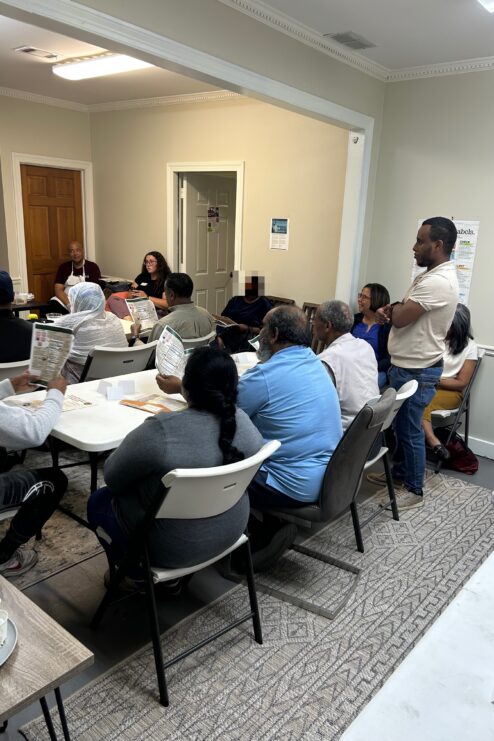
Mosaic patients, representing countries all over the globe, crowd into the clinic’s main room. And they’re hanging on Aliza Lukowski’s every word. Lukowski, a community dietitian with the Atlanta nonprofit Open Hand, speaks to the class at a level approaching a shout.
She has to. It takes a lot of volume to be heard over the handful of translators decoding her every word into Spanish, Arabic and Tigrinya — just to name a few.
On this day, the class is making a Moroccan white bean stew. And judging by the universally empty bowls in front of each class participant, the dish is a hit. That’s a shift from the first meeting, which Lukowski says got off to a rocky start due to the challenges of engaging a group with so many different tastes and traditions. That caused her to alter her approach, she says.
“Pulling spices and flavors from some of these folks’ cultures isn’t something we normally do in most classes,” Lukowski says, adding that those taking the class seemed to enjoy the results. Everyone returned the following week.
Federal food assistance money under a program known as SNAP-Ed, or the Supplemental Nutrition Assistance Program Nutrition Education and Obesity Prevention Grant Program, partially funded this wellness effort.
Nevertheless, recent federal budget cuts have left SNAP-Ed on the chopping block. The One Big Beautiful Bill Act, which President Donald Trump signed into law in July, ends funding for the program, which provides nutrition and lifestyle education to low-income families on SNAP benefits.
Georgia was able to piecemeal money to keep it going next year, according to Open Hand officials, but funding beyond 2026 is anything but certain.
What is certain, experts say, is future funding for low-income health care will look different than it does now.
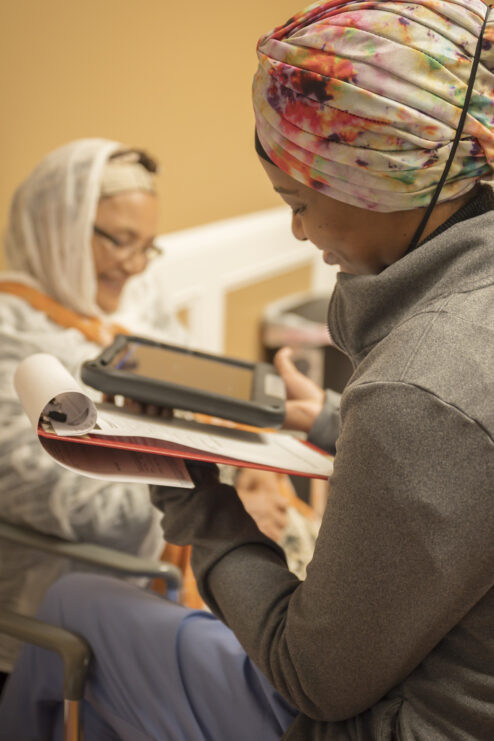
One of those taking part in the diabetic cooking skills class is Milita Segeet. She’s from Eritrea in East Africa and can neither read nor write — be it in English or her country’s native Tigrinya. She also has no insurance.
Traditionally, these factors would have virtually guaranteed her exclusion from the U.S. health care system. Yet, for Segeet, Mosaic offers a rare chance for her to receive quality care.
Segeet, speaking through Mosaic nurse and translator Helen Russom, expresses deep gratitude for the care she’s provided. She says Mosaic and those who operate the clinic are “next to God.”
The comment moves Russom, also from Eritrea, to tears.
“Next to God?” Russom repeats almost in disbelief. “That’s powerful.”
Mosaic’s executive director, Jeremy Cole, says there’s a reason why its patients are so enthusiastically positive about their experiences.
“The missing ingredient in healthcare is love,” he says.
Cole, who just three years ago was Mosaic’s only full-time employee, has overseen the clinic’s steady growth. Now, there are 11 full-time employees and seven more who work part-time. The clinic is now open six days a week, up from two.
But love, as vital as it is, doesn’t fund the clinic’s annual $1.6-million budget. Neither do insurance companies. Instead, Mosaic relies heavily on philanthropy, making the case to donors why those with funds to give should support local wellness.
“We can’t just not be there for them. We will find a way to make it work.”
Dr. Gulshan Harjee, co-founder of Mosaic Health Center
Shireesha Ghanta, executive director of the Decatur-based Ghanta Family Foundation, sees the clinic as a critical part of maintaining a viable, healthy community. She also sees foundations as having even more of a responsibility going forward as federal cuts take effect.
“This is a unique time for private funders to rise to the occasion,” says Ghanta, noting that philanthropists can fill some, but not all, of the gaps created by the loss of health care funding.
Aside from philanthropy, partnerships will play an increased role in meeting the needs of low-income and uninsured people, says Dr. Gulshan Harjee, co-founder of Mosaic. Harjee says affiliating with local hospitals, for instance, could help meet growing demands on the clinic’s services.
But Harjee acknowledges no one truly knows what the changing health care landscape will mean for those Mosaic serves. She does know that the need for non-profit, community health care will remain a constant.
“We can’t just not be there for them,” says Harjee. “We will find a way to make it work.”
This is part 6 of the WABE News series: “Medical Wealth Gap: Filling the cracks in Atlanta’s safety net.“