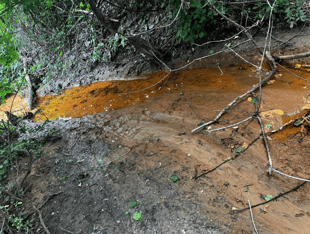
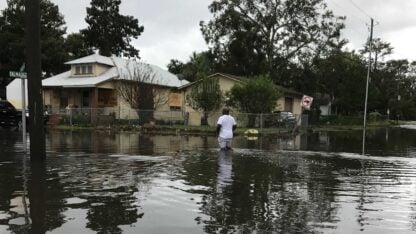
The Flint Riverkeeper and Southern Environmental Law Center have sent a letter of intent to sue the City of Atlanta and Hartsfield-Jackson International Airport over consistent pollution of the Flint River.
“For years, the airport has repeatedly spilled jet fuel, sewage, deicing fluid, and other pollutants from its stormwater and sewage infrastructure into the Flint River, Sullivan Creek, and Mud Creek,” the Southern Environmental Law Center wrote in a press release.
The groups say the ongoing pollution of the Flint River is in violation of federal clean water and solid waste laws.
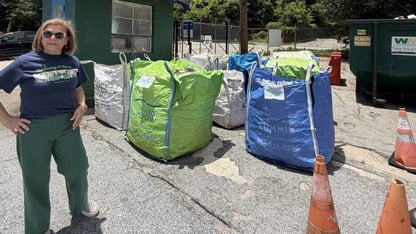
“Trash clearly originating from the airport, including luggage tags and ear plugs, routinely flows into the Flint when it rains,” the press release stated.
The Flint River provides drinking water to more than 400,000 people in downstream communities throughout Clayton, Coweta, Fayette, Pike and Spalding Counties, and over 1 million Georgians use it for drinking, swimming, fishing, commercial, agricultural and industrial purposes.
In an interview with WABE, Flint Riverkeeper Gordon Rogers said his organization has worked with Hartsfield-Jackson International Airport and the City of Atlanta for years to try to stem the repeated pollution.
“We’ve tried to work with the airport for over a decade,” Rogers said. “Georgia [Environmental Protection Division] has tried to work with them for longer than that, and it’s just time to bring some federal Clean Water Act scrutiny to this situation.”
He said to come forth with a lawsuit, it takes a lot of data collection — interpreted so it’s understandable to a judge or jury — that demonstrates pollution is coming from the airport in particular.
He said to qualify for a Clean Water Act suit, the Flint Riverkeeper needed to be able to prove the pollution is coming from pipes, gullies or other conveyances from the airport; that the pollution is ongoing; and that it enters the Flint River.
“And the reason for choosing that particular tool is that you can get a federal court order to impose remedies as opposed to something voluntary,” Rogers said. “So we’re moving this from a voluntary, ‘we want to work with you’ status to proving it to the federal bench getting an order.”
What pollution has there been in the Flint River?
There have been several pollution events from the airport into the Flint River this year.
In January, a large gallon jet fuel spill went undetected for several days and caused a “Do Not Consume” water advisory for the city of Griffin. The City of Atlanta said the fuel came from a fuel pit hydrant valve attached to a fuel system pipeline at the airport. Originally, the spill was estimated to be smaller, but final calculations of the volume increased from 10,000 gallons to about 20,000.
While the EPA and other agencies confirm the spill did not reach the drinking water intake of the City of Griffin on the Flint River, many residents in the area report a fuel odor or sheen in their water.
Subsequent investigations found that at the same time as the fuel spill, the airport was also spilling deicing agents. While jet fuel didn’t reach drinking water, deicers used on the planes in freezing temperatures had made it into drinking water sources.
In April, the airport announced a smaller, unidentified petroleum contamination. The airport and regulators didn’t specify what the material was. But according to Hartsfield-Jackson’s Planning and Environmental Division, the material did not appear “weathered” and may be mixed with hydraulic fluid. It also did not appear to be related to the jet fuel release reported on Jan. 30.
On Memorial Day weekend, a broken bolt on an underground fuel line caused a third petroleum spill into the Flint River, causing the airport and state to remediate tens of thousands of gallons of contaminated waters at the headwaters of the Flint.
According to the press release from the SELC, downstream sampling also shows elevated levels of forever chemicals known as PFAS that exceed federal drinking water limits for certain types of those chemicals.
The City of Griffin and Clayton County pull portions of their drinking water from the Flint downstream of the airport, and sampling from their drinking water systems demonstrate high levels of PFAS, according to the SELC.
What’s a 60-day notice?
The federal Clean Water Act requires plaintiffs to file a 60-day notice of intent to sue — it gives alleged violators time to get into compliance and potentially avoid lengthy, costly litigation.
These cases often target a particular type of permit called a NPDES permit — National Pollutant Discharge Elimination System. These are common, fundamental permits that regulate any wastewater or stormwater a facility is discharging into surface level water like rivers, streams, lakes and wetlands. They control pollutants like sewage and chemicals and outline monitoring and reporting requirements.
What’s next for Hartsfield Jackson?
This isn’t the first time Hartsfield-Jackson International Airport has faced trouble for violating its clean water permits.
The Georgia Environmental Protection Division fined the airport $40,000 in 2022 for a 1,300-gallon fuel spill the previous year.
In 2021, the Georgia EPD fined the airport $22,914 for several sewage overflows between 2010 and 2020 that flowed directly into Sullivan Creek, a tributary of the upper Flint River.
The state hasn’t said whether it plans to fine the airport for the several fuel spills this year, nor whether it plans to take further legal action like requiring upgrades to the airport’s stormwater system or better monitoring systems.
The airport has 60 days to attempt to improve conditions to prevent future spills and to negotiate with the Flint Riverkeeper and SELC to attempt to avoid litigation.
The City of Atlanta, Hartsfield-Jackson International Airport and the Georgia Environmental Protection Division did not comment in time for publication.
This is a developing story. Check back for updates.