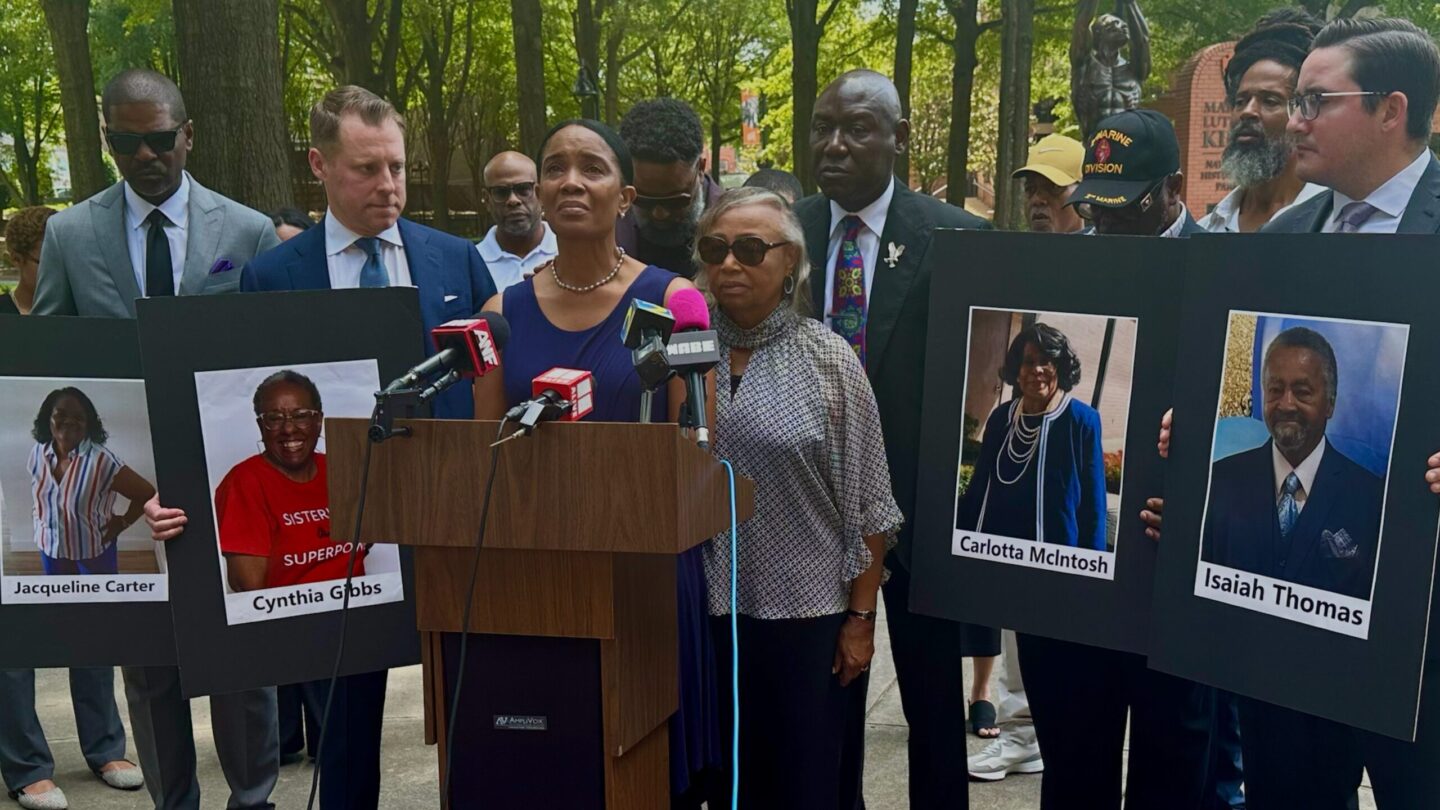
Survivor Regina Brinson recalls the events on Sapelo Island during last year's Cultural Day festival. She nearly drowned hoping to save her uncle, Isaiah Thomas. (Rahul Bali/WABE)
The families of seven people who drowned after the gangway on a ferry dock collapsed on Sapelo Island are taking legal action almost eight months after their deaths.
Wednesday, relatives and supporters of the Sapelo Seven joined civil rights attorney Ben Crump in Atlanta to announce a lawsuit filing against the companies who built and designed the gangway at Marsh Landing Dock.
“Drowning deaths are very horrific deaths, especially when people are reaching out for you, and you see them going down, and you realize that this watery grave is going to be their last time that they took a breath on this earth,” said Crump during the press conference.
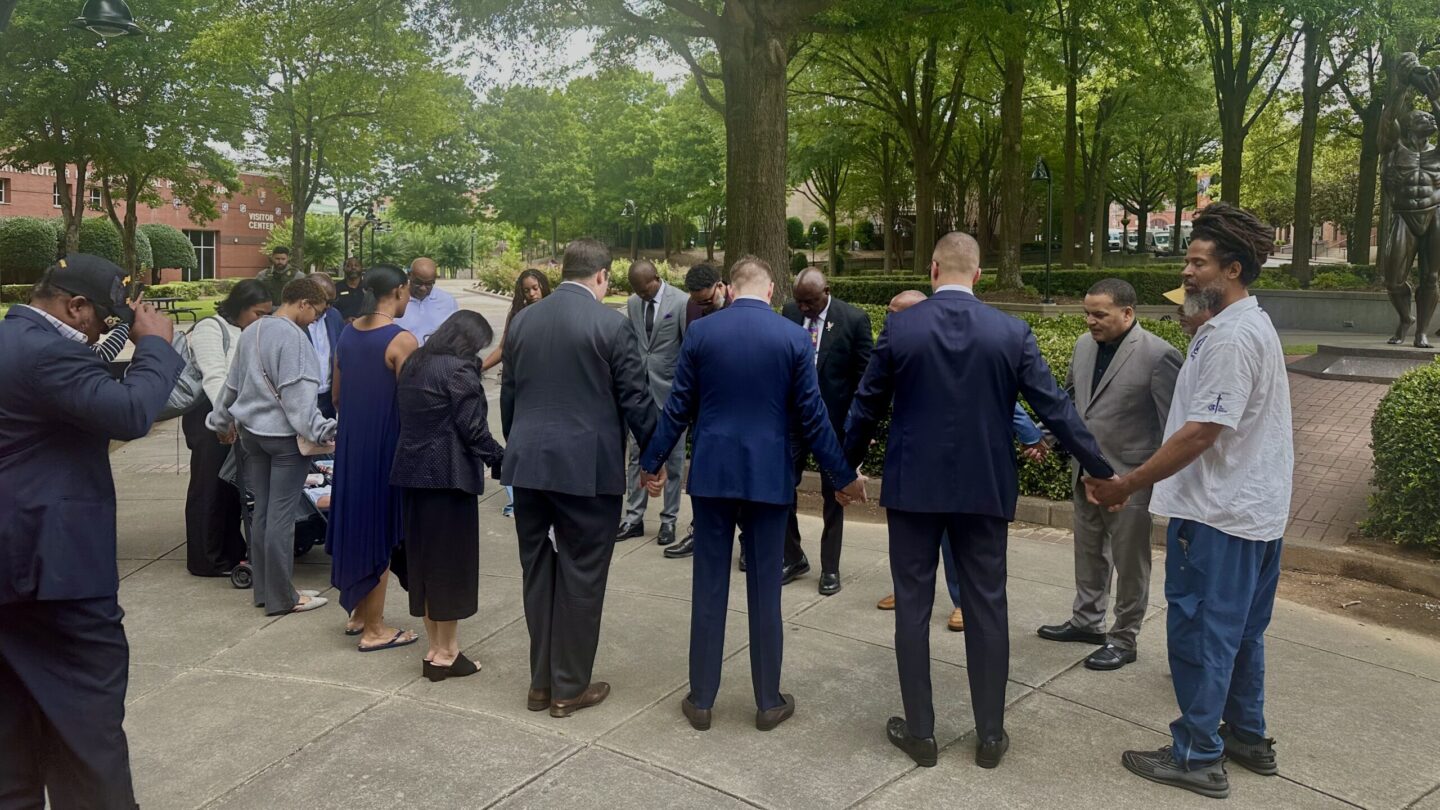
Family of seven people who were killed last year when a ferry dock gangway collapsed on Sapelo Island joined with attorneys for a prayer circle before announcing a lawsuit on the incident. (Rahul Bali/WABE)
Sapelo Island is about two hours away from Savannah, Georgia. The island is only reachable by boat, and it’s home to one of the last Gullah-Geechee communities in the South–Hogg Hummock.
The Gullah-Geechee people are descended from enslaved West Africans. Ancestors of the Gullah-Geechee heritage were forced to cultivate sea island cotton, indigo, and coastal rice on southern plantations along the east coast.
Now, a few dozen residents still live in the Hogg Hummock community. Despite ongoing hardship, the culture is celebrated annually with a Cultural Day festival, and last year the island welcomed about 700 visitors to the festivities.
But the celebration took a turn for the worse.
“We were standing in the middle of the gangway, and all of a sudden I heard a crack,” said Regina Brinson, a survivor of the collapse who attended the festival with her family.
After Brinson heard the noise, the 80-foot aluminum gangway snapped, taking her and about 19 other people into the water. According to her, the currents of the Duplin River were quite strong.
“As soon as I hit water, it’s like the currents were so rough and bad. The current just instantly just picked me up,” Brinson said.
Brinson spotted her uncle, Isaiah Thomas, among the chaos and attempted to help as he grabbed her and her shirt.
“I saw my uncle. I said, ‘Uncle Bubba … grab my hand.’ He grabbed my hand, but he also grabbed me right here. And he kept pulling me and pulling me and pulling me under the water. I said, ‘Oh, my God, I’m getting ready to die.’ And God said, ‘No, no. You have to release your uncle.’ I’m underwater, peeling finger by finger by finger off my shirt. Having to release my uncle to just be able to surface back up to the top of the water,” Brinson added.
The incident killed seven people, all over 70, while injuring about eight others.
Ferry operations are facilitated by Georgia’s Department of Natural Resources, which transports visitors to and from the gangway. The walkway was intended to hold about 64,000 pounds, or 320 people, according to the lawsuit, which was filed in Gwinnett County.
“To make this gangway safe, there was a requirement, a basic engineering requirement, that it needs to hold 100 pounds per square foot. That’s engineering 101,” said Jeff Goodman, an attorney and structure collapse expert with Saltz Mongeluzzi & Bendesky PC.
At the time of the collapse, only 40 people were on the gangway.
“We’ve had experts take apart the gangway, reconstruct the gangway, model the gangway. And what that has proven with clarity is that this gangway was capable of supporting less than one-third of what it needed to. This tragedy was not just preventable. It was inevitable,” he added.
The metal platform was rebuilt in 2021 following a different longstanding lawsuit from 2015.
Property owners on Sapelo Island federally sued McIntosh County, the State of Georgia, and the Sapelo Island Heritage Authority. Court documents from the case state that owners were “alleging discrimination and neglect against the Gullah-Geechee residents and property owners on Sapelo Island.”
According to filers, the sued agencies failed to provide services like emergency hospital transport and other government services “on the basis of race and/or national origin, and/or disability.”
The case was settled near the end of 2020, requiring monetary compensation to plaintiffs, plus investments into services and accessibility for disabled residents. The settlement also called for the gangway at Marsh Landing Dock to be demolished and rebuilt.
“We know that we’ve been fighting for our survival on Sapelo Island. We mentioned this in 2009 as to the dangers of these docks and these gangways,” Reginald Hall, who is part of the Sapelo Island community, said at the press conference. “These docs were rebuilt, but were engineered … improperly.”
The 2025 lawsuit doesn’t list the Department of Natural Resources among the defendants.
The agency “itself did not provide any designs for the project as it was beyond its expertise to perform” as it “relied on the sophisticated and experienced professional design and construction firms to design the gangway and to supervise and perform the construction.”
The companies Steven & Wilkinson, Inc., Centennial Contractors Enterprises, Inc., EMC Engineering Services, Inc., and Crescent Equipment Co., Inc. are being sued by the families for their involvement with the gangway rebuild.
Attorneys say the gangway’s general contractor, Centennial Contractors, is at the center of the suit. The company is located in Gwinnett County, where the case will be heard.
“The underlying facts remain the subject of ongoing investigation. We do not comment on pending legal proceedings. Our deepest sympathies are with those who lost loved ones or were injured,” said Centennial Contractors officials in an email to WABE.
“This was a tragic event, and our thoughts remain with those affected. As this matter is now the subject of litigation, we are unable to comment further at this time, and we continue to cooperate with the investigation,” said a spokesperson for Steven & Wilkinson, Inc. in an email to WABE.
The other companies named as defendants in the lawsuit did not respond to requests for comment.